NVIDIA, Microsoft, IBM Launch Open Secure AI Alliance
Major tech firms unite to build open-source defensive tools for AI security, countering arguments that only closed systems can be safe.
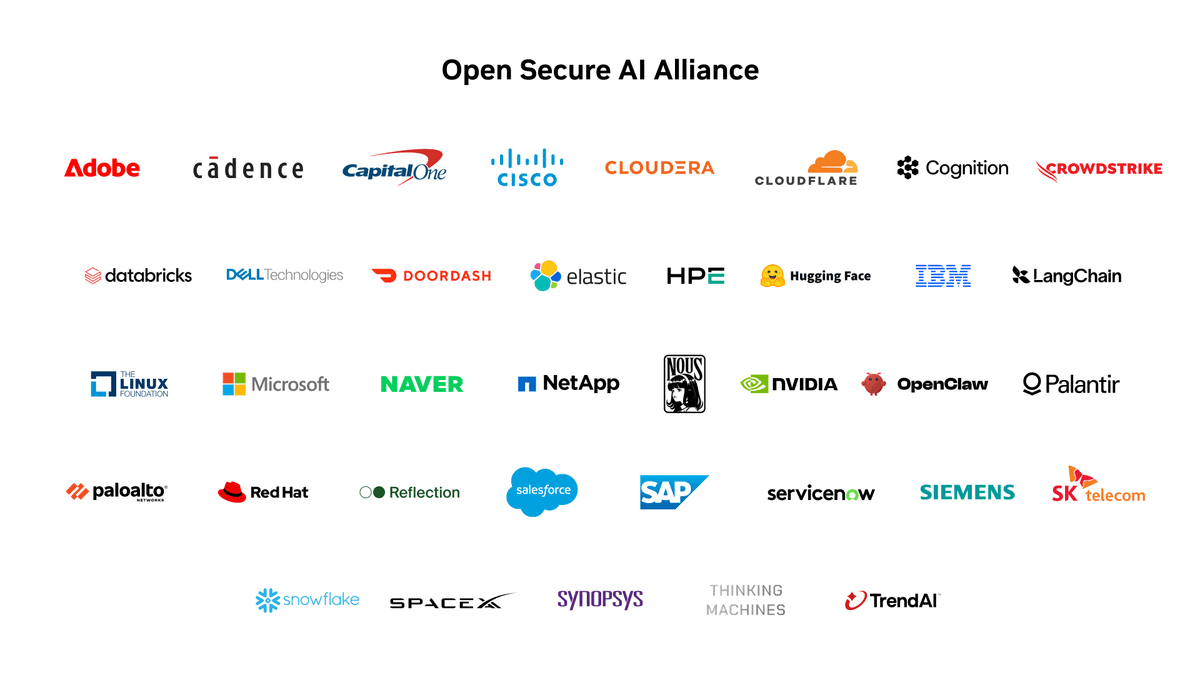
A coalition of more than 30 technology companies and foundations has formed the Open Secure AI Alliance to develop open-source security tools for AI systems, arguing that transparency and accessibility are essential for effective cyber defense.
NVIDIA, Microsoft, IBM, Hugging Face, and other industry leaders announced the initiative, which builds on the Linux Foundation's existing security work. The alliance will focus on creating open models, harnesses, and tools that any defender can inspect, modify, and deploy on their own infrastructure.
The case for open AI security
The alliance's formation follows a recent security incident at Hugging Face that illustrated the limitations of closed systems. When proprietary AI tools blocked forensic analysis—unable to distinguish legitimate security researchers from attackers—Hugging Face deployed an open-weight model on its own infrastructure to analyze more than 17,000 actions and contain the breach.
That incident demonstrated a critical vulnerability in relying solely on closed AI systems: defenders lose the ability to respond quickly when they cannot inspect or adapt tools during active incidents.
The alliance argues that while both open and closed AI models have roles, cybersecurity specifically requires open systems because they enable distributed defense, eliminate single points of failure, and allow organizations to maintain sovereign control over their security infrastructure.
Technical contributions
NVIDIA is contributing its new Object-Oriented Agent (NOOA) framework, now available on GitHub, which helps integrate safety capabilities into agent harnesses for better testing, tracing, and governance.
Other founding members are contributing complementary technologies: HPE brings SPIFFE/SPIRE for zero-trust identity verification of AI agents. Hugging Face has offered Safetensors, a secure format for storing model weights, to the PyTorch Foundation. Microsoft is contributing MDASH, a multi-model scanning harness that orchestrates specialized AI agents to discover exploitable bugs. IBM and Red Hat's Lightwell provides digitally signed patches for the open-source supply chain.
SpaceXAI has open-sourced its Grok Build coding agent and plans to release weights for its Grok model line.
Why it matters
The alliance directly challenges the assumption that AI safety requires keeping model weights closed. For cybersecurity teams, the ability to run advanced AI on their own infrastructure—without depending on external providers—can be the difference between containing a breach and watching it spread. The initiative also represents a strategic counter to potential regulations that would restrict open AI development, which alliance members argue would concentrate power among a few closed providers and weaken overall defensive capacity.
Policy implications
The alliance is calling on policymakers to recognize open AI systems as defensive assets rather than liabilities. Members argue that blanket restrictions on open frontier models would reduce the number of organizations capable of defending against sophisticated attacks.
Instead, the coalition advocates for investment in shared open infrastructure—datasets, evaluation frameworks, and red-teaming tools—similar to past public investments in open-source software.
Founding partners include Adobe, Cadence, Capital One, Cisco, Cloudera, Cloudflare, CrowdStrike, Databricks, Dell Technologies, Elastic, HPE, LangChain, Palo Alto Networks, Palantir, Salesforce, SAP, ServiceNow, Siemens, Snowflake, and others.
These details were first reported by NVIDIA in an announcement on the company's official blog.
This is an original analysis by the Omega editorial team. Source reporting: AI Watch.
Want systems like this working for your business?
Book a Call
