Nobel Economist: Automation Will Push States Toward Repression
New research models how governments may respond to automation-driven inequality with surveillance and control rather than redistribution.
A Nobel Prize-winning economist has published research suggesting that as automation accelerates, governments will increasingly choose repression over redistribution to manage social unrest.
Daron Acemoglu, who won the 2024 Nobel Memorial Prize in Economic Sciences, co-authored a working paper with Mehdi Shadmehr and Arda Gitmez titled "Automation and Repression." The paper models how political leaders respond when automation threatens to trigger popular revolts.
The economists argue that states face two options when automation creates inequality and unemployment: redistribute wealth through taxation, or deploy repression to prevent uprisings. Their model predicts repression becomes the preferred choice.
The economic logic behind repression
The paper's reasoning centers on cost structures. As automation expands, cushioning its disruptive effects requires ever-increasing redistribution funded by higher taxes on capital owners. Repression, by contrast, carries a fixed cost as a proportion of economic output.
"Greater automation makes repression more attractive to the capitalist state," the researchers write. Their dynamic model concludes that when credible revolt threats emerge, "the economy will ultimately converge to repression and the 'pitchforks' will be met with 'guns' from the capitalist state."
The paper even suggests democracies may not survive this transition. As capital accumulation grows, "democratic decision-making will become less and less acceptable to capitalists," potentially leading to anti-democratic coups.
Tech leaders acknowledge the threat
The research references comments from technology executives who have publicly discussed these dynamics. Mo Gawdat, former chief business officer at Google X, described the attitudes of many tech leaders as rushing toward full automation while planning to use "a lot of control, a lot of surveillance, a lot of forced compliance" to manage displaced workers.
Entrepreneur Nick Hanauer warned in 2014 that extreme wealth concentration historically ends in violence: "You show me a highly unequal society, and I will show you a police state. Or an uprising."
Why it matters
This research provides an economic framework for understanding why surveillance infrastructure is expanding even as automation remains incomplete. The model suggests current investments in monitoring technology may represent preparation for managing automation's social consequences through control rather than support systems. For business leaders, this frames technology deployment choices as having profound political implications beyond quarterly returns.
Surveillance expansion in practice
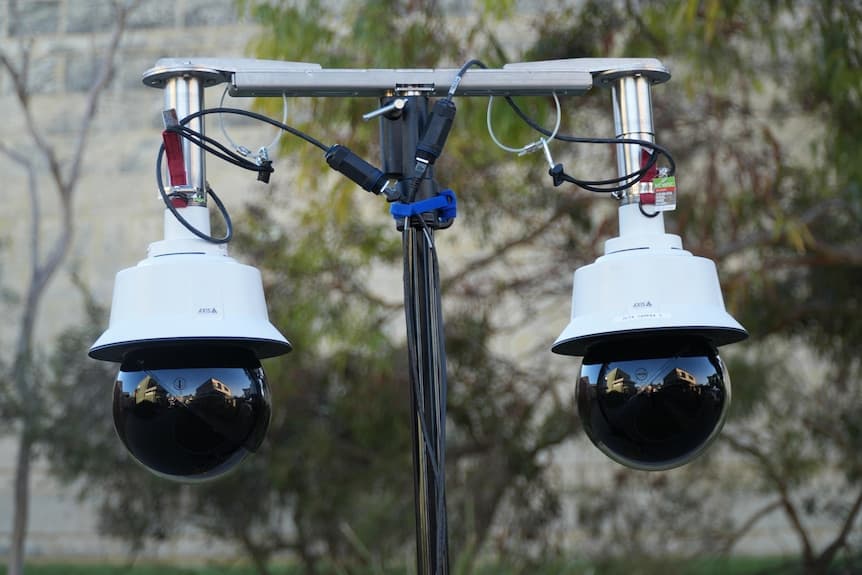
The paper arrives as surveillance capabilities grow across developed nations. ABC News reports that New South Wales Police are trialing rooftop drones in Moree, controlled remotely from hundreds of kilometers away. Western Australian police have deployed live facial recognition on Perth streets, scanning pedestrians against watchlists in real time.
Australian agencies including Centrelink, the tax office, and federal police have used Cellebrite phone extraction technology since at least 2017. New legislation seeks to expand these powers further.
The Economist has warned that data center and AI expansion faces growing public backlash in the United States, Britain, and Australia as citizens recognize the implications of these systems.
Acemoglu and his co-authors acknowledge their paper represents only a first step, noting it would be valuable to incorporate lobbying, political donations, and other forms of democratic capture into future models.
These details were first reported by ABC News.
This is an original analysis by the Omega editorial team. Source reporting: Automation Watch.
Want systems like this working for your business?
Book a Call
