New Zealand Sees 36% of Jobs Exposed to AI Transformation
Government modeling finds most roles will be augmented rather than replaced, but young workers and entry-level positions face mounting pressure.
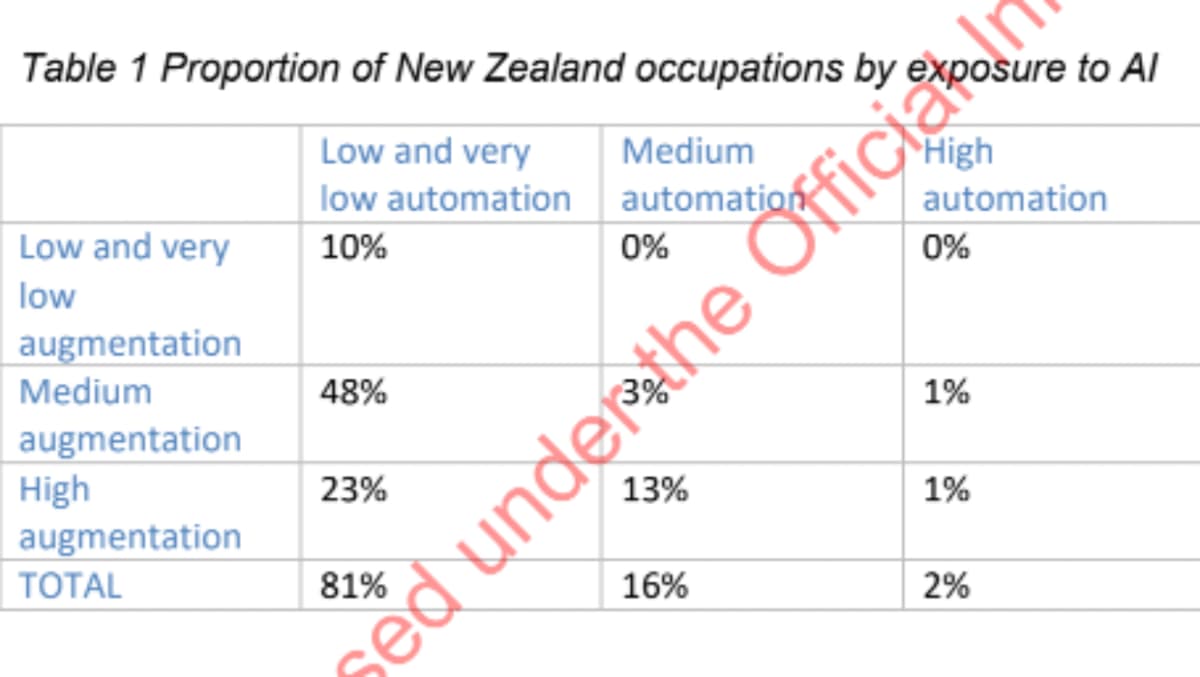
Government analysis reveals limited immediate automation risk
New Zealand's Ministry of Business, Innovation and Employment has concluded that roughly one-third of the country's occupations are exposed to transformation from artificial intelligence, though most will see their work augmented rather than eliminated outright.
According to a May 2024 briefing prepared for the Labour Market Ministers Group and obtained by Stuff under the Official Information Act, approximately 36% of occupations have high potential for augmentation with low to medium automation risk. Managers and higher-skilled knowledge workers comprise the largest share of this category.
Only 2% of current New Zealand occupations face high automation risk at AI's present capability level. Software programmers, ICT professionals, accountants, and call-center operators top this list.
Why it matters
As more than 200 economists—including 16 Nobel laureates—call for urgent action on AI's economic impact, New Zealand's relatively optimistic assessment stands in contrast to warnings from industry leaders like Anthropic CEO Dario Amodei, who predicts up to half of white-collar work could be automated by 2030. The disconnect between government modeling and private-sector forecasts raises questions about whether policymakers are adequately preparing for rapid technological change, particularly as the country pursues AI adoption to offset planned public service cuts of 9,000 roles over three years.
Data gaps and vulnerable populations
MBIE officials acknowledged significant limitations in their analysis, noting the modeling relied heavily on Australian economic research adapted for local conditions rather than New Zealand-specific data. To address this gap, the ministry is surveying 20,000 businesses, with results expected in September.
The briefing flagged particular concern for young workers entering the labor market. New Zealand's 15-to-24 age group currently faces a 15% unemployment rate—triple that of the broader working-age population. Officials warned that as entry-level positions become automated, these workers may struggle to develop the tacit knowledge and skills that AI can augment in more experienced roles.
Separate research from the AI Forum found that 45% of businesses plan to reduce headcount due to AI implementation.
Productivity gains and adoption challenges
MBIE forecasts AI will boost productivity by 1.5% by 2035 and nearly 3% by 2055. However, officials identified slow adoption among New Zealand businesses as a barrier to greater gains.
The ministry expressed confidence in the labor market's ability to absorb AI-driven changes, noting that new and disappearing jobs typically account for 13-15% of all positions annually, while one-fifth of workers change jobs each year.
International comparison
While New Zealand maintains a "light-touch" regulatory approach outlined in its National AI Strategy, allies are taking more interventionist stances. Australia announced this week it will establish an Office of AI to develop domestic standards addressing the technology's impact on climate, energy, education, employment, copyright, and defense.
Victoria University AI lecturer Andrew Lensen criticized New Zealand's response as inadequate, noting that no major political party has released a standalone AI policy ahead of the 2026 election despite the technology's broad implications for cost of living, jobs, environment, and sovereignty issues.
These details were first reported by Stuff's In-depth Team.
This is an original analysis by the Omega editorial team. Source reporting: Automation Watch.
Want systems like this working for your business?
Book a Call
