New AI Technique Prevents Recommendation Bias After Data Deletion
DGIST researchers develop Ada-Comp to ensure machine unlearning doesn't degrade service quality for specific user groups.
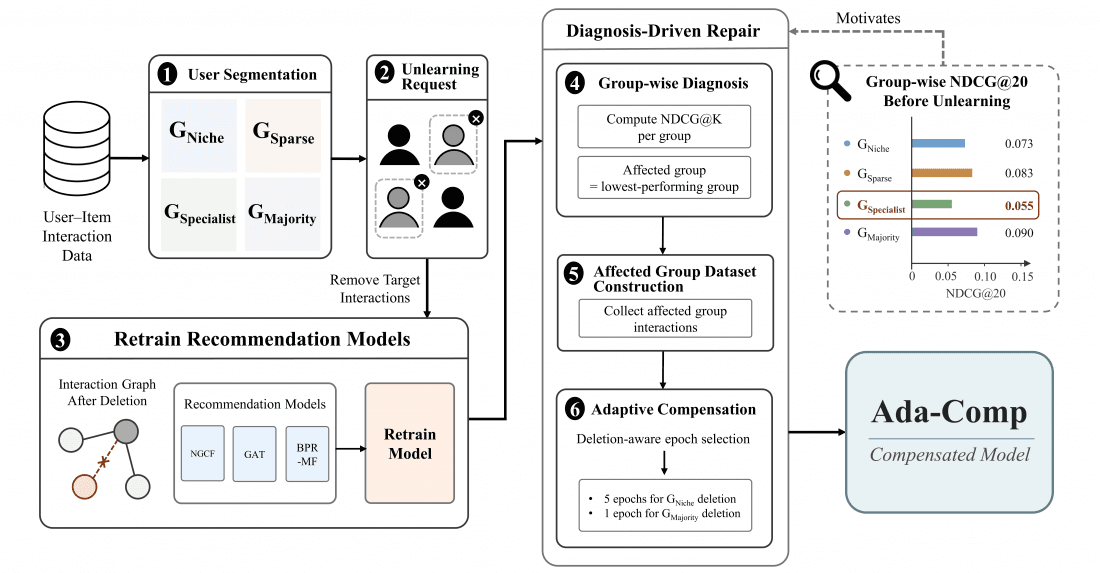
Researchers at South Korea's Daegu Gyeongbuk Institute of Science and Technology (DGIST) have developed a technique that addresses a critical blind spot in AI systems designed to forget user data: the unintended harm to other users when personal information is removed.
The technology, called Ada-Comp (Adaptive Compensation), automatically identifies and compensates for user groups whose recommendation quality deteriorates after someone else's data is deleted from the system. The work was presented at the ACM KDD Undergraduate Consortium in August 2025, with undergraduate researcher Eugene Jeong serving as first author.
The machine unlearning challenge
Machine unlearning has emerged as a key technology for implementing data deletion rights in AI systems. When users request their data be removed, the AI must eliminate that information's influence without retraining the entire model from scratch. However, this process creates an overlooked problem: deleting one user's data can degrade recommendation quality for others.
The DGIST team, led by Principal Researcher Sang-Chul Lee, identified why this happens in graph neural network-based recommender systems. Some users occupy structural positions that connect different user groups within the network. When their data disappears, the connections break, affecting recommendations for surrounding users.
How Ada-Comp works
Ada-Comp tackles this issue through selective intervention. After data deletion, the system automatically detects which user groups experienced the most significant performance decline. It then provides targeted additional training specifically for those affected groups, restoring recommendation quality without compromising the data deletion.
This approach shifts the focus of machine unlearning beyond simply erasing the targeted user's information. Instead, it considers the broader ecosystem effects and prevents performance degradation from concentrating among specific populations.
Why it matters
As privacy regulations expand globally, AI systems must balance individual data rights with service quality for all users. Ada-Comp demonstrates that these goals need not conflict. The technique offers a path toward trustworthy AI that respects deletion requests while maintaining equitable service across user groups—a critical consideration as recommender systems influence everything from content consumption to commerce.
The research also highlights DGIST's success in fostering undergraduate-led AI research. This marks the second consecutive year that DGIST undergraduate work has been selected for presentation at KDD, a leading academic conference in data science.
"For trustworthy AI, it is important not only to delete personal data safely, but also to ensure that the quality of service for other users does not deteriorate in the process," Lee stated. "We expect this study to present a new direction for reducing performance disparities among user groups that may arise after machine unlearning."
The findings were first reported by Asia Research News and presented as one of 28 papers selected for KDD-UC 2026.
This is an original analysis by the Omega editorial team. Source reporting: AI Watch.
Want systems like this working for your business?
Book a Call