MIT's GeoPT Trains Physics AI 60% Faster for Engineering Simulations
New pre-training method uses synthetic particle interactions to teach neural networks how objects respond to wind, water, and collisions.
A new approach to physics simulation
Researchers at MIT's Computer Science and Artificial Intelligence Laboratory and Tsinghua University have developed GeoPT, a pre-training system that teaches AI models to understand physics through synthetic particle interactions rather than massive datasets of real-world simulations.
The breakthrough addresses a fundamental bottleneck in engineering AI: current neural networks require enormous amounts of physics data generated by slow numerical solvers that calculate physical properties across 3D shapes. This computational expense has limited how quickly engineers can test vehicle designs, robotics systems, and industrial equipment in simulated environments.
GeoPT trains on 1.3 million samples of what the researchers call "synthetic dynamics"—simulations of tiny spheres moving at various speeds and angles until they contact complex 3D shapes and stop. This approach gives models an intuitive grasp of physical interactions before they encounter labeled training data for specific tasks.
How engineers will use it
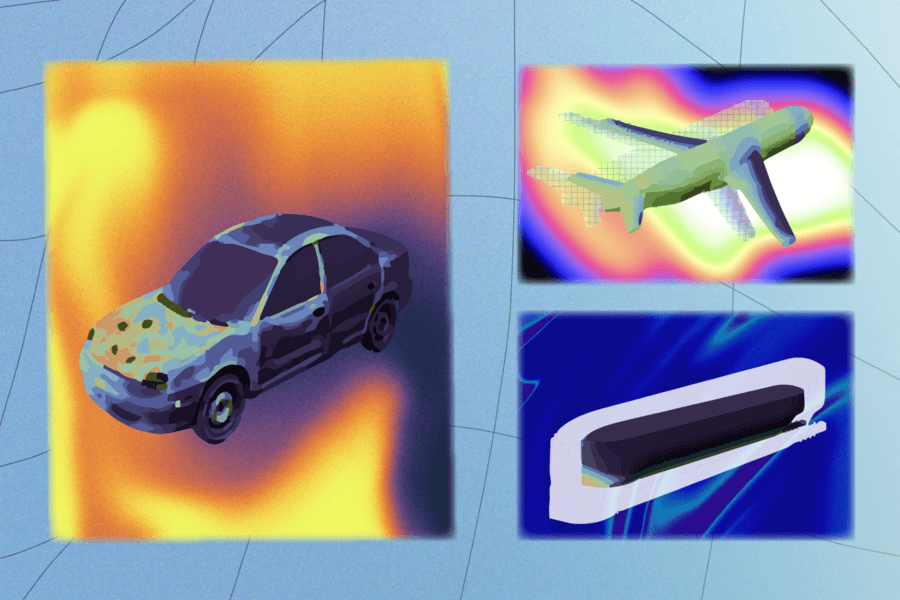
The system accepts 3D models of objects—battleships, passenger aircraft, trucks—along with specifications for force direction and speed. It outputs heat maps showing how different parts of the object respond to those forces.
According to MIT PhD student Minghao Guo, co-lead author on the research, "We believe physics is the third modality for AI models, after text and pixels." The team envisions GeoPT as a step toward a physics foundation model that could generalize across different simulation tasks, similar to how large language models handle diverse text applications.
Performance gains across industrial benchmarks
GeoPT demonstrated substantial efficiency improvements in testing. When simulating complex 3D shapes responding to wind currents and surface pressure, it outperformed state-of-the-art models in speed and accuracy. For fighter jet aerodynamics, it matched leading tools while training faster.
The most dramatic results came in marine engineering simulations, where GeoPT required 60% fewer labeled data points to model how boat hulls handle air and water forces, reaching peak accuracy four times faster than baseline models. The system also accurately predicted vehicle deformation in crash simulations and light refraction through 3D objects it had never encountered during training.
Co-lead author Haixu Wu, an MIT postdoc, noted that GeoPT can generate high-fidelity simulations with over 100 million mesh points in seconds, potentially reducing the need for costly physical prototyping.
Why it matters
Current AI models excel at generating text and images but struggle with physical accuracy—a critical gap for robotics, autonomous vehicles, and engineering design. GeoPT's efficiency gains could accelerate product development cycles by enabling rapid iteration on digital prototypes. More broadly, the research suggests that synthetic training data can effectively teach neural networks complex physical principles, opening a path toward general-purpose physics AI that doesn't require prohibitively expensive real-world datasets.
The team plans to scale the system to handle more complex phenomena including weather patterns, material science, and realistic video generation. These details were first reported by MIT News.
This is an original analysis by the Omega editorial team. Source reporting: AI Watch.
Want systems like this working for your business?
Book a Call