MIT Report Warns of 'Cognitive Surrender' as Students Rely on AI
Universities embrace artificial intelligence tools even as new research raises concerns about overreliance and academic integrity.
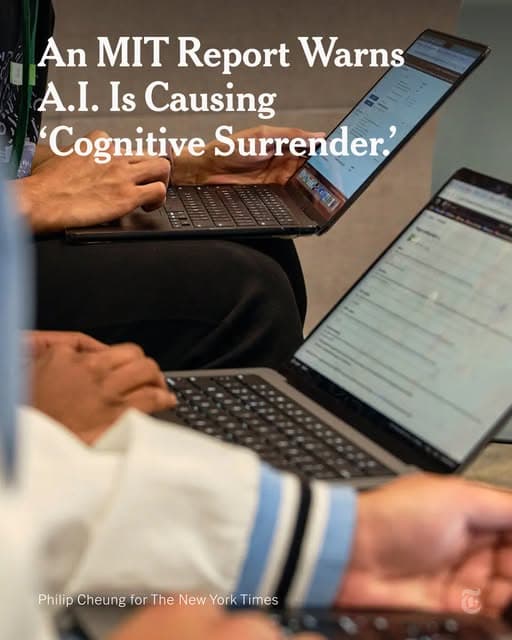
Growing Concerns Over Student AI Dependence
A new report from MIT has identified a troubling pattern it calls "cognitive surrender" — students increasingly relying on artificial intelligence to complete academic work without engaging in critical thinking. The phenomenon comes as AI tools have become ubiquitous in higher education, used for everything from research assistance to outright cheating.
Despite these concerns, many university leaders are moving forward with AI adoption enthusiastically, according to reporting by The New York Times. The disconnect highlights a fundamental tension in education: how to prepare students for an AI-integrated workplace while ensuring they develop essential reasoning skills.
Why it matters
The concept of cognitive surrender represents more than academic dishonesty — it signals a potential shift in how an entire generation approaches problem-solving. If students learn to defer to AI systems without developing their own analytical capabilities, they may enter the workforce unable to evaluate AI outputs critically or think independently when technology fails. This has implications for innovation, leadership, and decision-making across every sector.
The Debate Over AI in Education
The issue has sparked competing perspectives on how institutions should respond. Some argue that cognitive offloading to technology simply represents another paradigm shift, similar to calculators or search engines, freeing mental capacity for higher-level thinking. Others contend that accepting AI-generated answers without scrutiny only affects those who lack critical thinking skills to begin with.
A more nuanced view suggests educational institutions need a hybrid approach: deliberately creating AI-free assignments to build foundational skills while also teaching students to use AI tools effectively and responsibly. This perspective acknowledges that completely banning AI fails to prepare students for workplaces where these tools are standard.
The Stakes for Higher Education
The challenge for universities extends beyond policing cheating. Institutions must determine which cognitive skills remain essential when AI can perform many traditional academic tasks. Writing, research, and analysis — long considered core competencies — may need to be reconceptualized for an era when machines can execute these functions at scale.
The MIT report's findings suggest that without intentional intervention, students may graduate having outsourced too much of their intellectual development. Yet the path forward remains unclear, as educators balance preparing students for AI-saturated careers against ensuring they can think independently.
These details were first reported by The New York Times.
This is an original analysis by the Omega editorial team. Source reporting: AI Watch.
Want systems like this working for your business?
Book a Call