Microsoft's Orchard framework trains small AI agents to rival frontier models
Open-source system enables 3B-parameter models to achieve 73% on complex coding tasks using reusable infrastructure across domains.
Microsoft Research has released Orchard, an open-source framework designed to make training autonomous AI agents more accessible and cost-effective. The system demonstrates that relatively small models—around 3 billion active parameters—can approach the performance of frontier systems more than ten times their size on complex real-world tasks.
At the core of Orchard sits Orchard Env, a Kubernetes-based environment service that provides reusable infrastructure for training and evaluating agents across different domains. Unlike existing frameworks that require custom builds for each task type, the same Orchard infrastructure supports software engineering, web navigation, and personal assistant agents without modification.
Training inside real deployment harnesses
A key innovation is Orchard's ability to train agents directly inside the sophisticated harnesses they'll actually use in production—systems like Codex, OpenClaw, and ZeroClaw that manage multi-turn reasoning and tool use. Most open training tools force researchers to train on simplified stand-ins and then deploy in different environments, creating a mismatch. Orchard eliminates this gap by running each training rollout in its own container, recording the harness's model calls as training data.
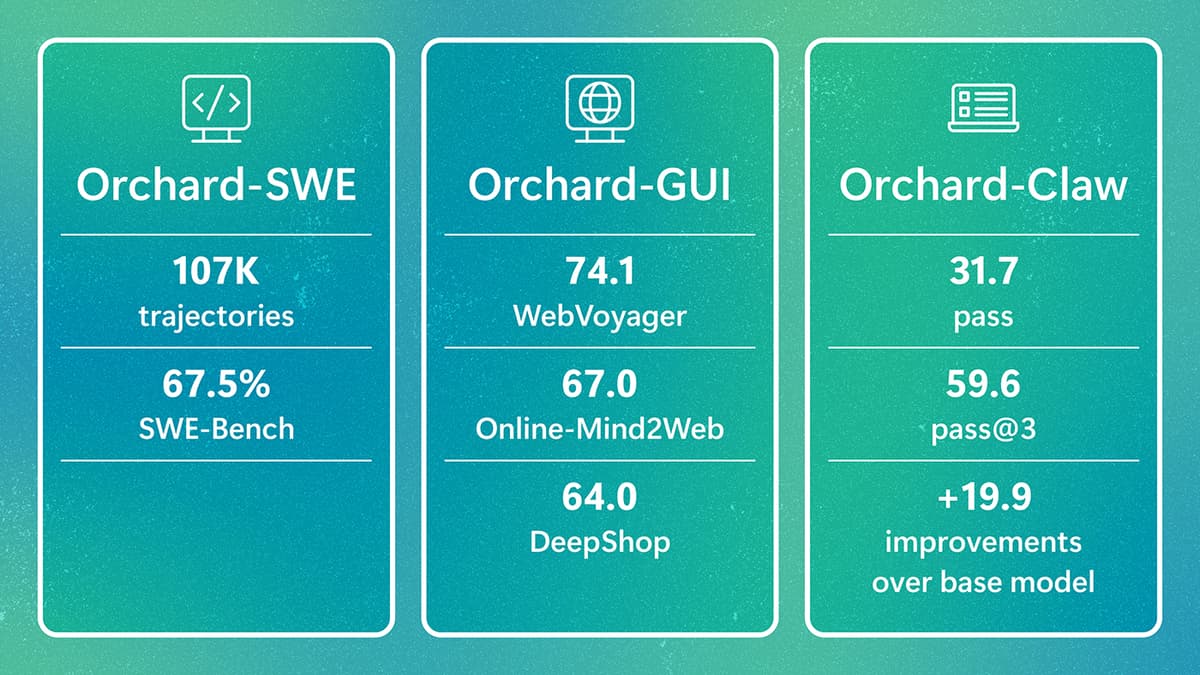
Microsoft released three domain-specific implementations to demonstrate the approach. Orchard-SWE tackles software engineering tasks and reaches 69.7% on SWE-bench Verified using roughly 3 billion active parameters—rising to 73% when paired with value-model reranking. The system was trained on 107,000 agent interactions distilled from larger models, using credit-assignment supervised fine-tuning that learns from productive portions of failed attempts rather than discarding them entirely.
Orchard-GUI, a 4-billion-parameter vision-language model for web navigation, achieves an average of 68.4% across WebVoyager, Online-Mind2Web, and DeepShop benchmarks despite training on only 400 demonstrations and 2,200 tasks. Orchard-Claw, focused on personal assistant workflows, completes 59.6% of productivity tasks with three attempts—increasing to 73.9% when paired with the ZeroClaw agent system—after training on just 200 synthetic tasks.
Why it matters
The research community has faced a persistent bottleneck in agentic AI development: building capable systems typically requires proprietary infrastructure, closed training pipelines, and datasets that most researchers cannot access. By releasing the complete stack—environment service, training pipelines, and datasets—Orchard lowers the barrier to entry for agentic AI research. The data efficiency demonstrated across domains suggests that capable agents can be trained without massive manually-created datasets, while the framework's ability to accumulate and reuse training experience points toward more cumulative learning approaches where each generation of agents inherits knowledge from previous ones rather than starting from scratch.
The results were first reported by Microsoft Research in a blog post detailing the Orchard framework and its three domain implementations.
This is an original analysis by the Omega editorial team. Source reporting: AI Watch.
Want systems like this working for your business?
Book a Call