Micron CEO: AI demand ends memory chip boom-bust cycles
Sanjay Mehrotra says artificial intelligence is creating sustained demand that's transforming the historically volatile semiconductor memory business.
AI transforms memory from commodity to strategic asset
Artificial intelligence has fundamentally altered the economics of the memory chip business, ending the boom-and-bust cycles that have defined the industry for decades, according to Micron Technology CEO Sanjay Mehrotra.
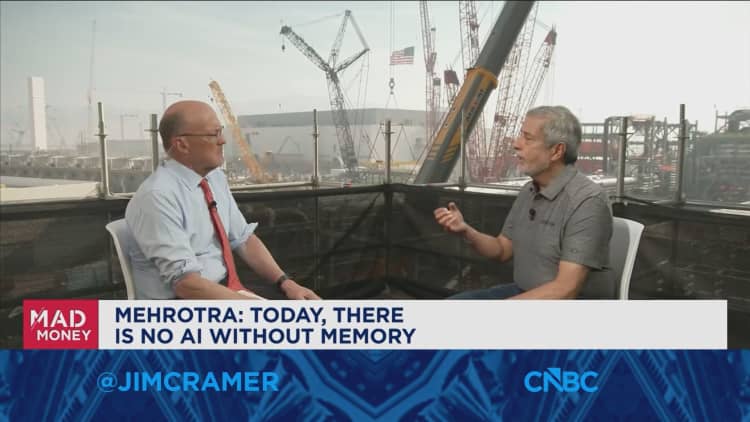
"Today there is no AI without memory," Mehrotra said in an interview with CNBC's Jim Cramer. "AI systems need more memory. They need higher performance memory. They need lower power memory. So, the value of memory, that equation has totally changed."
The shift represents a dramatic departure for an industry historically characterized by cyclical swings. Manufacturers would add capacity during periods of strong demand, only to see excess supply eventually crater prices. Mehrotra, who has spent over 40 years in the chip industry and previously co-founded SanDisk, believes AI is creating a more stable foundation.
Why it matters
The transformation from commodity component to strategic infrastructure changes how memory chipmakers invest, partner with customers, and manage risk. If sustained, this shift could support more predictable revenue streams and justify the massive capital investments required for advanced manufacturing — a critical consideration as the U.S. seeks to rebuild domestic semiconductor capacity.
$250 billion bet on sustained demand
Micron is backing Mehrotra's thesis with a $250 billion investment in U.S. manufacturing and research. Near the company's Boise, Idaho headquarters, construction is underway on a massive fabrication site that will eventually house two fabs, each roughly the size of 10 football fields. A single fab will contain enough steel rebar to circle Earth twice, Mehrotra noted. The first Boise facility is expected to begin producing wafers in mid-2027.
That scale of investment reflects confidence that AI demand extends far beyond current data center applications. Mehrotra expects autonomous vehicles, robots, and AI-enabled consumer devices to require increasingly large amounts of memory in coming years. "Memory today is essential," he said. "That's why I call it the strategic infrastructure of the AI era."
From price competition to design partnerships
The nature of customer relationships is also evolving. Rather than simply soliciting bids and buying from the lowest-price supplier, customers now need memory designed alongside the processors and systems in which it operates, according to Mehrotra. This makes memory essential to overall system performance rather than an interchangeable component.
"We are working closely with them earlier and earlier in their development cycle," Mehrotra said. "Our customers recognize the value of memory, because memory is what is enabling them to design products that are driving growth engines for them."
Micron has formalized this shift through long-term supply agreements. During its late June earnings call, the company announced five-year strategic agreements with 16 customers, with additional deals signed since. "They have committed to taking the supply," Mehrotra said. "So, this gives us assurance of demand."
Demand currently outstrips supply across Micron's business. "All our customers across our end markets will buy everything that we make," Mehrotra said, noting that data center customers want roughly 50% more supply than Micron can currently commit.
The details were first reported by CNBC.
This is an original analysis by the Omega editorial team. Source reporting: AI Watch.
Want systems like this working for your business?
Book a Call