Medical ethics journal retracts high schooler's AI paper
Fabricated references and peer review manipulation led to the withdrawal of a pharmaceutical AI ethics study.
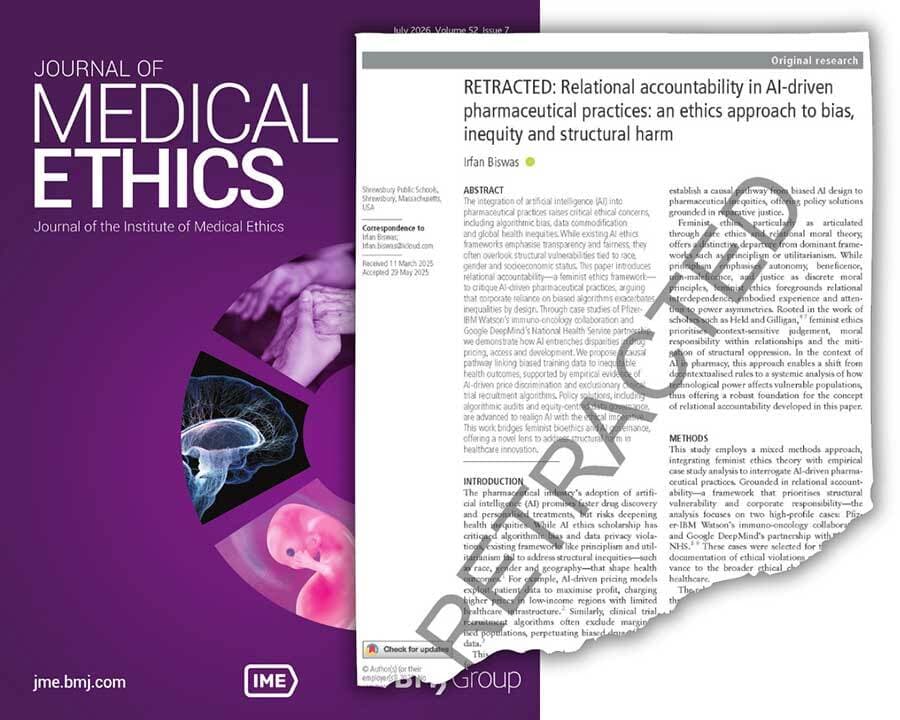
High school author's paper withdrawn for AI fabrications
The Journal of Medical Ethics has retracted a paper examining AI bias in pharmaceuticals after discovering the sole author—a Massachusetts high school student—submitted work containing nonexistent references generated by AI tools.
Irfan Biswas, who listed Shrewsbury Public Schools as his affiliation, published the paper in September 2025. The article argued that biased algorithms could worsen healthcare inequities. A May 28 retraction notice revealed that Biswas used generative AI to identify and interpret sources but never verified whether the citations actually existed before submission.
The journal's investigation uncovered multiple phantom references alongside what the notice termed "evidence of peer review manipulation," though BMJ Group, the journal's publisher, declined to provide specifics about the peer review issues. Biswas confirmed his high school student status to the journal and agreed to the retraction. He did not respond to requests for comment from Retraction Watch, which first reported the details.
A pattern of AI hallucinations in academic publishing
This case exemplifies a growing problem in scholarly literature. Research suggests approximately one in 277 papers indexed in PubMed now contains fabricated references—a phenomenon that emerged alongside tools like ChatGPT. Another ethics journal made a similar retraction in 2024 after a reader identified invented citations in a whistleblowing paper.
Recent months have seen multiple high-profile cases. A World Bank obesity study contained at least 14 fake references. A librarian discovered 12 of 14 citations in a Springer Nature article were nonexistent. Retraction Watch co-founder Ivan Oransky was even listed as an author on a hallucinated reference in a Springer Nature journal.
Biswas appears in at least one other publication under investigation. An August 2025 paper in Frontiers in Genome Editing on CRISPR ethics listed him with affiliations at UMass Medical School and the University of Rhode Island. UMass confirmed no record of his attendance. URI acknowledged an undergraduate by that name but could not verify it was the same person. Frontiers is now investigating following inquiry.
Why it matters
The ease with which AI tools generate plausible-but-fake academic citations threatens the integrity of peer review itself. When journals cannot reliably verify that authors have read the sources they cite, the entire foundation of scholarly discourse erodes. This case also raises questions about editorial gatekeeping: how a high school student with fabricated credentials and manipulated peer review navigated publication in a respected medical ethics journal points to systemic vulnerabilities that extend beyond any individual author's misconduct.
Precedent for student retractions
While unusual, high school authors have faced retractions before. Nathan Georgette withdrew a paper he wrote at 16 after discovering an error in 2012. Last year, a NASA researcher who collaborated with a high school student earned a retraction for incorrectly assuming a physical law without measurement.
The details were first reported by Retraction Watch.
This is an original analysis by the Omega editorial team. Source reporting: AI Watch.
Want systems like this working for your business?
Book a Call