Massachusetts Proposes $425M Robotics and AI Investment
New economic development bond bill positions automation as central to state competitiveness, funding research, defense innovation, and workforce development.
Massachusetts lawmakers have advanced legislation that would commit more than $425 million to robotics, artificial intelligence, and advanced manufacturing—a signal that state-level economic policy increasingly treats automation as essential infrastructure rather than optional technology.
The Massachusetts House recently approved an economic development bond bill allocating $75 million for AI development and deployment, $100 million for defense innovation including autonomous systems, $200 million for university research bridge funding, $25 million for the MassTech Robotics Initiative, and $25 million for manufacturing facility expansion. The legislation now moves to the Senate before potentially reaching the governor's desk.
Why it matters
States are emerging as decisive players in determining where robotics companies locate and scale. While federal programs capture headlines, state-level research grants, workforce programs, and commercialization support often determine whether lab breakthroughs become viable industries. Massachusetts is betting that strengthening its existing robotics ecosystem—rather than chasing individual corporate relocations—will deliver more durable economic returns.
Building on existing strength
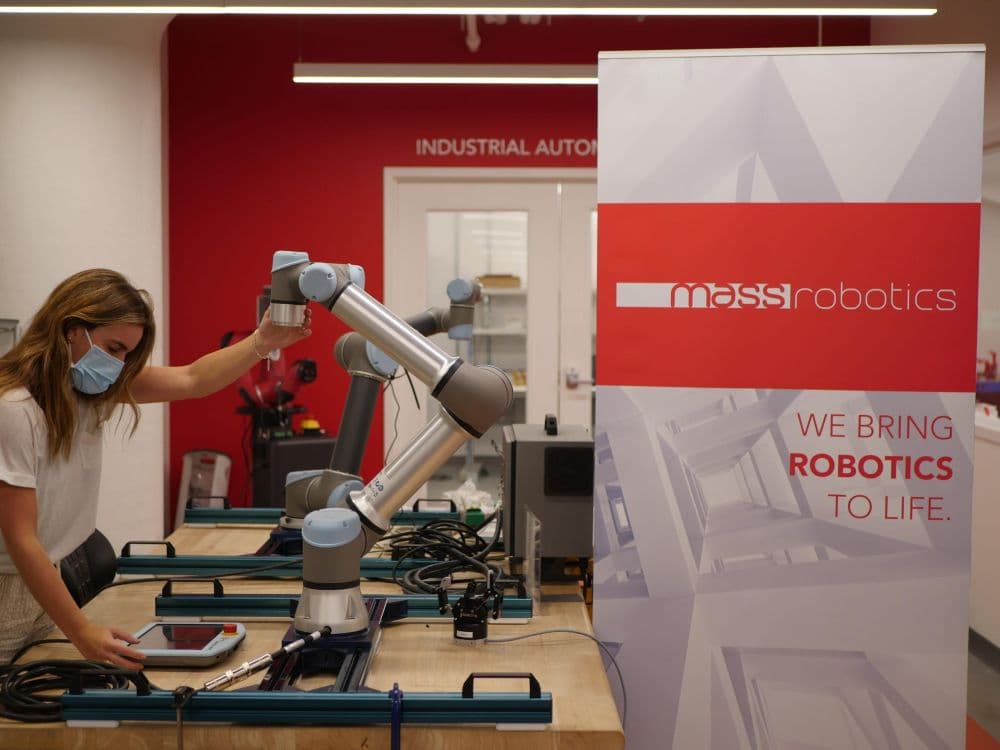
The Commonwealth already hosts more than 500 robotics companies and organizations, over 35 robotics research programs across 18 universities, and MassRobotics, a prominent startup accelerator that serves as a U.S. market gateway for international firms. The proposed funding aims to accelerate this established ecosystem rather than construct one from scratch.
The investment strategy spans the full innovation pipeline. University research funding addresses early-stage development. Defense allocations support autonomous systems with national security applications. Workforce and manufacturing provisions target commercialization and deployment barriers.
Interstate competition intensifies
Massachusetts faces growing competition from states including Texas, Ohio, Michigan, Arizona, Tennessee, and North Carolina, all pursuing advanced manufacturing and AI infrastructure investment. Rather than competing on operating costs, Massachusetts is reinforcing traditional advantages: research institutions, engineering talent, and commercialization networks.
This represents a shift in how states approach robotics policy. Earlier legislation typically addressed narrow operational questions—delivery robot regulations or autonomous vehicle testing parameters. Current proposals tackle broader strategic questions about economic competitiveness, workforce development, and which industries merit public investment.
Cluster strategy over corporate incentives
Notably, the legislation invests in ecosystem components—universities, commercialization programs, defense partnerships, manufacturing capacity—rather than incentive packages targeting specific companies. This cluster-based approach creates networks of startups, suppliers, investors, and researchers that reinforce one another over time.
The proposal also reflects recognition that robotics no longer develops in isolation. Grouping robotics alongside AI, cybersecurity, semiconductors, and advanced manufacturing acknowledges these technologies increasingly depend on integrated ecosystems. Demand for automation now extends beyond traditional manufacturing into healthcare, logistics, construction, and critical infrastructure.
What comes next
The Senate will develop its own economic development package before negotiations produce final legislation. Regardless of ultimate funding levels, the House proposal demonstrates how automation has moved from manufacturing technology to economic infrastructure in state policy conversations.
These details were first reported by Automation Watch, the publication of the Association for Advancing Automation (A3).
This is an original analysis by the Omega editorial team. Source reporting: Automation Watch.
Want systems like this working for your business?
Book a Call
