London Finance Analyst Jobs Drop 77% as AI Reshapes White-Collar Work
Recruitment data shows dramatic declines in postings for analysts, lawyers, and consultants as automation accelerates across professional services.
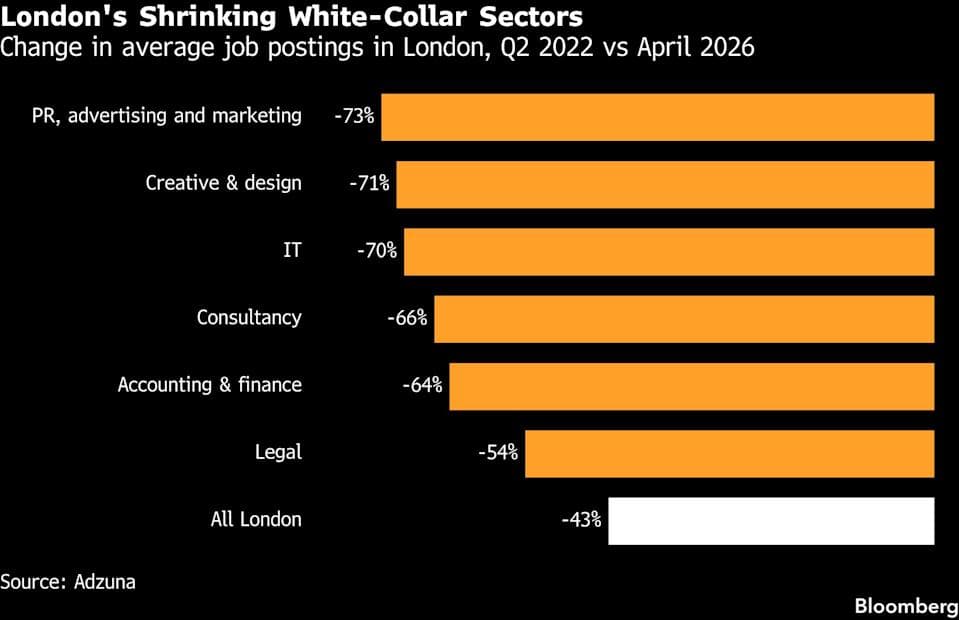
Steep decline in professional job postings
London's white-collar job market is experiencing a dramatic contraction driven by artificial intelligence adoption. Finance analyst positions in the city have fallen from more than 350 listings four years ago to approximately 80 today, according to recruitment platform Adzuna—a 77% decline that signals a fundamental shift in how financial services firms staff their operations.
The pattern extends well beyond finance. Corporate lawyer, software developer, management consultant, and digital marketing manager postings have all dropped from the hundreds into double digits. White-collar sectors now represent just a quarter of total London job vacancies, down from nearly half in 2022, Adzuna reported.
How AI is replacing traditional roles
The mechanics of this displacement are becoming clear across industries. Hedge funds that previously employed three junior analysts to review company filings now assign one person to supervise an AI model performing the same work. Consulting firms are eliminating executive assistant positions as calendar management and travel booking become automated tasks. Banks are reducing the size of junior analyst classes while cutting back-office functions including customer service and transaction monitoring.
These changes reflect AI's ability to handle pattern recognition, data synthesis, and routine decision-making—capabilities that once defined entry-level and mid-tier professional work. The technology is not simply augmenting human workers but fundamentally restructuring how organizations allocate labor.
Why it matters
London serves as an early indicator for global white-collar employment trends. As an international hub for finance, law, consulting, and technology services, the city's labor market shifts often preview changes that will ripple through other major business centers. Organizations evaluating their own workforce strategies should note the speed and scale of this transition—a 50% reduction in white-collar job share in just two years suggests AI adoption is accelerating faster than many forecasts predicted.
Response and human impact
Mayor Sadiq Khan has appointed entrepreneur Martha Lane-Fox to lead London's response to AI transformation. Speaking at a King's College London conference, Lane-Fox described "an enormous shift unfolding across offices, hospitals, classrooms, film studios, public services, and all the things that might define our city, and it's happening fast."
The human cost is already visible. Adam Banaszek, a 39-year-old graphic designer, spent six months searching unsuccessfully for work—an experience that illustrated how AI and economic pressures are converging to reshape creative professions.
These details were first reported by Bloomberg.
This is an original analysis by the Omega editorial team. Source reporting: AI Watch.
Want systems like this working for your business?
Book a Call
