Linux Kernel Exploit Uses AI to Achieve Root Privilege Escalation
A security researcher leveraged artificial intelligence to discover and exploit CVE-2026-53264, a use-after-free vulnerability in Linux's traffic-control subsystem.
AI-Assisted Discovery of Linux Kernel Flaw
STAR Labs has released working exploit code for a Linux kernel vulnerability that allows local privilege escalation from ordinary user to root access. The flaw, designated CVE-2026-53264 with a CVSS score of 7.8, stems from a use-after-free race condition in the kernel's network traffic-control subsystem.
Researcher Lee Jia Jie reported that artificial intelligence played a significant role in both identifying the vulnerability and accelerating exploit development. The disclosure marks a notable instance of AI tooling being applied to kernel security research, though Lee emphasized that human judgment remained essential throughout the process.
The vulnerability affects Linux kernel versions starting from 4.14. Upstream fixes were committed on June 1, 2026, and have been backported to stable branches including 5.10.259, 5.15.210, 6.1.176, 6.6.143, 6.12.94, 6.18.36, and 7.0.13, with the mainline fix appearing in 7.1-rc7.
Technical Requirements Narrow Exposure
This is a local privilege escalation vulnerability, not remote code execution. An attacker must already have access to the target system before the exploit becomes relevant. Additional prerequisites further constrain the attack surface: the exploit requires unprivileged user namespaces, specific kernel configuration options (CONFIG_NET_ACT_GACT and CONFIG_NET_CLS_FLOWER), and a kernel-specific return-oriented programming chain with hardcoded offsets.
The vulnerability exists in how Linux handles the lifecycle of traffic-control actions. When RTM_NEWTFILTER and RTM_DELTFILTER operations run concurrently, one thread can read an action object after another thread has freed it. The upstream patch addresses this race by deferring the free operation until existing read-copy-update readers complete.
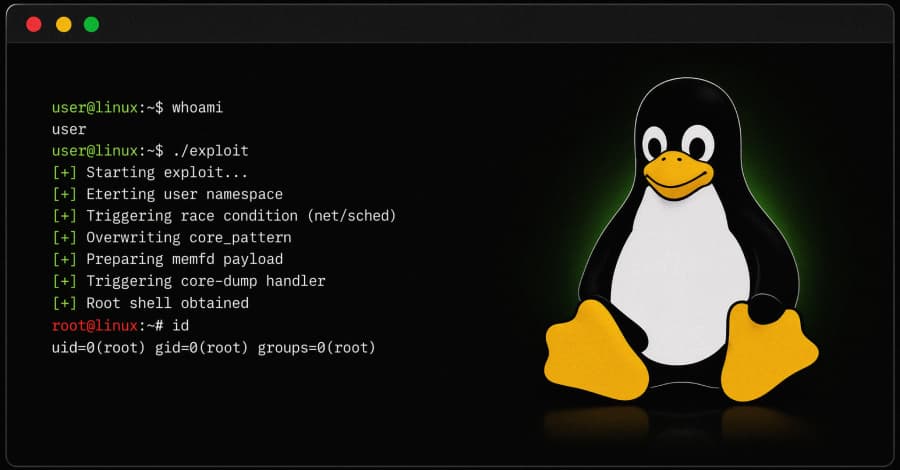
Lee's exploit creates isolated user and network namespaces to gain namespace-local CAP_NET_ADMIN capabilities without host administrator rights. The attack path uses a clsact qdisc and flower filter to reach the vulnerable code, employs timerfd and epoll operations to widen the race window, and ultimately overwrites core_pattern through a ROP chain. When a child process crashes, Linux executes the attacker's code as the root core-dump handler.
In testing on CentOS Stream 9, Lee reported 100% success across 10 runs, with exploitation times ranging from nine to 111 seconds. The exploit's reliance on fixed gadget offsets means it must be recompiled for different kernel packages and may not adapt to some newer builds.
Why It Matters
The publication of working exploit code increases urgency for organizations running vulnerable Linux systems, particularly those with the specific kernel configurations required. While the prerequisites narrow immediate exposure compared to a remote vulnerability, the availability of public exploit code lowers the barrier for potential attackers who have already gained initial access to a system. Distribution adoption of the fix remains inconsistent as of late July 2026, with Ubuntu marking multiple kernel packages as still vulnerable and SUSE listing the issue as pending across several products. The disclosure also raises questions about how AI tools will reshape vulnerability research workflows, though without details on the specific AI system used, the extent of automation versus human expertise remains unclear.
The Hacker News first reported these details and noted that as of July 28, 2026, the vulnerability had not appeared in CISA's Known Exploited Vulnerabilities catalog, and no exploitation in the wild had been officially documented. Kyle Zeng, who uses the handle KyleBot, is credited as the original reporter to the upstream Linux project, with Lee discovering the flaw independently shortly thereafter and subsequently publishing the technical analysis and exploit code.
This is an original analysis by the Omega editorial team. Source reporting: AI Watch.
Want systems like this working for your business?
Book a Call