Las Vegas Workers Confront AI Automation as Casinos Deploy Robots
Casino dealers and warehouse employees are already losing jobs to machines, prompting union leaders and lawmakers to demand worker protections.
Casino dealer Kanie Kastroll watched a news segment showing a robotic arm attempting to deal blackjack at a Las Vegas trade show. Despite the machine's clumsy, slow performance, the demonstration alarmed her.
"The fact that they even thought about creating it is the scary part," Kastroll said. "Because you will get better and better in time."
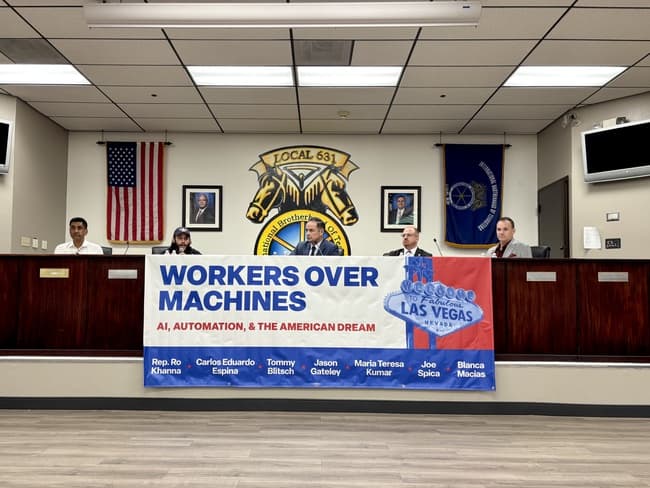
Her concerns drew her to a town hall Wednesday evening where Rep. Ro Khanna, D-Calif., and Rep. Steven Horsford, D-Nev., met with workers from the Culinary Workers Union Local 226, Teamsters, and other labor organizations to address automation's impact on Nevada's workforce.
Why it matters
Las Vegas represents a critical test case for how service-sector workers will navigate the collision between AI advancement and job security. With 43 planned or constructed data centers in the valley and automation already displacing workers in casinos and warehouses, the region's experience will likely preview challenges facing hospitality and logistics workers nationwide.
Automation Already Displacing Workers
The threat is not hypothetical. In March, approximately 50 workers lost their jobs when Southern Glazer's Wine & Spirits automated its Las Vegas warehouse, according to Jason Gately, secretary-treasurer of Teamsters Local 14.
MGM Resorts introduced automated cocktail dispensing machines in its service bars in 2019, shifting additional responsibilities onto cocktail waitresses, according to Culinary Union member Joe Silva. Golden Gate casino on Fremont Street has replaced live dealers with electronic table game machines, though ownership said affected dealers were offered reassignment at sister properties rather than layoffs.
These experiences pushed the Culinary Union to negotiate technology protections in its five-year contracts with Las Vegas resort companies in 2023. The agreements secured advance notification requirements when new technology is introduced, training for affected workers, and severance pay for those who lose jobs to automation.
Legislative Proposals Target Corporate Benefits
"If automation makes a company more productive, the benefit should mean safer jobs, better wages, shorter hours and more security," Horsford said. "Not pink slips for our workers, and big profits for billionaires."
Horsford advocated for legislative guardrails including advance notice and training requirements when employers introduce new technology, plus strengthened collective bargaining rights.
Khanna promoted his recently introduced Data Center Bill of Rights, a resolution affirming communities' right to ban data centers in residential areas and within 2,500 feet of homes, schools, childcare facilities, hospitals, or nursing homes. The measure would also require data centers to use clean energy and allow communities to reject proposed projects through transparent processes.
Political Implications
The town hall marked Khanna's sixth Nevada visit since the 2024 election. The Silicon Valley congressman has said he is "thinking seriously" about a 2028 presidential run, and Nevada will hold the second position in the Democratic primary calendar on February 1, 2028, following South Carolina.
Kastroll, who deals at Wynn Las Vegas, hopes her employer's reputation for five-star service provides some protection from automation. But she remains wary of technological progress that could eliminate her profession.
These details were first reported by the Las Vegas Sun.
This is an original analysis by the Omega editorial team. Source reporting: Automation Watch.
Want systems like this working for your business?
Book a Call
