Kazakhstan Caught Between U.S. and Chinese AI Coalitions
Astana's dual membership in competing technology frameworks tests its traditional balancing act as Washington signals countries must choose sides.
Dual Membership Creates Diplomatic Tension
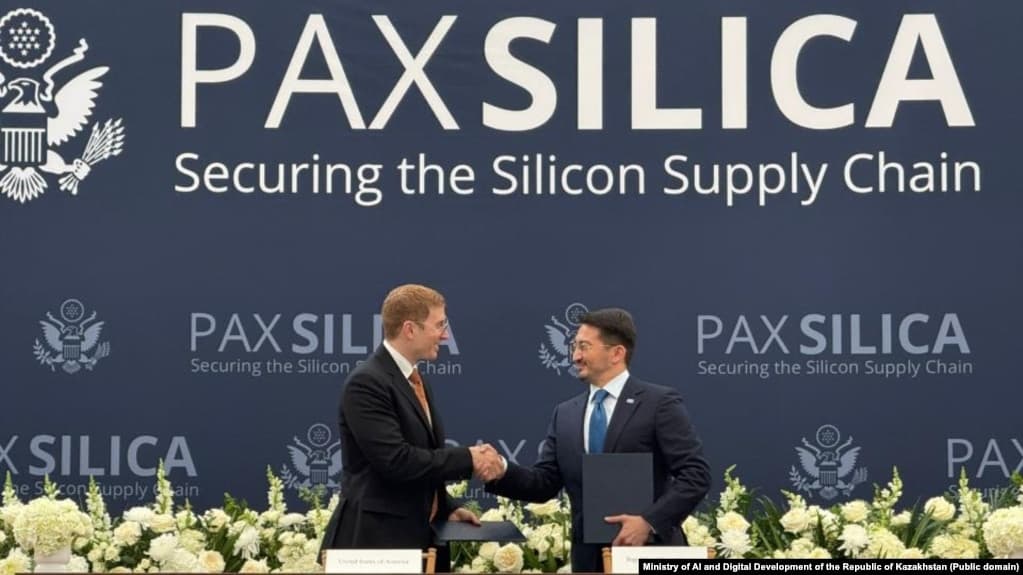
Kazakhstan has become the only nation to join both major competing artificial intelligence coalitions—the U.S.-led Pax Silica initiative and China's World Artificial Intelligence Cooperation Organization (WAICO)—placing its long-practiced multivector foreign policy under unprecedented technological pressure.
The Central Asian country signed the Pax Silica declaration on June 25, becoming the first in its region to join the 25-member framework focused on securing AI supply chains. Three weeks later, on July 16, Kazakhstan joined 28 other nations in establishing WAICO in Shanghai, a China-backed organization promoting international AI cooperation and governance standards.
According to Radio Free Europe/Radio Liberty, which first reported these details, Washington is now preparing to force countries into a choice. A draft State Department letter reviewed by Reuters warned that nations participating in China's framework could face exclusion from the U.S. coalition. "To be part of everything is to be part of nothing," the letter stated, characterizing Pax Silica membership as a commitment rather than casual participation.
Why It Matters
Unlike conventional trade disputes, AI competition involves strategic infrastructure with potential military applications—semiconductors, data centers, advanced computing, and critical minerals. Countries that have successfully maintained economic ties with both superpowers may find that technological ecosystems demand harder choices about which standards, supply chains, and governance frameworks will underpin their digital futures. Kazakhstan's vast critical mineral reserves make it particularly valuable to both initiatives.
Strategic Value on Both Sides
Pax Silica offers Kazakhstan access to U.S.-led investment and trusted supply-chain partnerships spanning minerals, semiconductors, manufacturing, energy, and AI infrastructure. The country holds significant reserves of rare earth elements and other materials essential for advanced technologies.
WAICO provides a role in China's framework for international AI development, with Beijing promoting open-weight AI models as accessible alternatives for countries lacking resources for proprietary systems. The organization includes Russia, Uzbekistan, Kyrgyzstan, Tajikistan, Pakistan, Indonesia, and Brazil among its members.
President Qasym-Zhomart Toqaev told China's Xinhua news agency that Kazakhstan's participation aligns with its belief that AI should serve humanity with fair access to modern technology. He described WAICO membership as supporting an "open and effective international system" for coordinating AI efforts.
Narrowing Room for Maneuver
A U.S. official told Reuters that credibly positioning as a trusted partner in one technology ecosystem while joining a competing Chinese initiative presents inherent contradictions. Washington views AI infrastructure as requiring deeper commitments than traditional commercial relationships.
Analyst Wilder Alejandro Sanchez, president of Washington-based Second Floor Strategies, suggested Astana may have miscalculated by not anticipating Washington would draw such clear boundaries. He recommended Kazakhstan seek dialogue with Washington while maintaining it prefers not choosing between the powers.
However, Ken Moriyasu, a senior fellow at the Hudson Institute, argued that Kazakhstan's flexibility actually benefits U.S. strategy in Eurasia. "Keeping Kazakhstan a trusted ally and partner in this endeavor is more important than forcing it to choose sides in Pax Silica," he told The Astana Times.
China's embassy in Washington has rejected the premise that countries should face forced choices, calling on the United States to avoid politicizing trade and technology issues.
For now, Kazakhstan has not received a formal ultimatum to withdraw from either initiative. But the emerging contest suggests its traditional balancing act faces a harder test in technology than in other diplomatic arenas.
These details were first reported by Radio Free Europe/Radio Liberty.
This is an original analysis by the Omega editorial team. Source reporting: AI Watch.
Want systems like this working for your business?
Book a Call