JD.com Plans Robot Delivery Fleet as EU Opens Subsidy Probe
Chinese e-commerce giant confirms hundreds of thousands of courier roles will shift to automation while facing regulatory scrutiny in Europe.
JD.com is moving forward with plans to replace hundreds of thousands of delivery workers with robots, according to recent statements from founder Richard Liu. The Chinese e-commerce giant has signed contracts with 120 schools to retrain affected couriers, even as European Union regulators opened a foreign subsidies investigation into the company's bid to acquire German retailer Ceconomy.
The dual developments underscore the tension between JD.com's aggressive automation strategy and the regulatory headwinds it faces as it expands internationally. Liu's confirmation of the massive workforce transition represents one of the largest announced shifts from human to robotic delivery in the retail sector.
Why it matters
JD.com's automation push directly addresses its largest operational expense—last-mile delivery—but creates execution risk around cost savings timelines and workforce management. Meanwhile, the EU probe highlights how Chinese companies' overseas expansion plans now face heightened scrutiny over state subsidies, potentially slowing JD.com's international growth ambitions just as it seeks new markets to offset domestic competition.
Balancing automation investment with shareholder returns
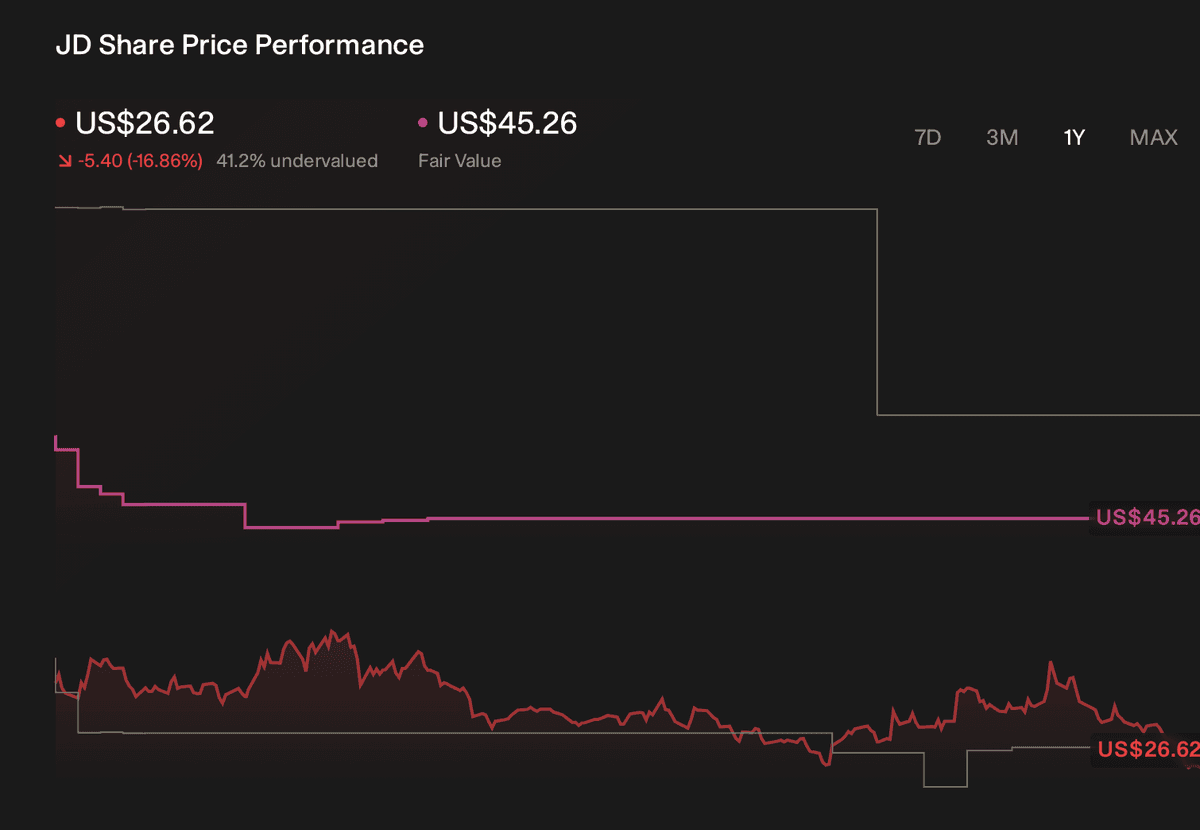
Despite the capital requirements of its robotics buildout, JD.com has maintained an aggressive share buyback program. By March 2026, the company had repurchased approximately 15.9% of its outstanding shares for roughly $3.6 billion under its current authorization. This capital allocation signals management confidence that automation investments will generate returns sufficient to justify both the technology spending and shareholder distributions.
The company's investment narrative hinges on whether heavy logistics automation can improve margins without sacrificing growth. Analyst projections cited by Simply Wall St anticipate JD.com reaching CN¥1,517.4 billion in revenue and CN¥45.1 billion in earnings by 2028, requiring 6.2% annual revenue growth and earnings expansion from CN¥38.7 billion currently.
Regulatory risk clouds international expansion
The EU's foreign subsidies probe into JD.com's Ceconomy acquisition attempt represents a new category of regulatory challenge for Chinese technology companies operating abroad. Unlike antitrust or data privacy investigations, subsidy probes examine whether state financial support creates unfair competitive advantages in cross-border deals.
For JD.com, the investigation adds uncertainty to its European expansion strategy at a time when the company is investing heavily in automation infrastructure. More optimistic analyst scenarios project revenue reaching CN¥1,697.1 billion and earnings of CN¥58.1 billion, but these targets assume successful international expansion and realized efficiency gains from robotics—both now facing increased uncertainty.
The retraining contracts with 120 schools demonstrate JD.com's awareness of the social implications of large-scale workforce automation. However, the transition timeline and ultimate success of retraining hundreds of thousands of workers remain open questions that could affect both operational execution and the company's regulatory standing in China.
These details were first reported by Simply Wall St in their analysis of JD.com's automation strategy and regulatory challenges.
This is an original analysis by the Omega editorial team. Source reporting: Automation Watch.
Want systems like this working for your business?
Book a Call