How HCA Healthcare scales AI across 189 hospitals
Chief transformation officer Dr. Michael Schlosser explains the governance, team structure, and human-in-the-loop safeguards behind enterprise AI deployment in healthcare.
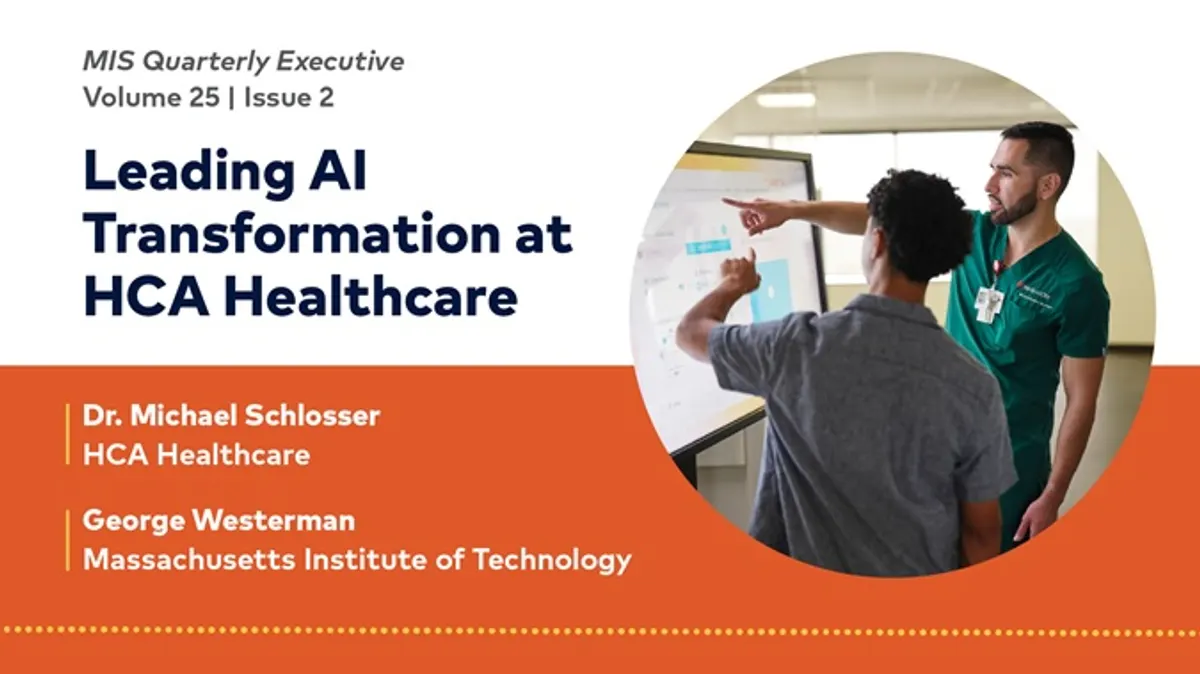
How a health system with 47 million patient encounters annually turns AI pilots into production tools
HCA Healthcare operates 189 hospitals and approximately 2,600 ambulatory care sites across 19 states and the United Kingdom, supported by more than 320,000 employees. That scale, according to Dr. Michael Schlosser, the organization's senior vice president and chief transformation officer, functions as a competitive advantage for AI innovation rather than a source of bureaucratic drag.
In a recent interview with George Westerman of the MIT Sloan School of Management, Schlosser outlined how HCA Healthcare's Digital Transformation and Innovation group moves AI-powered tools from concept to enterprise deployment. The conversation, originally published in MIS Quarterly Executive Volume 25, Issue 2, offers concrete details on governance structures, accuracy thresholds, and the role clinical expertise plays in technology leadership.
Building AI tools with nurses, not for them
One of the organization's most instructive projects is Nurse Handoff, an AI application that generates shift-change summaries for incoming care teams. The idea originated directly from bedside nurses who identified handoffs as a persistent pain point. Previous attempts to automate summaries through electronic health record systems produced outputs that were either too sparse or too verbose to be clinically useful.
Schlosser's team spent approximately one year refining large language models to think like a nurse—identifying which clinical details matter and which can be omitted. The process involved iterative feedback from care teams who perform handoffs daily. Engineers adjusted model architecture, retrieval augmented generation configurations, and output formats until accuracy metrics reached the high 90s across measures including cohesiveness, accuracy, conciseness, and usefulness.
The tool is now deployed in eight hospitals, with broader rollout planned. Critically, the system maintains human oversight. Nurses review and validate all AI-generated summaries, with one-click feedback mechanisms that flag inaccuracies. That feedback feeds back into model improvement cycles, currently through human review with automation in development.
Governance that balances top-down strategy with ground-level input
HCA Healthcare structures its AI decision-making through both hierarchical and grassroots channels. A governance committee including the CEO and CFO conducts quarterly business reviews to ensure alignment with enterprise strategic priorities such as workforce development and resource stewardship.
Idea generation flows from multiple sources. Three hospitals serve as designated Innovation Hubs, cultivating expertise in translating concepts into scalable implementations. Business unit sponsors—executives with operational responsibilities who dedicate partial time to the transformation group—bring domain context and help measure impact. Nursing leadership forums and other feedback structures surface pain points from frontline staff.
Schlosser's team includes three core functions: product teams combining clinical, business, and technical expertise; implementation teams handling change management and scaling; and a data organization led by a chief data officer. The structure deliberately separates these functions from IT infrastructure and cybersecurity, which are managed through a close partnership with the CIO.
Why it matters
Healthcare organizations frequently struggle to move AI pilots beyond initial testing phases. HCA Healthcare's approach demonstrates how clinical credibility, structured governance, and purpose-built teams can overcome regulatory caution and organizational inertia. The emphasis on human oversight and continuous feedback loops offers a template for deploying non-deterministic AI systems in high-stakes environments where errors carry patient safety implications.
A value-tracking team with biostatisticians evaluates potential impact across financial, safety, quality, experience, and operational dimensions from the earliest discovery phases. This multi-dimensional measurement framework helps prioritize projects and demonstrate outcomes beyond traditional ROI calculations.
These details were first reported by MIS Quarterly Executive in an interview conducted by George Westerman.
This is an original analysis by the Omega editorial team. Source reporting: AI Watch.
Want systems like this working for your business?
Book a Call