HiddenLayer raises $100M as AI security spending surges 83%
The Austin startup's ARR grew 10x in a year as enterprises deploy agents and face new attack vectors in production environments.
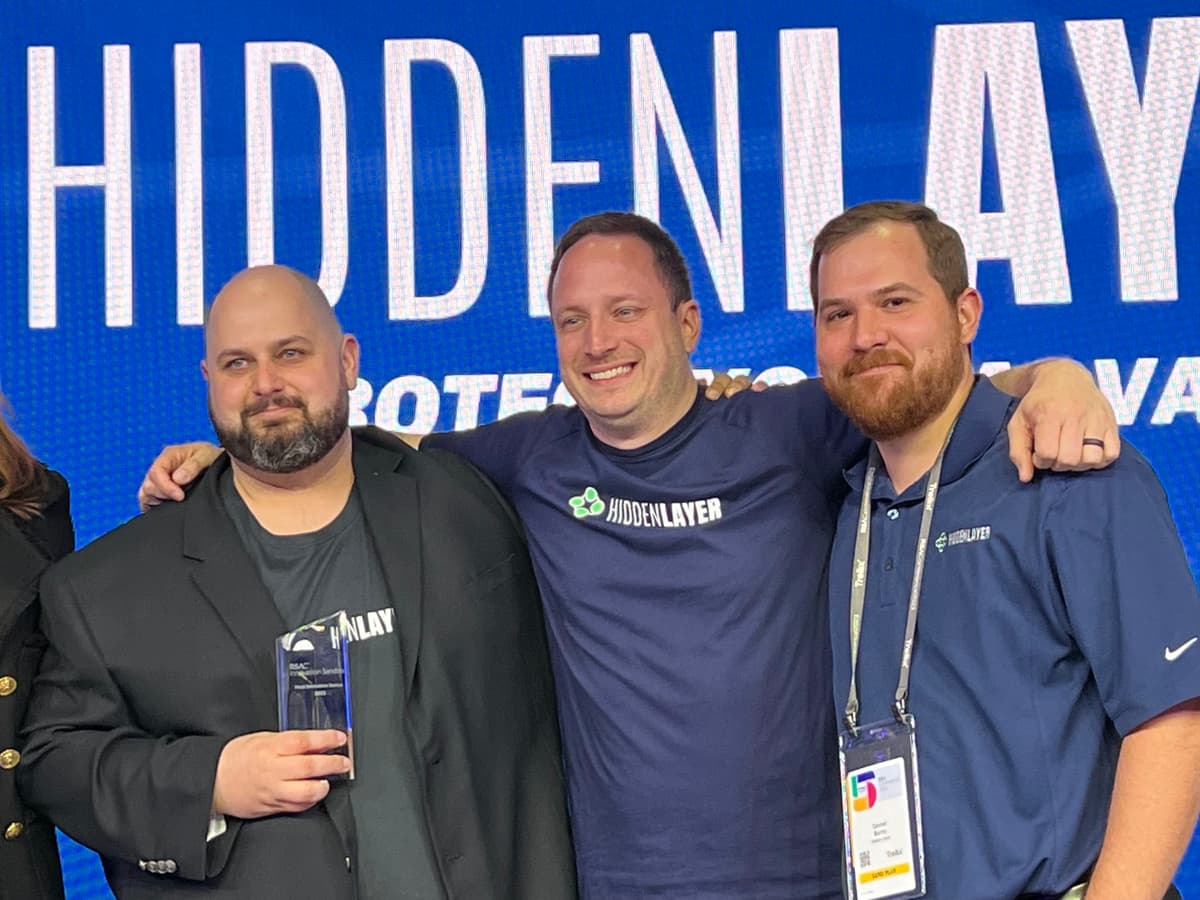
AI security startup HiddenLayer has closed a $100 million Series B funding round led by Delta-v Capital, capitalizing on explosive growth in enterprise demand for tools that protect AI deployments from adversarial attacks and malicious code injections.
The Austin-based company's annual recurring revenue grew more than tenfold over the past year, reaching tens of millions of dollars, with over 90% of that growth driven by new customer acquisitions, according to co-founder and CEO Chris Sestito. The funding round included participation from Ten Eleven Ventures, Morgan Stanley, Microsoft's M12, and Booz Allen Hamilton.
Why it matters
When HiddenLayer raised its $50 million Series A three years ago, concrete examples of AI attacks at scale were scarce. Today, the threat landscape has materialized rapidly as enterprises deploy AI agents and workflows in production. Gartner now estimates companies will spend $2.83 billion this year on AI security products—an 83% increase from 2025—with spending expected to reach nearly $4.78 billion next year. The market validation represents a fundamental shift from theoretical risk to operational necessity.
Expanding beyond model security
HiddenLayer's core products—discovery, runtime protection, attack simulation, and supply chain security—have evolved to address emerging threats specific to generative AI and agentic systems. The company now focuses on defending against prompt injection, agent manipulation, and malicious tool use as enterprises move beyond traditional machine learning deployments.
Sestito emphasized that runtime security has become a critical priority, comparing the company's approach to endpoint detection and response (EDR) solutions but purpose-built for AI infrastructure. "Inference is still inference," he explained, noting that the company's underlying technology applies across traditional ML models, generative AI, and agentic workflows without requiring a fundamental pivot.
New attack surfaces in open source
The startup has developed capabilities to parse and scan approximately 50 different AI file frameworks, addressing vulnerabilities in open source and open-weight models. Sestito highlighted a specific threat vector: models that misrepresent their identity or contain hidden models embedded within them. This supply chain risk has become particularly acute as enterprises increasingly rely on open source AI components.
HiddenLayer's customer base spans financial services and large technology companies building AI products, with contracts extending to the Department of Defense and intelligence community. One customer is described as a "leading frontier model provider" with more than 700 million weekly users.
Competitive landscape intensifies
The new capital will fund sales expansion and distribution efforts while supporting continued engineering and research investment. The company plans to expand into Europe and the broader EMEA region as it scales.
HiddenLayer faces competition from multiple directions. Large cybersecurity vendors like Cisco, Palo Alto Networks, and Check Point frequently acquire rather than build AI security capabilities. Meanwhile, startups including Noma and Zenity have each raised over $100 million to address adjacent or overlapping market segments.
Sestito acknowledged that some AI security features could eventually be bundled into platforms from Microsoft, OpenAI, and AWS, but expects those providers to focus on governance capabilities like discovery, identity, and policy controls rather than the specialized protection tools HiddenLayer builds.
The details were first reported by TechCrunch.
This is an original analysis by the Omega editorial team. Source reporting: AI Watch.
Want systems like this working for your business?
Book a Call