Hand Dexterity Remains Key Bottleneck in Humanoid Robot Deployment
New benchmark framework aims to standardize measurement of robotic manipulation skills as labor shortages accelerate automation investments.
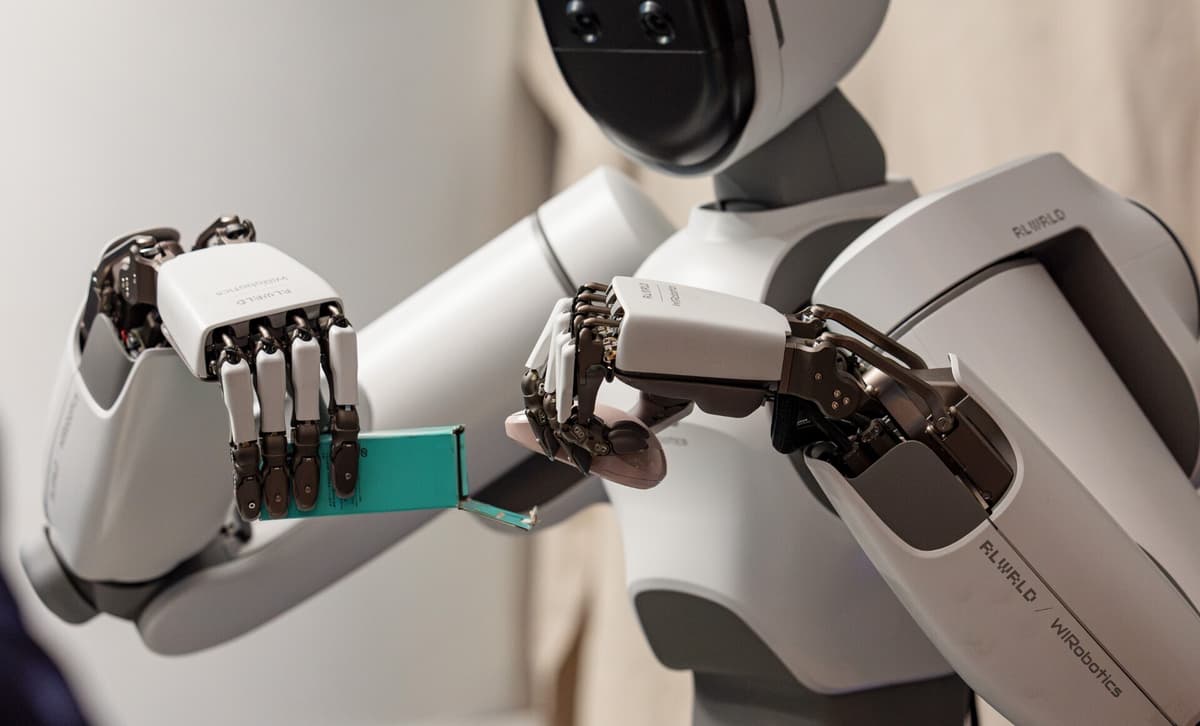
The automation gap that won't close itself
Demographic trends are colliding with manufacturing reality. Working-age populations are contracting across Korea, Japan, Europe, and China's industrial regions while demand for physical goods holds steady. The result: a global shortage of hands that has fueled unprecedented investment in humanoid robotics and physical AI.
Yet despite dramatic advances in robot locomotion and navigation, a fundamental capability gap persists. Robots can now walk, balance, and move through human environments with increasing reliability. What they still struggle with is the manipulation work humans perform without conscious thought—folding fabric, seating electrical connectors, handling deformable materials under time pressure.
The bottleneck is not in the legs. It is in the hands.
Why it matters
Without standardized measurement of robotic dexterity, the gap between laboratory demonstrations and factory-floor deployment will continue to widen. Buyers cannot compare systems objectively, developers lack clear targets for improvement, and investors must evaluate competing technologies using incomparable metrics. The history of AI development shows that measurable progress follows standardized benchmarks—ImageNet catalyzed computer vision, MMLU shaped language model evaluation. Physical AI needs the same foundation.
A framework built from real industrial needs
DexBench approaches the measurement problem from the opposite direction of traditional robotics benchmarks. Rather than designing laboratory tasks, the framework begins with recurring manipulation requirements observed across manufacturing, logistics, and service operations, according to details first reported by the World Economic Forum.
The system maps tasks along two dimensions. Object State Complexity measures how difficult a manipulated object is to perceive and control, ranging from rigid, well-defined parts to deformable or unpredictable materials. Dexterity Regime categorizes the manipulation skill required, distinguishing five types of capability: grip adaptation across varied shapes, precise contact placement, time-critical action when objects move or disappear from view, force sensing to detect slips or seat components, and task decomposition for error recovery.
From thousands of observed industrial tasks, researchers identified 18 atomic manipulation primitives that recur across industries. Composed into approximately 80 representative test cases, these cover the majority of manipulation work performed in real environments.
Building adoption across the ecosystem
The framework has secured early endorsements from major industrial players including Lotte, SK Telecom, Hyosung, HL Mando, CJ Logistics, Fuji, ANA, and Mitsui Chemicals. The design remains open to all participants.
For procurement teams, DexBench offers a way to verify whether a robot can handle specific tasks before purchase. Developers gain visibility into which object complexity levels and skill regimes their systems fail to address. Investors receive comparable performance data across competing technologies.
The demographic pressures driving humanoid robot investment will not ease. Closing the dexterity gap requires the industry to first agree on how capable manipulation should be measured. DexBench represents an attempt to establish that common language.
These details were first reported by the World Economic Forum ahead of the Annual Meeting of the New Champions in China, scheduled for June 23-25, 2026.
This is an original analysis by the Omega editorial team. Source reporting: Automation Watch.
Want systems like this working for your business?
Book a Call