GSA's Proposed AI Acquisition Rule Draws Industry Pushback
Major contractors warn that restrictive terms could force agencies away from GSA vehicles for advanced AI tools.
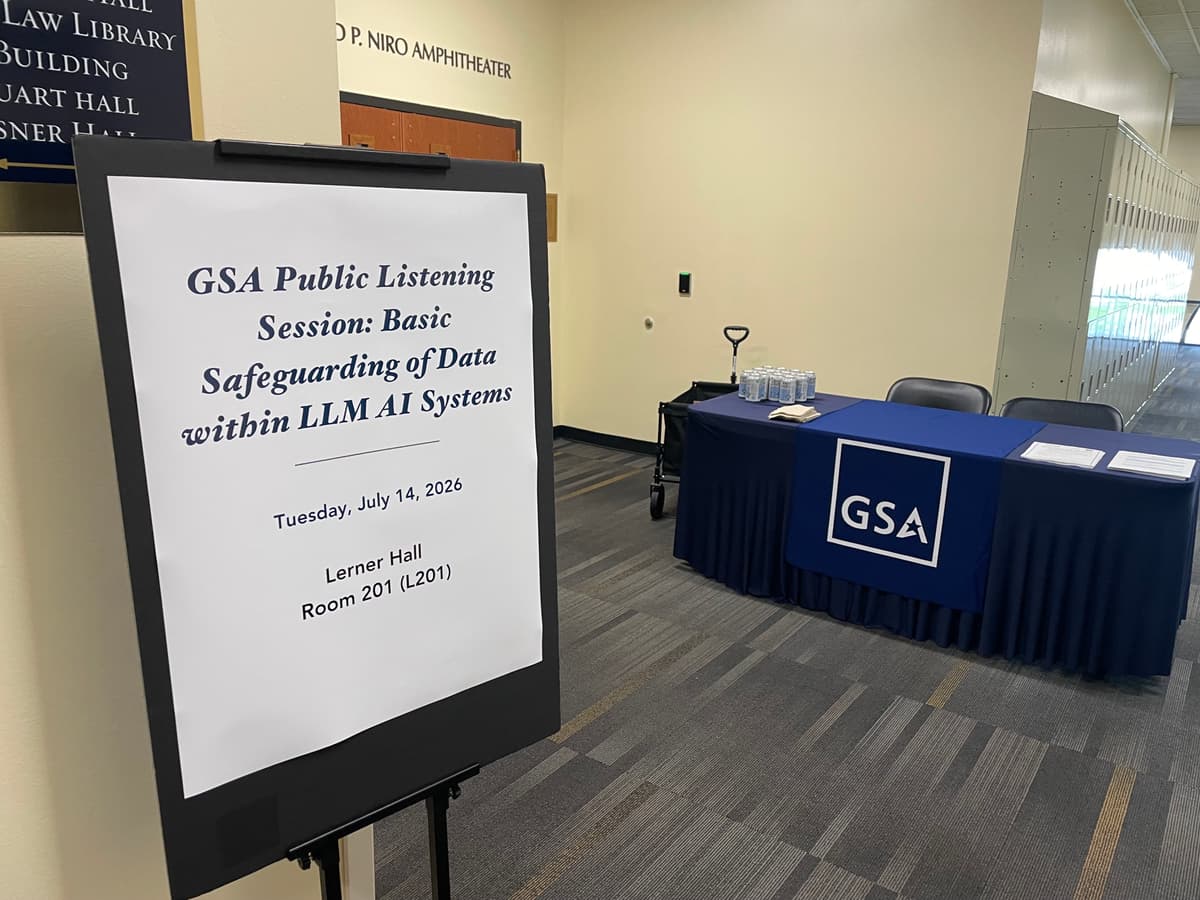
The General Services Administration's proposed regulation for acquiring artificial intelligence systems faces significant resistance from contractors and legal experts who say the rule's requirements may be incompatible with how commercial AI companies operate.
At a listening session held Tuesday at George Washington University, stakeholders raised concerns that could reshape how federal agencies procure AI capabilities. The proposed clause, originally published in January and revised in June following initial feedback, remains open for public comment through August 3.
Commercial practice conflicts
Menaka Kalaskar, who leads Palantir's U.S. government legal and contracting team, warned that major language model developers may reject GSA's contract terms entirely. The rule requires vendors to provide notice of "material changes" within seven or 30 days depending on the type of change—a timeline Kalaskar called "unworkable" for Software-as-a-Service providers.
"GSA seems to be taking a lot of risk with this initiative, and it's not obvious why," Kalaskar said. She argued the terms contradict customary commercial practice and conflict with the Federal Acquisition Streamlining Act's commercial mandates. If major AI vendors refuse these terms, agencies seeking cutting-edge language models would need to bypass GSA vehicles entirely.
Data protection gaps remain
Jessica Tillipman, associate dean for Government Procurement Law Studies at George Washington University, acknowledged GSA's prohibition on vendors training AI systems using government data but identified enforcement challenges. The rule doesn't clearly protect against vendors learning from agency usage patterns—insights about how agencies work, their priorities, and future needs.
"A contractor may also learn from an agency's patterns of use," Tillipman explained. "That is an informational advantage." She recommended GSA define protected data by asking whether information is tied to government use, reveals operational details, or could be inferred through aggregation.
Other concerns centered on vague language requiring "unbiased AI principles"—a term stakeholders said lacks clear definition—and provisions giving government ownership of metadata that companies consider proprietary.
Open model access questioned
Shane Shaneman, an AI strategist for Nvidia, suggested shifting data handling responsibilities from AI developers to system integrators or operators. This approach would enable open-source models to participate in government contracts while maintaining data protections.
"The future of AI isn't one model; it's many," Shaneman said, pointing to emerging use of AI agents that coordinate multiple models.
Laura Stanton, GSA's acting Federal Acquisition Service commissioner, defended the agency's approach as necessary to protect public data while enabling rapid AI adoption. "We must protect the people's data, and we must ensure that agencies can adopt AI quickly and with confidence," she said.
Why it matters
If GSA cannot reconcile its acquisition terms with commercial AI practices, federal agencies may fragment their AI procurement across non-GSA channels. This would undermine GSA's role as a centralized acquisition vehicle and potentially leave agencies negotiating individually with vendors—the exact inefficiency acquisition reforms aimed to eliminate. The outcome will determine whether the government can access frontier AI capabilities through its preferred procurement mechanisms.
These details were first reported by FedScoop.
This is an original analysis by the Omega editorial team. Source reporting: AI Watch.
Want systems like this working for your business?
Book a Call
