Grindr CEO: AI Replaced Need for 200 Engineers, $60M in Costs
George Arison says the dating app's engineering output jumped 3.5x with minimal staff growth, crediting generative AI tools.
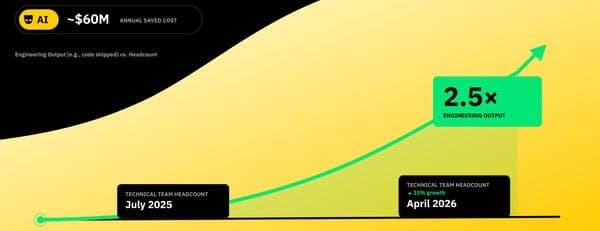
Grindr quantifies AI's engineering impact
Grindr CEO George Arison has put specific numbers to a question many technology leaders are asking: how much engineering work can AI actually replace? In a letter to shareholders and on the company's second-quarter earnings call, Arison stated that the dating app's engineering output increased by 3.5 times between July 2025 and April 2026, despite minimal growth in its engineering headcount.
The productivity jump would have required approximately 200 additional engineers and $60 million in annual costs to achieve through traditional hiring, Arison wrote. The company initially reported a more conservative 2.5x multiplier in its shareholder letter because the actual 3.5x figure "sounded unreasonable," according to the CEO.
Grindr measured this output increase by the volume of code shipped—a metric that has drawn criticism in the software development community for prioritizing quantity over quality. Marco Argenti, Goldman Sachs' chief information officer, told Business Insider in May that measuring lines of code was "not really a great way to do it."
Why it matters
Arison is among the first CEOs to attach concrete workforce numbers to AI productivity claims. While his remarks focused on avoiding new hires rather than cutting existing jobs, the implication is clear: companies may increasingly view AI as a substitute for expanding engineering teams. For technology leaders evaluating AI investments, Grindr's experience offers a rare data point—though one that should be weighed against the limitations of code volume as a productivity measure.
Token spending and ROI focus
Grindr expects to spend $6 million on AI tokens this year, Arison told CNBC. When questioned about token costs on the earnings call, the CEO emphasized that the company encourages engineers to use available AI tools without worrying about expenses, provided the return on investment justifies the spending.
Some organizations have attempted to measure productivity through AI token consumption, which can lead to "tokenmaxxing"—optimizing for token usage rather than meaningful outcomes.
Talent scarcity argument
Arison framed AI adoption not just as a cost-saving measure but as a response to what he called the industry's perpetual constraint: "scarcity of exceptional engineering talent." The technology allows Grindr to keep its strongest engineers focused on areas requiring human creativity and judgment, he argued.
The CEO shared that when he outlined his vision for Grindr to a mentor, he estimated needing 250-300 engineers. His mentor responded that requiring that many engineers represented "the old world," suggesting AI coding could handle much of the work instead.
Workforce implications
Engineers have reason to monitor these developments closely. AI code editors are advancing rapidly, and several companies—including Block and Atlassian—have explicitly cited AI capabilities in recent layoff announcements. Despite widespread concern, job openings for software engineering roles actually increased this year, according to the report.
Arison's comments notably avoided discussing job cuts, focusing instead on not creating positions that would have been necessary in the pre-AI era. Still, statements quantifying how many engineers AI can replace may heighten anxiety among technology workers about future downsizing justified by "do more with less" efficiency arguments.
These details were first reported by Business Insider.
This is an original analysis by the Omega editorial team. Source reporting: AI Watch.
Want systems like this working for your business?
Book a Call