Google Maps 15 Million AI Interactions Across 150 Countries
New ATLAS research reveals how workers use conversational AI for collaboration rather than automation, with surprising adoption patterns in manual trades.
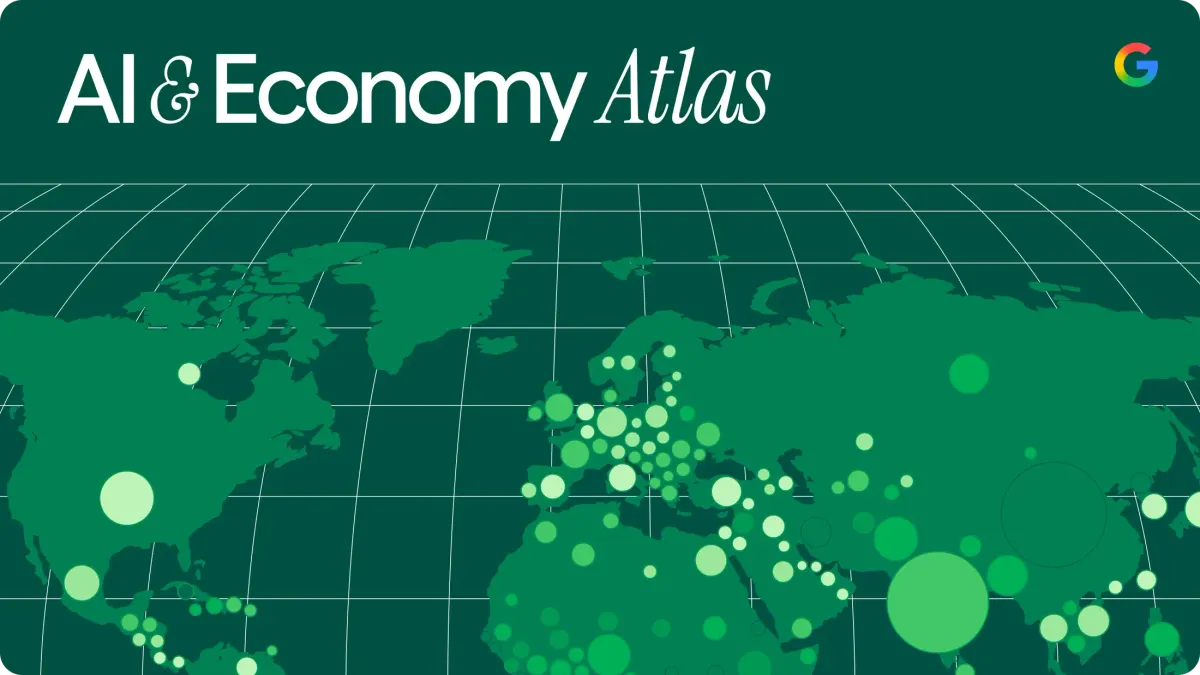
Google has released findings from ATLAS (Activity, Task, Landscape, and Adoption Study), a large-scale analysis of how people actually use AI tools in their work and daily lives. The research draws from 15 million aggregated and de-identified interactions across Gemini App, AI Mode, and the Gemini API—products collectively used by more than 1 billion people monthly.
The dataset spans more than 150 countries, 140 languages, 800 occupations, and 4,000 tasks, making it the most comprehensive empirical look at real-world AI usage to date, according to Google.
Why it matters
As businesses and policymakers navigate AI's economic impact, most discussions rely on speculation rather than evidence. ATLAS provides concrete data showing that AI adoption is widespread but selective—workers are using these tools as collaborators for specific tasks rather than wholesale job replacements. This distinction matters for workforce planning, training investments, and regulatory approaches.
Broad adoption, selective use
The research reveals a striking pattern: AI use at work spans all industry sectors and 68% of all occupations representing 90% of total U.S. employment. However, within individual jobs, workers use AI for only approximately 21% of their tasks.
Most workplace AI interactions focus on collaboration rather than automation. The data shows workers primarily use AI for ideation, strategy development, information retrieval, and learning. Tasks categorized as "non-routine cognitive"—including creative design and hypothesis testing—appear in AI work interactions at nearly double their prevalence in the broader economy (65% versus 35%). Fewer than 10% of interactions fully automate tasks.
Beyond knowledge work
AI adoption extends beyond traditional white-collar roles. Workers in manual and technical trades, including automotive technicians and industrial mechanics, use conversational AI for real-time diagnostics, troubleshooting, and on-the-fly learning. These workers are twice as likely to use multimodal AI capabilities—such as image or video generation—compared to other occupations. Applications include interpreting complex test results, debugging electrical wiring, and inspecting machinery.
Home use dominates
Over 86% of AI interactions in the ATLAS dataset occur outside work settings. People use these tools for productive household activities like researching purchases and navigating appliances, as well as high-friction administrative tasks such as taxes, licensing, and government services—use cases not captured in standard economic metrics.
Global patterns and gaps
AI usage appears in more than 150 countries representing 99% of the world's population. English accounts for only about one-third of global AI conversations, and users do not systematically switch to English for complex tasks. Per-capita AI usage generally tracks GDP per capita, though some middle-income countries in South America and the Middle East show adoption rates comparable to wealthier nations.
The ATLAS methodology uses Google DeepMind's Observation Clustering and Taxonomy Organisation (OCTO) tool to analyze unstructured conversation data while maintaining privacy protections, including removal of personally identifiable information and aggregation across multiple users.
Google notes that ATLAS v1.0 represents the initial phase of ongoing research and does not capture AI usage in other Google products like Workspace, Translate, or enterprise platforms. The research was first reported by Google and developed with contributions from Dame Diane Coyle of Cambridge and Dr. David Autor of MIT.
This is an original analysis by the Omega editorial team. Source reporting: AI Watch.
Want systems like this working for your business?
Book a Call