Google Launches First State-Backed Trial to Reduce Contrails
Operation Blue Skies will test AI-powered flight routing across North Atlantic airspace to cut aviation's climate impact by one-third.
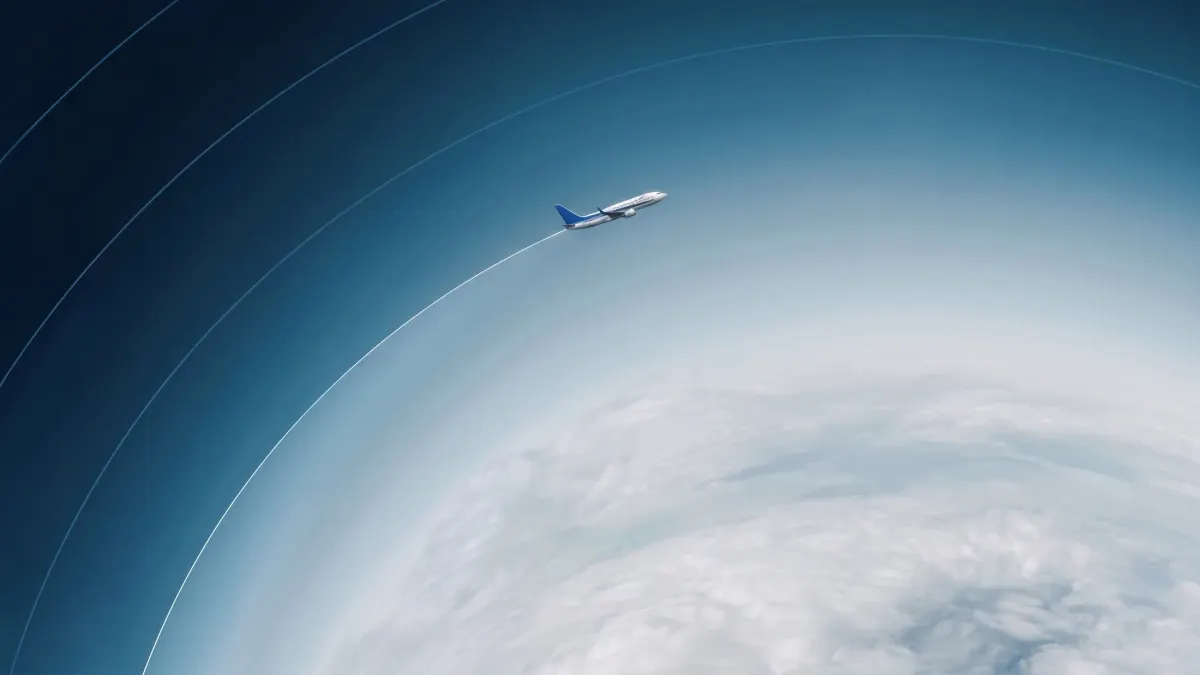
Google is launching the world's first government-backed trial to reduce aircraft contrails at the scale of an entire oceanic airspace. The 30-month initiative, called Operation Blue Skies, will use AI-powered forecasting to route flights around contrail-forming conditions in the eastern North Atlantic.
Contrails—the white streaks trailing behind aircraft—form when water vapor condenses around soot particles in jet exhaust. These artificial clouds trap heat in the atmosphere and account for roughly one-third of aviation's total climate impact, according to details first reported by Google Research.
Testing at unprecedented scale
The trial will operate in Shanwick airspace, which covers the eastern half of the North Atlantic corridor and represents approximately 5% of global contrail warming. Over two four-month operational periods, around 10,000 flights annually passing through the region will be eligible for slight route adjustments during trial hours. Only flights that would otherwise pass through contrail-sensitive airspace will be diverted, preventing the formation of strongly warming contrails.
Google has been developing AI models that predict where and when contrails will form and cause the most warming. The company previously partnered with individual airlines including American Airlines, air navigation providers like EUROCONTROL's MUAC, and flight planning software companies to validate the approach. Those trials demonstrated that avoiding warming contrails is both scientifically sound and operationally feasible within normal flight operations.
A UK consortium approach
Operation Blue Skies brings together a consortium of UK partners, each contributing specialized expertise. NATS, the UK's primary air navigation service provider, will manage trial operations, air traffic control coordination, and safety assessment. The nonprofit Contrails.org will lead forecast assessments and trial design. Imperial College London and the University of Cambridge will provide independent verification of climate impact. The Met Office will develop new UK contrail forecasting capabilities.
The program is co-funded by industry partners and the UK Department for Transport through the ATI Programme. All government grant funding flows directly to academic, nonprofit, and aviation partners. Google UK is participating pro bono, contributing £1.4 million in-kind through AI research, engineering resources, and computing infrastructure.
Why it matters
Research indicates that contrail avoidance could be one of the most cost-effective methods to reduce aviation's climate footprint. Unlike engine redesigns or alternative fuels that require decades of development, contrail mitigation can be implemented with existing aircraft through relatively minor route adjustments. If Operation Blue Skies proves operationally practical at airspace scale, it could provide a validated model for global adoption—offering the aviation industry a near-term tool to significantly cut its climate impact while longer-term decarbonization technologies mature.
Google is inviting aviation industry participants interested in contrail mitigation to contact the team about collaboration opportunities. The company first detailed the initiative on the Google Research blog.
This is an original analysis by the Omega editorial team. Source reporting: AI Watch.
Want systems like this working for your business?
Book a Call