Google Launches AI Edge Gallery for Mac with Gemma 4 12B Model
The new platform enables Mac users to run Google's AI models locally, including a powerful 12-billion-parameter model designed for consumer laptops.
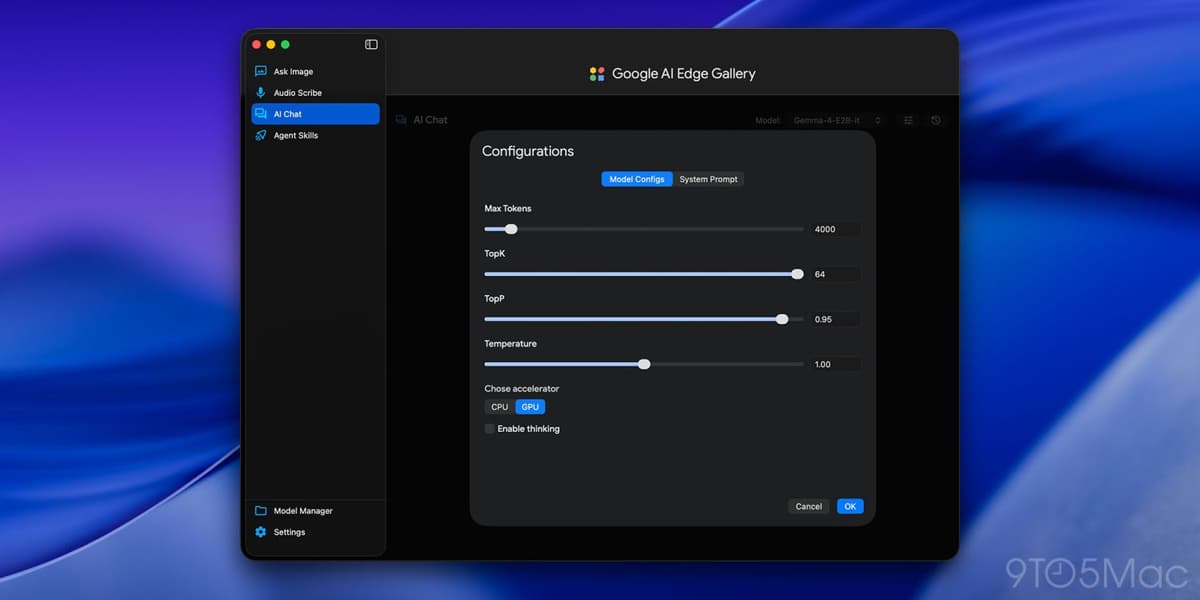
Google has expanded its AI Edge Gallery platform to macOS, enabling Mac users to run Gemini models directly on their devices without cloud connectivity. The release includes the new Gemma 4 12B model and a dictation application that processes speech locally.
Why it matters
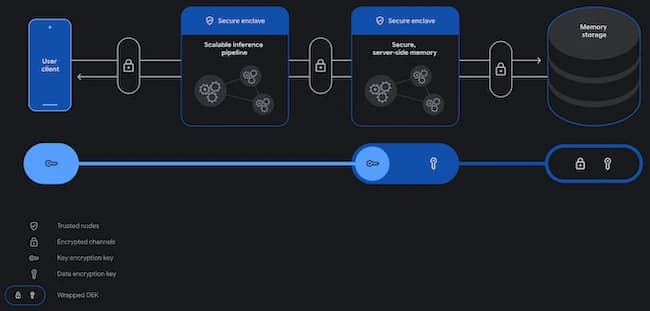
Local AI execution addresses growing privacy concerns while eliminating internet dependency for AI tasks. For enterprise users, on-device processing means sensitive data never leaves the machine—a critical consideration for regulated industries and organizations handling confidential information.
What Google AI Edge Gallery offers
Unlike platforms such as Ollama and LM Studio that support thousands of open-source models, Google AI Edge Gallery for Mac currently provides access to five proprietary Google models. All are instruction-tuned variants designed to follow user commands rather than simply complete text.
The lineup includes Gemma-4-12B-it, Gemma-4-E2B-it, Gemma-4-E4B-it, Gemma-3n-E2B-it, and Gemma-3n-E4B-it. The platform already existed for Android and iOS before today's macOS launch, according to details first reported by 9to5Mac.
Gemma 4 12B specifications
The flagship Gemma 4 12B model represents a significant advancement in local AI capabilities. Google designed the 12-billion-parameter model to deliver performance comparable to its 26-billion-parameter mixture-of-experts architecture while remaining compact enough to run on consumer laptops with 16GB of RAM.
The model supports multimodal inputs including text, vision, and audio. Google emphasizes its coding capabilities, positioning it as a tool for extracting insights from data directly on user devices. This contrasts with cloud-based models like ChatGPT, Claude, or Gemini that require server connectivity and typically operate at trillion-parameter scale.
Local versus cloud tradeoffs
Local models sacrifice some capability compared to their cloud-based counterparts but offer distinct advantages. They function without internet connections, leverage the computer's own processing power, and maintain complete privacy since conversation data remains on-device. Performance scales with hardware quality—more powerful machines deliver faster responses and can handle larger models.
Google AI Edge Eloquent
Google simultaneously launched AI Edge Eloquent for Mac, a dictation application that transcribes speech while refining the output. The app removes disfluencies and applies light edits for clarity, all processed on-device rather than in the cloud.
Users can select writing styles and add custom vocabulary including names, jargon, and specialized terms to improve accuracy with domain-specific language. The iOS version launched several months prior.
9to5Mac reported these releases, which mark Google's continued investment in edge AI capabilities for consumer hardware.
This is an original analysis by the Omega editorial team. Source reporting: AI Watch.
Want systems like this working for your business?
Book a Call