Google DeepMind Partners with EVE Online for AI Research
The tech giant will use the 20-year-old space MMO's persistent universe to develop agents capable of continual learning and long-term planning.
Google DeepMind has formed a major research partnership with Fenris Creations, the studio behind EVE Online, to advance AI capabilities in persistent game worlds. The collaboration represents a strategic shift from building systems that master games to creating agents that can learn, adapt, and operate across timescales spanning months or years.
From mastery to understanding
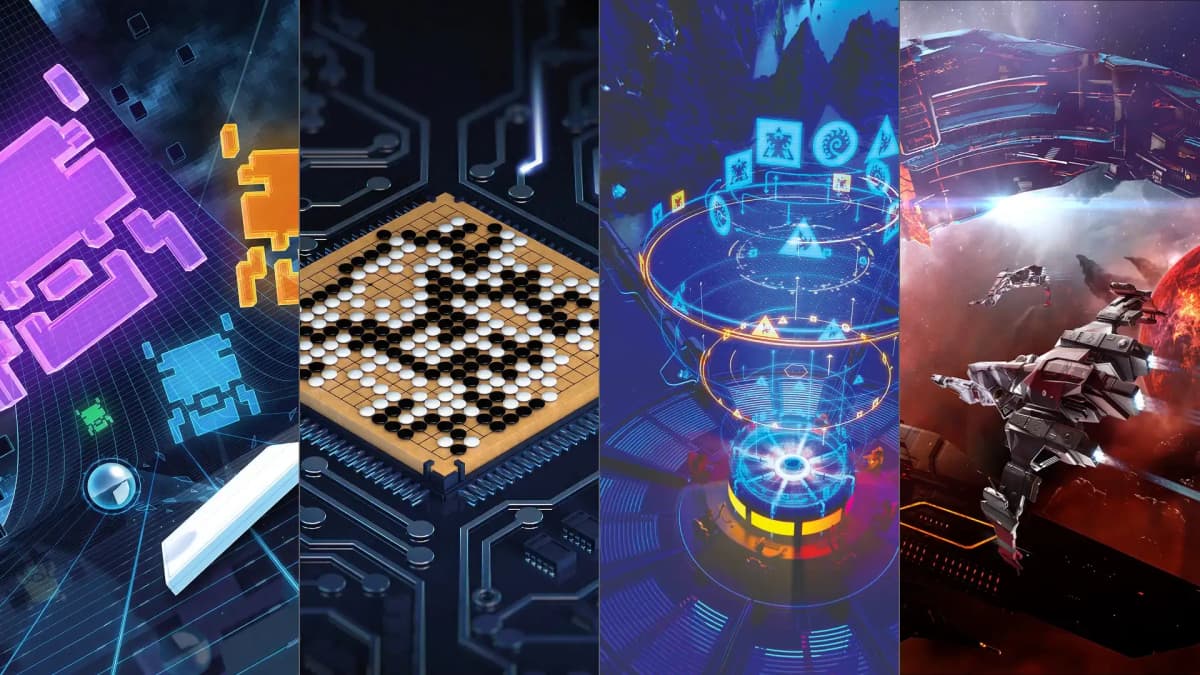
DeepMind's gaming research began with Deep Q-Network learning Atari games from raw pixels in 2015, progressed through AlphaGo's 2016 defeat of world champion Lee Sedol, and reached StarCraft II Grandmaster level with AlphaStar in 2019. Each milestone produced increasingly general systems, with techniques that eventually contributed to AlphaFold's protein structure prediction breakthrough.
The company's current focus centers on SIMA (Scalable Instructable Multiworld Agent), powered by Gemini models. Unlike earlier systems optimized for high scores, SIMA operates through standard keyboard and mouse controls, processes natural language instructions, and requires no access to game source code. The agent achieves human-level performance across multiple 3D games including No Man's Sky and Valheim.
Why EVE Online matters for AI research
EVE Online presents unique challenges that align with frontier AI research priorities. Launched in 2003, the space simulation hosts thousands of players in a single persistent universe with a functioning economy spanning thousands of star systems. Player actions have permanent consequences, and the world has evolved continuously for over two decades.
According to details first reported by Google DeepMind, the environment demands four capabilities critical for advanced AI systems: continual learning without forgetting previous knowledge, memory systems extending beyond current model context windows, planning across weeks or months rather than seconds, and navigation of complex multi-agent dynamics including cooperation, competition, and emergent social behavior.
The research program will begin in an offline instance of EVE Online, separate from live players. It will then progress to EVE Frontier, which features programmable game mechanics that can change the rules themselves. Only mature capabilities would potentially reach EVE Online's live environment or the first-person EVE Vanguard.
Why it matters
Persistent game worlds like EVE Online offer controlled environments to study AI challenges that mirror real-world complexity—economic systems, long-term planning, and multi-agent coordination—at scales impossible to replicate in laboratory settings. Success could inform AI systems designed for supply chain management, climate modeling, or any domain requiring adaptation over extended timeframes.
Immediate applications
The partnership has already produced player-facing results. The Aura Guidance system uses Gemini to deliver player-generated knowledge to new pilots, drawing from actual community questions and answers in the game's Rookie Help channels.
Fenris Creations joins a roster of studios collaborating with DeepMind, including Hello Games, Coffee Stain Studios, and Foulball Hangover. Demis Hassabis, DeepMind's co-founder and a former game developer, emphasized that the goal remains "AI as a catalyst, not a replacement" for human creativity.
These details were announced by Google DeepMind in a blog post outlining the company's 15-year history of AI research in gaming environments.
This is an original analysis by the Omega editorial team. Source reporting: AI Watch.
Want systems like this working for your business?
Book a Call