Goldman Sachs Projects 6.5M Humanoid Robots by 2035
New forecast signals shift from industrial automation to physical AI as Amazon, Tesla, and NVIDIA pursue different layers of the robotics stack.
Goldman Sachs has sharply revised its robotics forecast upward, now projecting approximately 6.5 million humanoid robots could be shipped by 2035—a dramatic increase from the firm's earlier estimates. The investment bank sees this creating a $138 billion market opportunity, with logistics, warehousing, and automotive sectors expected to lead adoption, according to a September 2026 report highlighted by Yahoo Finance.
The projection represents a fundamental shift in how analysts view the robotics market. Goldman expects shipments to climb from roughly 75,000 units in 2026 to 890,000 by 2030, then accelerate to 6.5 million by 2035. This trajectory reflects more than incremental growth in industrial automation—it signals the emergence of what technologists call physical AI: systems that perceive their environment, process information, make decisions, and take physical action in the real world.
Why it matters
The robotics opportunity is fragmenting across multiple technology layers rather than consolidating around a single product category. Companies can participate by manufacturing robots, supplying semiconductors and computing infrastructure, developing AI software, or deploying automation at scale. This creates distinct investment theses that don't depend on humanoid robots specifically succeeding—warehouse automation, specialized industrial robots, and the computing systems that power them all represent separate addressable markets. For business leaders, the shift toward physical AI means automation economics are changing: robots may soon handle variable tasks in unstructured environments rather than just repetitive work in controlled settings.
Different approaches to the same opportunity
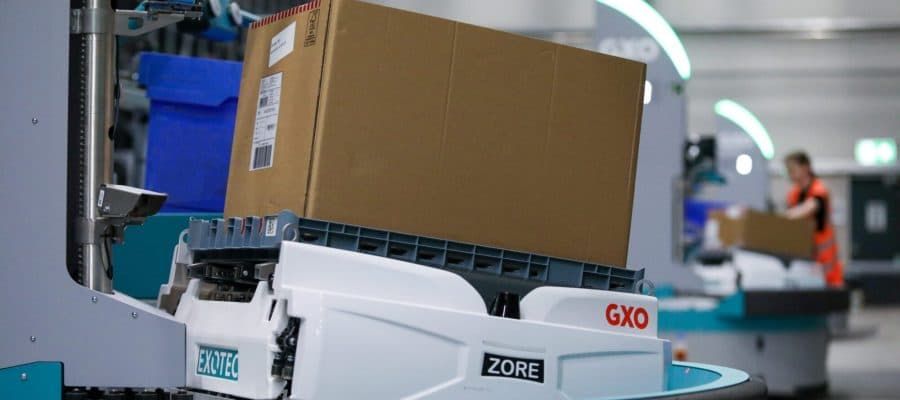
Amazon illustrates how robotics already operates at commercial scale without humanoid form factors. The company has deployed more than 1 million robots across its fulfillment network since acquiring Kiva Systems in 2012. Its current systems include mobile robots and robotic arms designed for specific warehouse tasks—transporting inventory, sorting packages, and assisting workers with physically demanding work. Amazon's Sequoia system combines robotics, AI, and computer vision to organize inventory and deliver products to ergonomically positioned workstations.
In April 2026, Amazon Web Services announced a collaboration with NEURA Robotics focused on physical AI, exploring opportunities to deploy NEURA's technologies in selected fulfillment operations. This suggests Amazon sees robotics expertise as both an operational advantage and a potential service offering.
Tesla takes a different approach with its Optimus humanoid robot, designed for general-purpose tasks rather than specialized industrial functions. At the 2026 Conference on Computer Vision and Pattern Recognition, Tesla presented research on foundation models for robotics, including systems that control robots from visual inputs through physical actions. The company's bet is that humanoid designs offer flexibility—robots built for human environments could perform multiple tasks without requiring workplace redesigns around specialized machinery.
NVIDIA occupies the infrastructure layer, supplying computing hardware, software, and development platforms rather than building physical robots. Its Isaac robotics platform includes simulation tools, AI models, and computing systems for applications ranging from robotic arms to humanoid machines. The Isaac GR00T platform specifically targets humanoid robot development, combining foundation models, data pipelines, simulation frameworks, and computing technology.
Simulation proves particularly important because training physical machines entirely in real-world settings is expensive, slow, and potentially dangerous. As robot deployments increase, demand extends beyond the machines themselves to the chips, computing systems, software, and simulation tools needed to train and operate them.
From repetitive tasks to adaptive systems
Traditional industrial robots perform specific, repetitive tasks in controlled environments—a robotic arm welding the same component repeatedly, for example. Physical AI aims to make machines more adaptable, using AI models to help robots interpret visual information, understand instructions, navigate unfamiliar environments, and adjust behavior based on changing conditions.
If this approach succeeds, robots could deploy across warehouses, factories, healthcare facilities, agriculture, construction, and other settings where repetitive, physically demanding, or hazardous work occurs. Goldman's 6.5 million unit projection, therefore, represents less a forecast about humanoid robots specifically than an indication of how AI could increasingly move into the physical economy.
The details were first reported by Streetwise Reports, drawing on Goldman Sachs research and company disclosures.
This is an original analysis by the Omega editorial team. Source reporting: Automation Watch.
Want systems like this working for your business?
Book a Call