Global Test Scores Drop to Record Lows as AI Use Surges
Latest PISA results reveal worldwide learning declines while more than half of students now use chatbots for schoolwork.
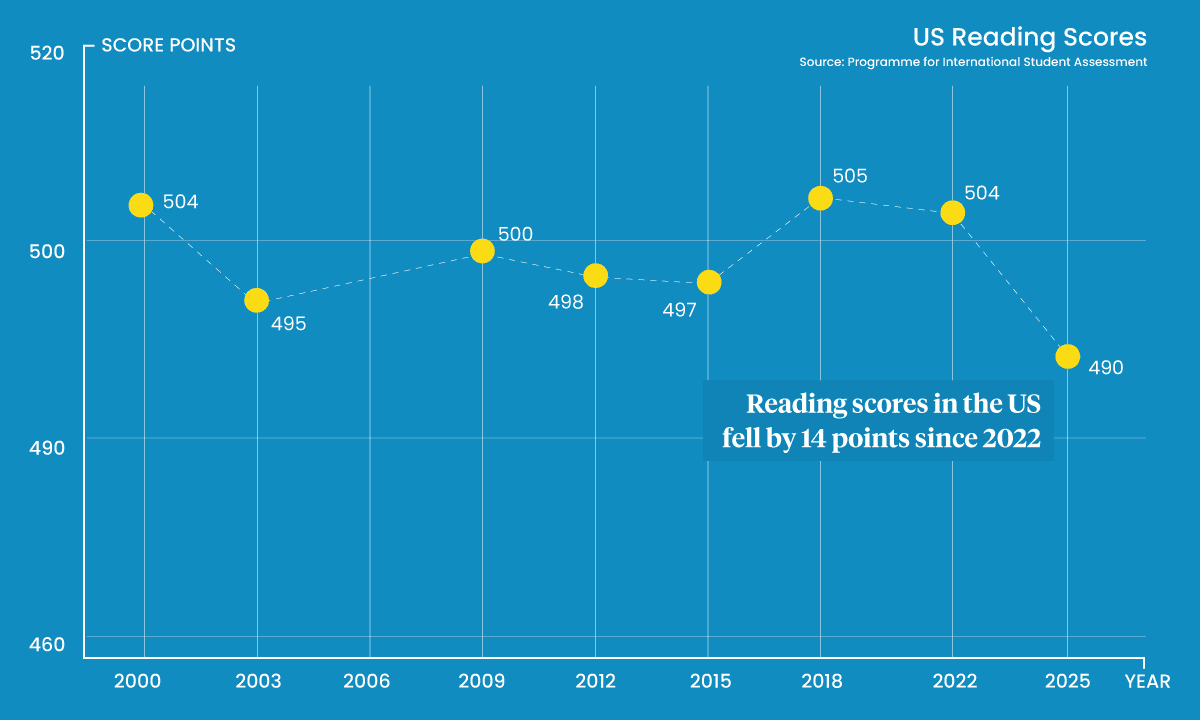
Record-Low Achievement Across Core Subjects
The 2025 Programme for International Student Assessment (PISA) results released Tuesday reveal the worst global test scores since the exam's inception in 2000. Average performance in both math and reading has reached unprecedented lows across participating countries, marking a continued decline that stretches back more than a decade.
U.S. students saw reading scores drop 14 points since 2022 and math scores fall 15 points below 2018 levels. Science performance remained essentially flat. Despite these declines, America maintained its relative standing among the 82 participating jurisdictions because most other countries experienced similar or steeper drops.
Only a handful of education systems bucked the trend, including Singapore, Taiwan, Japan, England, and Estonia. The widespread nature of the decline suggests common global forces at work rather than isolated national failures.
Why it matters
The collision of declining academic achievement with rapid AI adoption creates an urgent policy challenge for education leaders worldwide. As economies demand higher-level skills, students are simultaneously falling behind in foundational competencies while potentially using AI tools in ways that may further erode learning. Organizations must consider how workforce development strategies will address cohorts with weaker baseline skills and different technology dependencies than previous generations.
AI Chatbot Use Now Mainstream Among Students
Accompanying survey data revealed that AI tools have achieved rapid penetration in classrooms globally. More than half of all students reported using chatbots like ChatGPT at least several times monthly for research, drafting papers, or summarizing required texts. Fewer than 30% of students in most countries said they rarely or never used AI for schoolwork, with Japan the sole exception at 39%.
Separate polling from the Thomas B. Fordham Institute found 48% of U.S. high school students regularly use AI to solve math problems, while over one-third employ it to avoid reading assigned texts.
Widening Inequality in U.S. Performance
While America's overall decline appears moderate compared to global trends, the country stands out for extreme inequality in outcomes. The gap between students at the 10th and 90th percentiles in reading grew by 50 points since 2015. The science score disparity now exceeds 290 points on a 1,000-point scale—greater than any other country except Luxembourg.
"Knowledge is not a zero-sum game; we should want every child, everywhere, to achieve their full cognitive and academic potential, and that's clearly not happening," said Michael Petrilli, president of the Fordham Institute.
Concerns About Learning Dependency
Education researchers worry that routine AI use may prevent students from developing essential skills. Dan Goldhaber, an education professor at the University of Washington, expressed concern that automation of basic academic tasks could create "a huge gap in knowledge for whole cohorts of students."
Vicki Phillips, head of the National Center on Education and the Economy, noted the troubling timing: "At exactly the moment our economies and societies are asking more of young people, too many education systems are struggling to build the knowledge and capabilities they will need."
These findings were first reported by The 74.
This is an original analysis by the Omega editorial team. Source reporting: AI Watch.
Want systems like this working for your business?
Book a Call