GenAI Productivity Claims Lose Ground as Task-Specific Wins Rise
New survey data shows broad workflow efficiency benefits dropped 6 points while documentation, automation, and code generation gains accelerated.
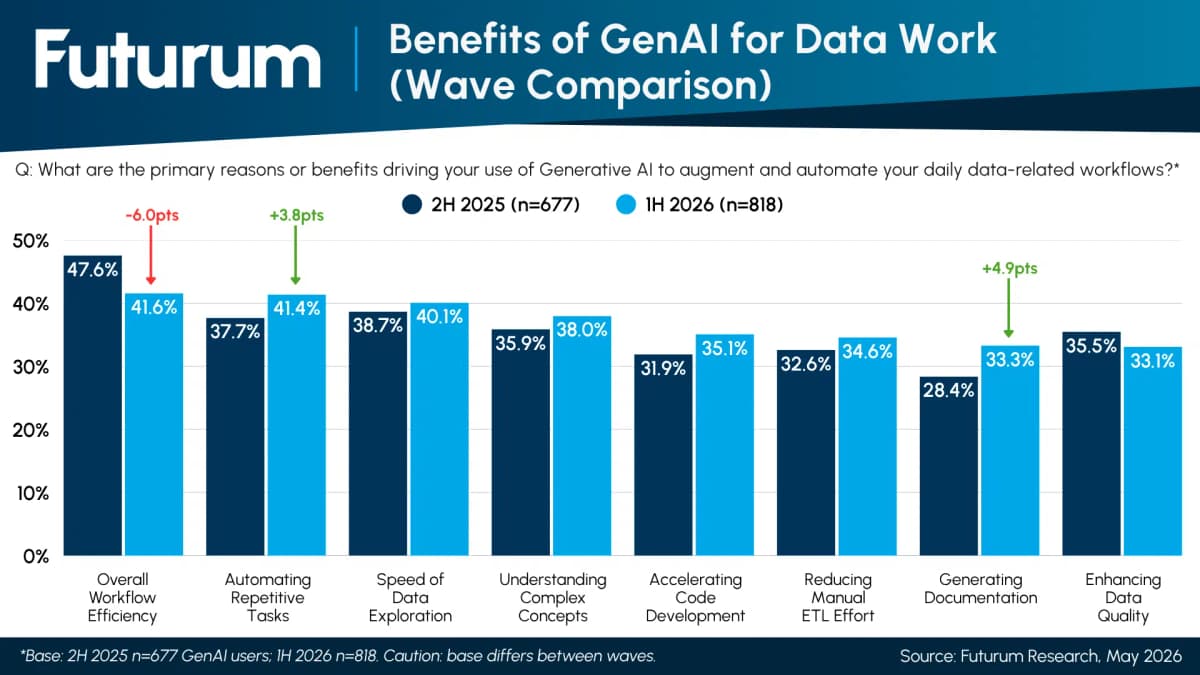
The market for generative AI is shifting from sweeping productivity promises to measurable, task-specific value propositions, according to new survey data that tracks how enterprise users perceive GenAI benefits over time.
The Futurum Group's 1H 2026 Data Intelligence, Analytics, and Infrastructure Decision Makers Survey found that perceived benefits from overall workflow efficiency dropped 6.0 percentage points between late 2025 and early 2026, even as concrete use cases showed consistent growth. The survey polled 677 GenAI users in the second half of 2025 and 818 in the first half of 2026.
Documentation and automation lead specific gains
While vague productivity claims lost credibility, three categories posted significant increases. Documentation generation rose 4.9 percentage points, marking the largest gain in the benefit set. Task automation climbed 3.8 points, and code acceleration increased 3.2 points.
These gains cluster around a common characteristic: outputs that can be verified and workflows with clear boundaries. Auto-generated technical documentation either meets specifications or it doesn't. Automated tasks either complete successfully or fail. Code either compiles and passes tests or requires revision.
Aspirational benefits fade under scrutiny
Benefits framed in broad or indirect terms showed consistent decline. Data quality enhancement fell 2.3 percentage points, while strategic time liberation slipped 0.5 points. The pattern suggests that after initial deployment, organizations are reassessing which GenAI promises deliver tangible returns.
"The market has moved past the hype peak for GenAI as a universal productivity tool," said Brad Shimmin, VP and Practice Lead for Data Intelligence, Analytics, and Infrastructure at The Futurum Group. "What is growing is what can be measured: documentation, automation, code. What is shrinking is what is vague: overall efficiency, free time, creative liberation."
Why it matters
This data signals a maturation point for enterprise GenAI adoption. Organizations that deployed tools based on broad productivity narratives now have operational experience to separate measurable wins from aspirational claims. Vendors still positioning GenAI as a universal efficiency solution may find buyers increasingly skeptical. The winning approach focuses on specific, verifiable use cases where output quality can be assessed and ROI calculated. For technology leaders evaluating GenAI investments, the message is clear: prioritize implementations with concrete success metrics over those promising diffuse productivity gains.
The findings were first reported by The Futurum Group in their 1H 2026 Data Intelligence, Analytics, and Infrastructure Decision Makers Survey Report, available on the Futurum Intelligence Platform.
This is an original analysis by the Omega editorial team. Source reporting: Automation Watch.
Want systems like this working for your business?
Book a Call