Four Types of Companies Building the AI Military Complex
From legacy defense contractors to frontier AI labs, a new ecosystem is reshaping how wars are fought through software and screens.
Four Types of Companies Building the AI Military Complex
Warfare is shifting from boots on the ground to battles fought through screens. While tanks and artillery remain essential, software now sits at the center of military operations—and a new industrial ecosystem has emerged to supply it.
Global military spending reached $2.88 trillion in 2025, with governments directing record budgets toward AI-powered defense systems. Recent contracts illustrate the scale: the UK Ministry of Defence committed £2 billion over 15 years to train 60,000 soldiers annually on AI systems, while NATO awarded contracts for its Enhanced Air Command and Control Data Platform to companies deploying AI-driven battlefield software.
Researchers at the Stockholm International Peace Research Institute have mapped this evolving landscape, identifying four distinct categories of companies now competing for military contracts. Al Jazeera reported the framework as part of a series examining AI and warfare.
Defense primes layer AI onto legacy systems
Traditional arms manufacturers—Lockheed Martin, RTX, Northrop Grumman, BAE Systems, and General Dynamics—are integrating AI into decades-old product lines. Lockheed Martin began flight-testing AI tools for F-35 fighter jets in February to accelerate hostile aircraft identification. L3Harris embedded AI directly into camera systems for real-time targeting, while also incorporating Shield AI's Tracker platform for drone detection.
These companies reached all-time stock valuations following the onset of the US-Israel conflict with Iran, reflecting investor confidence in AI-enhanced defense systems.
Software-first defense startups target decision-making
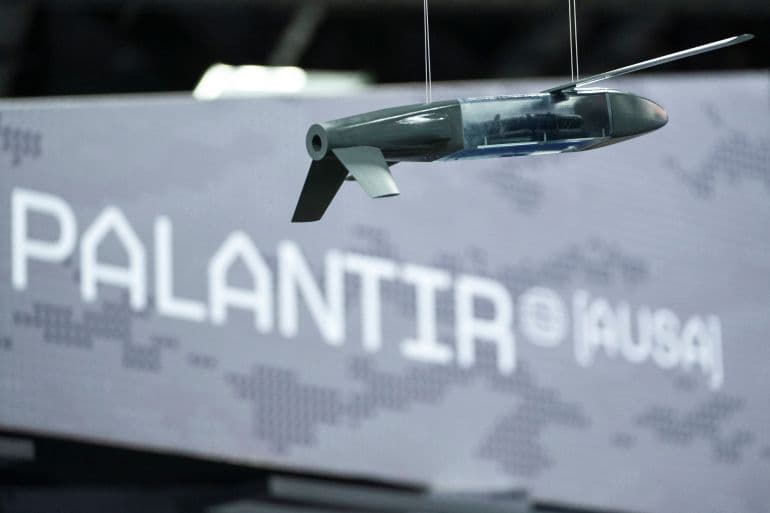
A newer category of companies, sometimes called "neoprimes," builds specialized data products for military, policing, and border applications. Palantir leads this segment through its role in Project Maven, the Pentagon's flagship military AI program designed to accelerate battlefield decision-making by automatically analyzing satellite imagery, drone footage, and signals intelligence.
Maven identified 1,000 targets within 24 hours of the US-Israel conflict with Iran and is deployed in Ukraine. Anduril's competing Lattice platform integrates drones, sensor towers, and autonomous vehicles into unified command networks, with heavy adoption by the US Army.
Big Tech provides the infrastructure layer
Google, Meta, Amazon Web Services, Microsoft, Oracle, NVIDIA, SpaceX, and OpenAI control approximately 67 percent of global cloud infrastructure. In May, the Department of Defense granted these eight companies access to IL6 and IL7 networks—the military's most classified computing environments—as part of a push to become an "AI-first fighting force."
These agreements enable traditional defense contractors to build applications on Big Tech's cloud platforms while maintaining security clearances for sensitive operations.
Foundational model providers supply the AI core
Companies building underlying AI models—OpenAI, Anthropic, and Europe's Mistral AI—form the fourth category. Chinese researchers have developed military AI tools since the early 2020s, including ChatBIT, a People's Liberation Army system built on Meta's Llama model for intelligence gathering and field decision support.
The Pentagon estimates Chinese military AI spending at $1.5 to $2 billion annually, comparable to US figures. This year the Pentagon added Alibaba, Baidu, BYD, NIO, RoboSense, and Unitree to its list of Chinese military companies. Smaller Chinese AI firms with ties to former Baidu, Alibaba, and Tencent employees have built targeting, surveillance, and decision-making tools for military use, according to a 2021 Centre for Security and Emerging Technology report.
Many frontier AI labs initially prohibited military applications. OpenAI removed its military-use ban in 2024, the same year Palantir and Anthropic formed a partnership now complicated by lawsuits over how Claude is being used by the US military.
Why it matters
This four-tier structure reveals how military procurement has fundamentally changed. Governments no longer rely solely on a handful of prime contractors for long-term hardware programs. Instead, they're assembling capabilities across legacy manufacturers, venture-backed startups, cloud infrastructure giants, and AI research labs—creating dependencies on commercial technology companies that operate globally and face fewer export restrictions than traditional arms dealers. The speed of software development cycles, measured in months rather than decades, is compressing decision timelines for both procurement and combat operations.
These details were first reported by Al Jazeera.
This is an original analysis by the Omega editorial team. Source reporting: AI Watch.
Want systems like this working for your business?
Book a Call
