Flock Safety's AI Tool Identifies Drivers, Tracks Movement Patterns
Vehicle surveillance company's OS Investigate system can surface suspects by behavior alone, despite years of claims it cannot track individuals.
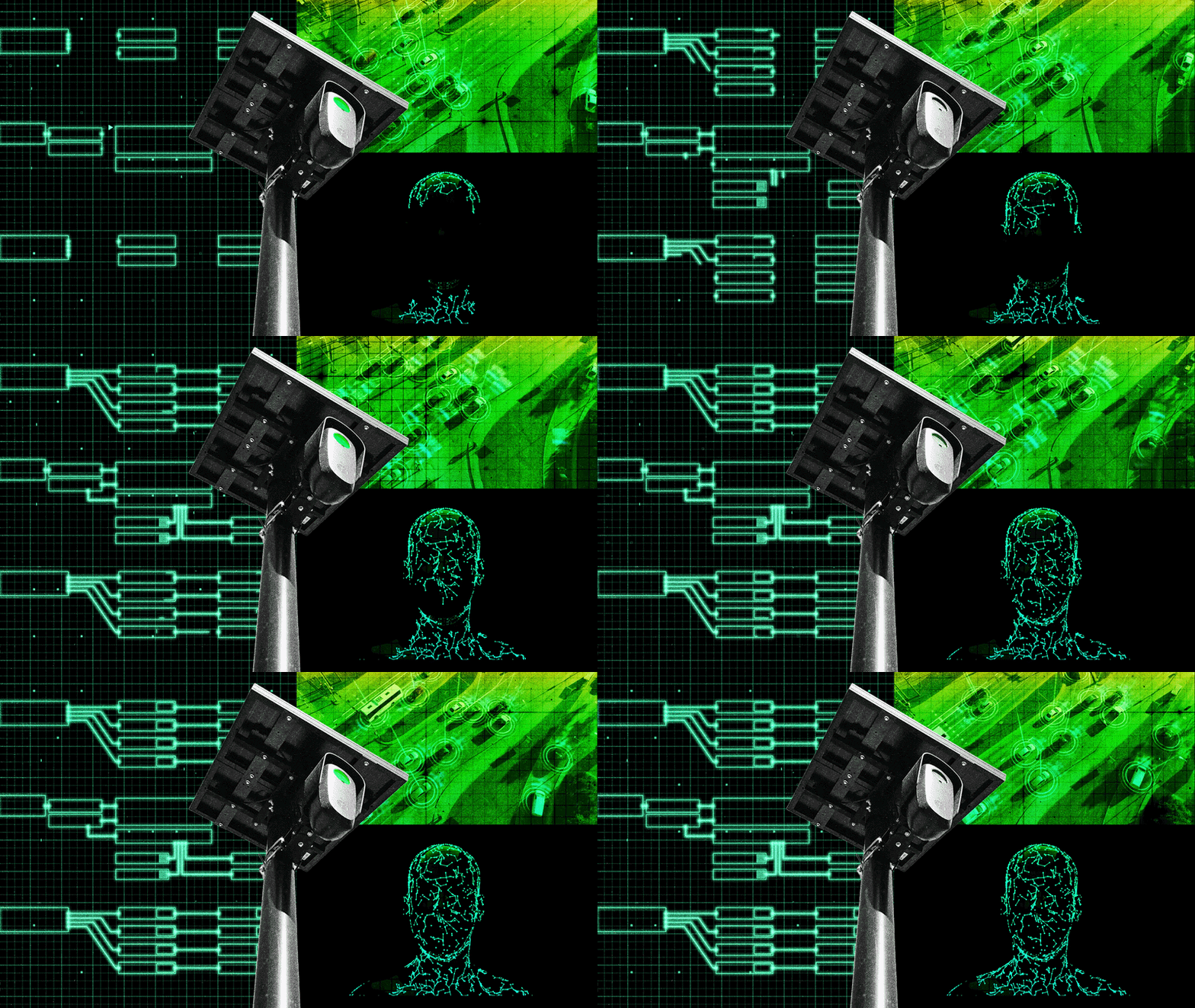
Flock Safety deploys AI system that identifies and tracks drivers
Flock Safety has developed an artificial intelligence tool that can identify drivers and track vehicles based solely on movement patterns, contradicting years of public statements that its technology "cannot recognize, identify, or track individuals," according to WIRED.
The system, called OS Investigate (formerly Nightshift), draws on a network of cameras monitoring more than 6,000 communities. It can identify potential witnesses by how frequently their vehicles pass through neighborhoods, surface a driver's "associates" based on cameras they pass together, and convert license plates into names, home addresses, and relatives by accessing police case files, 911 dispatch logs, and commercial identity databases.
WIRED discovered the software's capabilities by examining more than 450 files found on Flock's own website, served by its login pages. The code revealed 69 prewritten prompts officers can select and submit to the AI, along with 45 tools accessing plate scans, arrest records, ballistics results, and commercial databases containing Social Security numbers, dates of birth, phone numbers, and email addresses.
Why it matters
The tool represents a fundamental shift in how police can conduct surveillance. Officers no longer need a specific vehicle, name, or crime to begin an investigation—they can search based on location, timeframe, and behavioral patterns alone. This capability raises constitutional questions about warrantless access to movement data and could enable fishing expeditions that cast suspicion on drivers who have committed no crime. With Flock valued at $7.5 billion and logging 20 billion plate scans monthly across roughly 140,000 active users, the scale of potential surveillance is unprecedented.
Pattern-based searches without specific targets
Nineteen of the preloaded prompts focus on identifying patterns rather than looking up known records. Fourteen require no plate, name, or description—officers simply provide a location, time window, and behavior.
One prompt reads: "Find me witnesses based on vehicles most seen in [neighborhood] during [last 14 days] during [daily timeframe]." Another instructs the system to list everyone arrested more than twice in two years for any offense, map where they live, retrieve calls for service at their homes, and "do a workup on the top 3 individuals."
Other searches target vehicles visiting multiple retail locations in three days, multiple banks in a week, or multiple gas stations between midnight and 5 am—none requiring a specific incident or suspect.
The system can also identify "associates" by counting how often other plates appear at the same cameras within a two-minute window of a target vehicle, reporting any car that shows up next to it three or more times.
Constitutional concerns and abuse potential
Jay Stanley, senior policy analyst with the ACLU's Speech, Privacy, and Technology Project, said the tool goes far beyond what most people imagine license plate readers do. "We're increasingly seeing the aggressive deployment of AI by Flock. And in some ways, like China, very little space between what can be done and what is being done," he told WIRED.
The system allows searches by physical description alone, querying police records that sort people by sex, race, ethnicity, height, weight, build, scars, marks, and tattoos. Officers can bound these searches by selecting a radius or drawing arbitrary shapes on a map—creating what Stanley describes as sophisticated geofencing capabilities.
Flock has faced mounting scrutiny for camera system abuse. A Washington Post analysis found 50 officers charged with or accused of misusing plate readers, 26 of them to track wives, girlfriends, or women they wanted to meet. A Texas officer searched more than 83,000 cameras while looking for a woman who had a self-administered abortion, according to search logs obtained by 404 Media.
Flock spokesperson Paris Lewbel told WIRED the company is testing OS Investigate with a small group of law enforcement partners and described it as still in development. The company did not dispute the capabilities described in the reporting.
These details were first reported by WIRED.
This is an original analysis by the Omega editorial team. Source reporting: WIRED.
Want systems like this working for your business?
Book a Call
