Federal Court Rules AI-Generated CSAM Protected Speech
A Wisconsin judge's First Amendment decision has child safety advocates warning of investigative challenges and predator loopholes.
Federal ruling creates new enforcement challenges
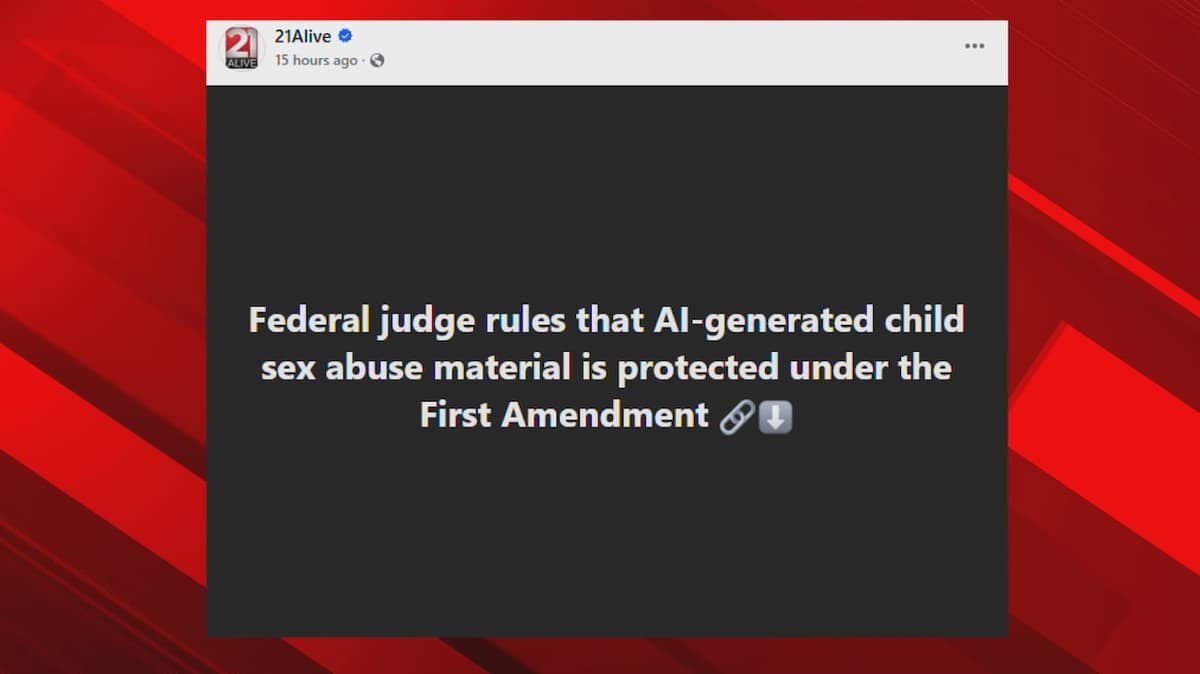
A federal judge in Wisconsin has ruled that AI-generated child sexual abuse material (CSAM) is protected under the First Amendment, a decision that child safety advocates say could fundamentally complicate law enforcement investigations and create dangerous legal loopholes.
The ruling, which dismissed charges in an AI-generated CSAM case, relies on legal precedents established two decades ago — well before generative AI technology existed in its current form.
Why it matters
This decision arrives as photo-realistic AI generation becomes increasingly sophisticated and accessible. Child advocates warn the ruling could force investigators to verify whether explicit images depict real children before pursuing charges, adding investigative burden while potentially allowing offenders to claim AI generation as a defense. The gap between 20-year-old case law and today's technology creates enforcement uncertainty at a critical moment.
Local advocate warns of investigative complications
Trish Fox, a Fort Wayne child advocate who works directly with abuse victims, said the ruling could make her work significantly harder. Law enforcement will now face the challenge of determining whether sexually explicit images of children are AI-generated or real before proceeding with investigations.
"The police look at how do they know? So everything's going to still have to be investigated," Fox told 21Alive News. "And then it's going to be, well, is it AI? If it's AI, it's okay."
Fox expressed particular concern about a scenario the technology now enables: predators taking innocent photos of local children from social media and using AI tools to morph them into sexually explicit images. Under the current ruling, such material could potentially fall under First Amendment protection if no actual child was photographed in a sexual situation.
Advocates see normalization risk
Fox argued that any material depicting child sexual abuse — regardless of how it was created — indicates attraction to children and should remain illegal. She said the ruling sends a message that perpetrators can find ways around existing laws.
"In many ways, we're also giving messages to perpetrators," Fox said. "It's okay, you can get around it."
The federal court indicated it was bound by existing legal precedents that do not address modern AI capabilities. Fox said those precedents fail to account for current technology and its implications for child safety.
Fox said she will be monitoring whether any local northeast Indiana cases are affected by the ruling and called for legal frameworks that reflect today's technological reality rather than standards set before generative AI existed.
These details were first reported by 21Alive News in Fort Wayne.
This is an original analysis by the Omega editorial team. Source reporting: AI Watch.
Want systems like this working for your business?
Book a Call
