Europe Could Halt AI Arms Race by Restricting Chip Equipment
A growing coalition from Bernie Sanders to Bill Gates wants to slow AI development, and the EU controls the one technology that could make it happen.
A Rare Consensus on AI Risk
An unusual alliance is forming around artificial intelligence: Bernie Sanders, Bill Gates, and AI company Anthropic all now publicly support slowing down AI development. Gates recently wrote he would "likely support" any credible plan to slow AI advances globally, while Anthropic called for a "brake pedal" this summer. The Guardian reports these voices join a broader chorus warning that unchecked AI development threatens outcomes ranging from ecological collapse to mass unemployment, surveillance states, and autonomous weapons systems.
Yet international agreements remain unlikely. Like nuclear weapons, AI follows a prisoner's dilemma where each actor races forward fearing others will gain advantage. Industry self-restraint has proven ineffective. Any meaningful pause must come from outside pressure.
The ASML Chokepoint
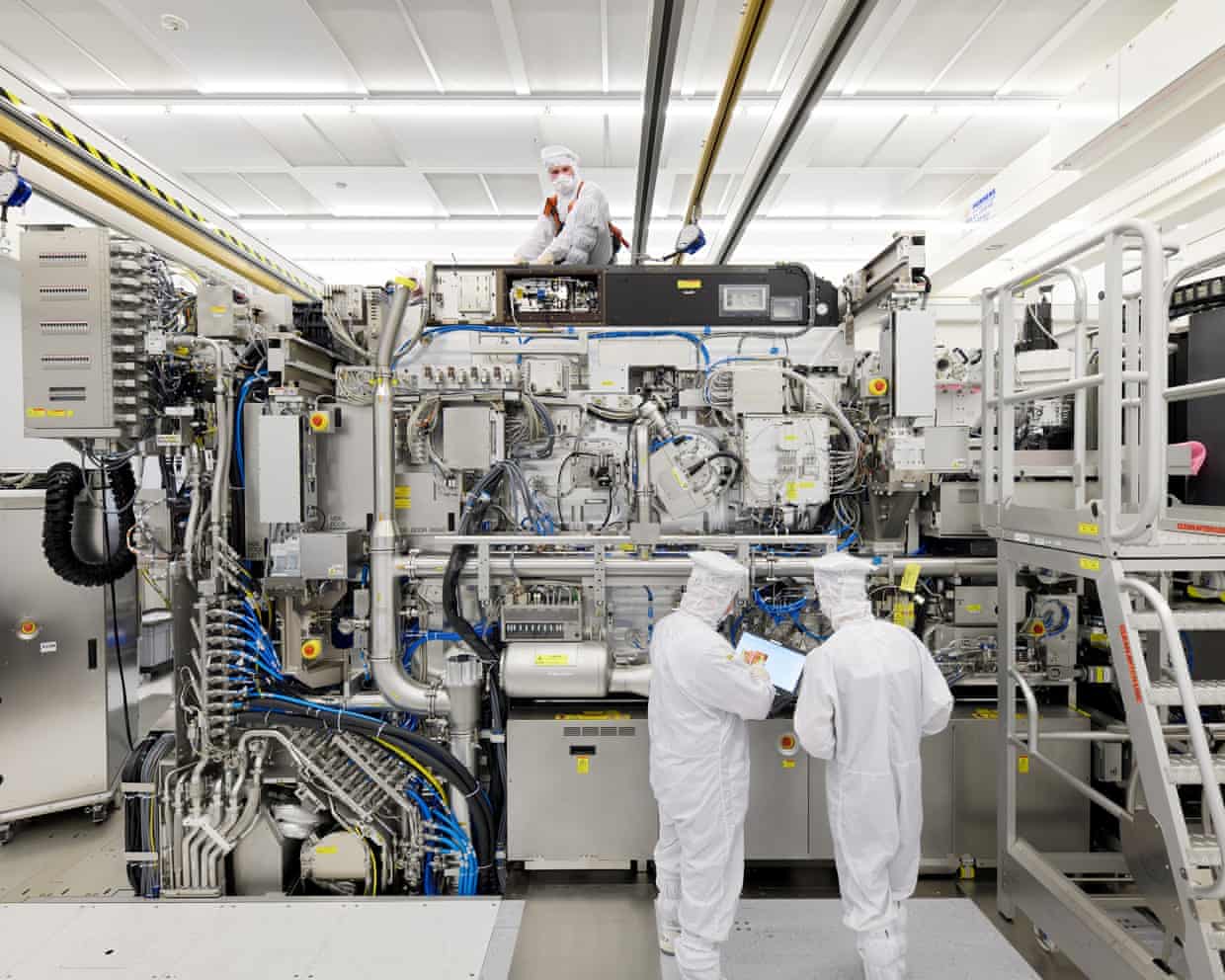
The European Union holds a rarely discussed card that could force such a pause: Dutch company ASML, Europe's most valuable firm. ASML manufactures extreme ultraviolet (EUV) lithography machines that are essential for producing the most advanced semiconductors. These $400 million machines etch patterns onto silicon using light focused to 13.5 nanometers—roughly one ten-thousandth the width of a human hair.
Without ASML's technology, there are no advanced chips. Without those chips, the massive datacenter buildout fueling AI development grinds to a halt. The industry expects to construct $7 trillion worth of datacenters globally by 2030, primarily in the United States. Taiwan's TSMC alone plans $265 billion in fabrication facility investments. All depend on ASML machines.
The United States already recognizes this vulnerability. Washington imposes extraterritorial export controls blocking ASML from selling its most advanced EUV systems to China, attempting to slow Chinese chip capabilities. These restrictions reveal American dependence on European technology even as Europe relies on U.S. financial and software services.
Why Europe Might Act
A complete export ban on ASML equipment would create an immediate chip shortage, forcing the AI industry to plateau. This would give regulators time to catch up with technology, allow lawmakers to update copyright and tax frameworks, and enable public debate about AI's role in society.
The EU has both humanitarian and self-interested reasons to consider this option, according to The Guardian's analysis. Europe's AI industry lags far behind the United States in both model development and computing infrastructure. Industry experts warn that without massive investment, the EU will become dependent on U.S.-controlled AI systems and lose negotiating leverage as ASML's technological lead narrows over time.
The calculation resembles nuclear weapons theory's "use it or lose it" dilemma. Europe can exercise its ASML leverage now or watch that advantage erode as more fabrication facilities get built elsewhere and competitors work to replicate the technology.
Why it matters
This represents the first concrete mechanism by which AI development could actually be slowed globally, not through voluntary industry commitments but through control of physical infrastructure. Whether Europe has the political will to wield this power remains uncertain, but the technical capability exists today and may not persist indefinitely.
These details were first reported by The Guardian.
This is an original analysis by the Omega editorial team. Source reporting: AI Watch.
Want systems like this working for your business?
Book a Call
