Enterprise AI Infrastructure Demands More Than GPU Capacity
Organizations scaling beyond pilots face challenges in power, cooling, networking, and operations that determine production success.
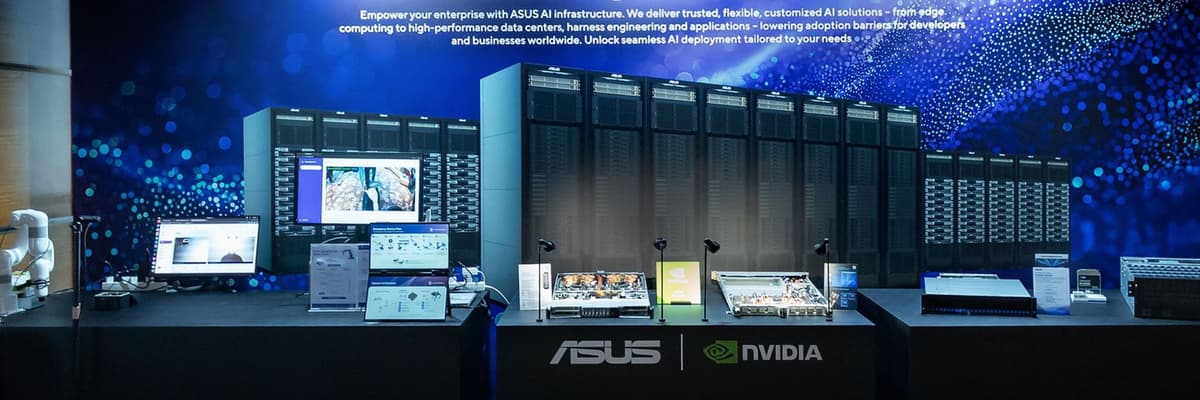
From Pilots to Production
Enterprises across Asia-Pacific are discovering that successful AI pilots don't automatically translate into production-ready systems. According to ASUS, organizations in manufacturing, financial services, telecommunications, and the public sector are asking the same question: what infrastructure do we need after the proof of concept?
The answer involves far more than adding GPU capacity. Real-world AI deployment exposes constraints in data location, storage throughput, network bandwidth, power delivery, cooling systems, and operational management—bottlenecks that rarely surface during controlled testing.
ASUS detailed these challenges at its AI Tech 2026 event in Seoul, where infrastructure discussions centered on designing systems capable of handling AI workloads in production environments. The company frames this transition as moving from systems that run AI to platforms that operate "AI factories"—integrated environments where performance, operational resilience, and governance function across the entire lifecycle.
Why it matters
Most AI initiatives stall not because models fail, but because supporting infrastructure wasn't designed for continuous operation at scale. Organizations that treat infrastructure as an afterthought face cascading problems: thermal throttling, data pipeline congestion, integration failures with existing systems, and operational complexity that grows faster than business value. Understanding these constraints early determines whether AI delivers sustained business impact or remains confined to isolated experiments.
Regional Infrastructure Priorities Vary
Infrastructure requirements differ significantly across Asia-Pacific markets. In Singapore, reliability and low latency dominate early conversations. Security firm Certis worked with ASUS to build a GPU farm and AI cloud platform supporting model training and inference for AI-enabled surveillance and monitoring services.
Taiwan presents different priorities depending on industry. Smart manufacturing emphasizes response time on production lines, while healthcare focuses on data protection and system reliability. National Chung Hsing University deployed ASUS-supported infrastructure across smart manufacturing and healthcare applications, including AI-enabled production lines and hospital collaborations. Meanwhile, Taiwan's National Center for High-performance Computing designed its Nano4 system specifically for dense AI workloads requiring advanced cooling and energy efficiency.
In Vietnam, growing digital infrastructure is driving investment in AI-ready systems built for continuous operation in manufacturing, finance, and digital services. FPT's AI factory integrated ASUS ESC N8-E11 servers into infrastructure designed to support AI workloads at scale, reflecting a regional shift from capacity expansion to operational reliability.
The Hidden Bottlenecks
Organizations frequently misdiagnose their limiting factors. Teams expecting compute constraints discover storage throughput or network bandwidth creates the actual bottleneck. Power and cooling—once late-stage considerations—now surface in early planning discussions as system density increases.
Data fragmentation slows many projects. Information scattered across multiple systems complicates quality control as use cases expand. Security teams need confidence in operational controls before approving production deployment. Business units require dependability when conditions change.
ASUS addresses these challenges through partnerships with Intel, AMD, and NVIDIA, supporting workloads from large-scale training to edge inference. The company collaborates with NVIDIA on the DSX Sim Blueprint, enabling enterprises to design, simulate, and validate AI infrastructure before physical installation—identifying constraints in compute, networking, storage, power, and cooling within a unified planning environment.
Building for Hybrid Deployment
Production AI increasingly spans cloud, data center, and edge environments. Some data cannot move due to regulatory or latency requirements. Other workloads benefit from cloud flexibility. ASUS industrial edge systems support factory automation, machine vision, video analytics, and healthcare applications where processing data near its source reduces latency and keeps sensitive information onsite.
The most successful AI projects tie directly to specific operational needs—making daily work faster, safer, or more consistent. Projects isolated from core business processes struggle to escape pilot status. Those integrated into operations justify expansion and deliver measurable value.
These details were first reported by ASUS in a blog post examining enterprise AI infrastructure challenges across Asia-Pacific markets.
This is an original analysis by the Omega editorial team. Source reporting: AI Watch.
Want systems like this working for your business?
Book a Call