Employment Lawyers Launch AI App for Restaurant Compliance
Connecticut attorneys build COMP to help managers document workplace incidents consistently across 67 locations.
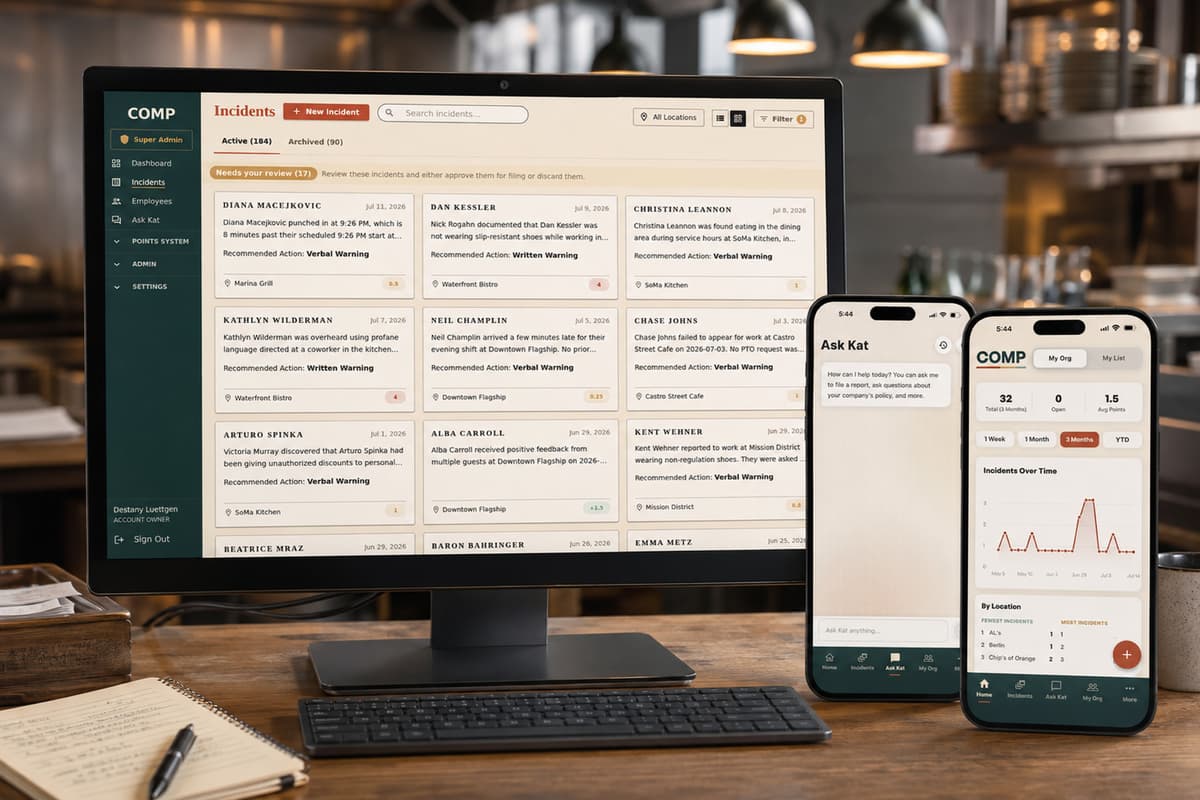
Two employment attorneys from Hartford law firm Pullman & Comley have launched a startup addressing a persistent challenge in restaurant management: inconsistent documentation of employee incidents.
Ryan O'Donnell and Eliot Gersten created COMP, a Farmington-based company that developed an AI assistant named Kat to help restaurant managers record and categorize workplace incidents in real time. The platform aims to solve a common problem where busy managers either skip documentation entirely or apply policies inconsistently across locations.
How the system works
Managers describe incidents through voice or text, and Kat uses the restaurant company's policies along with applicable state and federal regulations to categorize and document what happened. The system tracks both disciplinary issues and positive performance.
After a manager records an incident, it undergoes review and approval before employees receive notification the following day, giving them an opportunity to respond. Each employer establishes its own point system for infractions and progressive discipline, which COMP then applies.
Lucas Gray, COMP's chief technology officer, emphasized that customer data remains separate and Kat does not learn from one restaurant and apply that knowledge to another. The AI draws only from defined materials including the employer's handbook and jurisdiction-specific rules.
Why it matters
Inconsistent documentation creates legal vulnerability for employers, particularly in wrongful termination cases. An AI-guided system that standardizes incident reporting while maintaining human oversight could reduce litigation risk across industries where frontline managers juggle multiple responsibilities. The approach also reflects growing tension between AI efficiency and the need for human judgment in employment decisions.
Early traction in hospitality
COMP began development in early 2025 and now serves 15 restaurant groups representing 67 locations across Connecticut, New York, and Massachusetts. Customers pay per location.
Phil Barnett, co-owner of Hartford Restaurant Group, which operates the Wood-n-Tap chain with 11 locations and 850 employees, said his company has used COMP for six to eight months. Before the app, managers filled out performance improvement notices that could be delayed or skipped during busy shifts.
Both Hartford Restaurant Group and Newtown-based Market Hospitality Group are founding investors. The Connecticut Restaurant & Hospitality Association is promoting COMP to members.
Built-in limitations
O'Donnell stressed that Kat does not make employment decisions independently and is not designed to practice law. When the AI cannot find sufficient information to answer a question, it directs managers to ownership or human resources.
Lisa Zaccardelli, chair of the labor and employment practice at Hinckley Allen in Hartford and not affiliated with COMP, noted that while AI can improve efficiency, it introduces risks around discrimination, privacy, and evolving state laws. She cautioned against applying AI recommendations mechanically, citing examples where protected sick leave or medical conditions might require different responses than standard attendance policies would suggest.
COMP addresses these concerns through multiple levels of human review and by not collecting demographic information such as race.
The company has eight employees including full-time engineering staff and uses contract workers. O'Donnell said COMP is not yet profitable but targets profitability within 18 to 36 months. The founders see potential beyond restaurants in industries where frontline managers face similar compliance responsibilities.
These details were first reported by Hartford Business.
This is an original analysis by the Omega editorial team. Source reporting: AI Watch.
Want systems like this working for your business?
Book a Call