Edge AI Wall: Why Scaling Hardware Won't Fix Embodied Robotics
Autonomous robots face a mathematical barrier that more processors can't solve—researchers propose managing decision complexity instead.
The computational bottleneck blocking physical AI
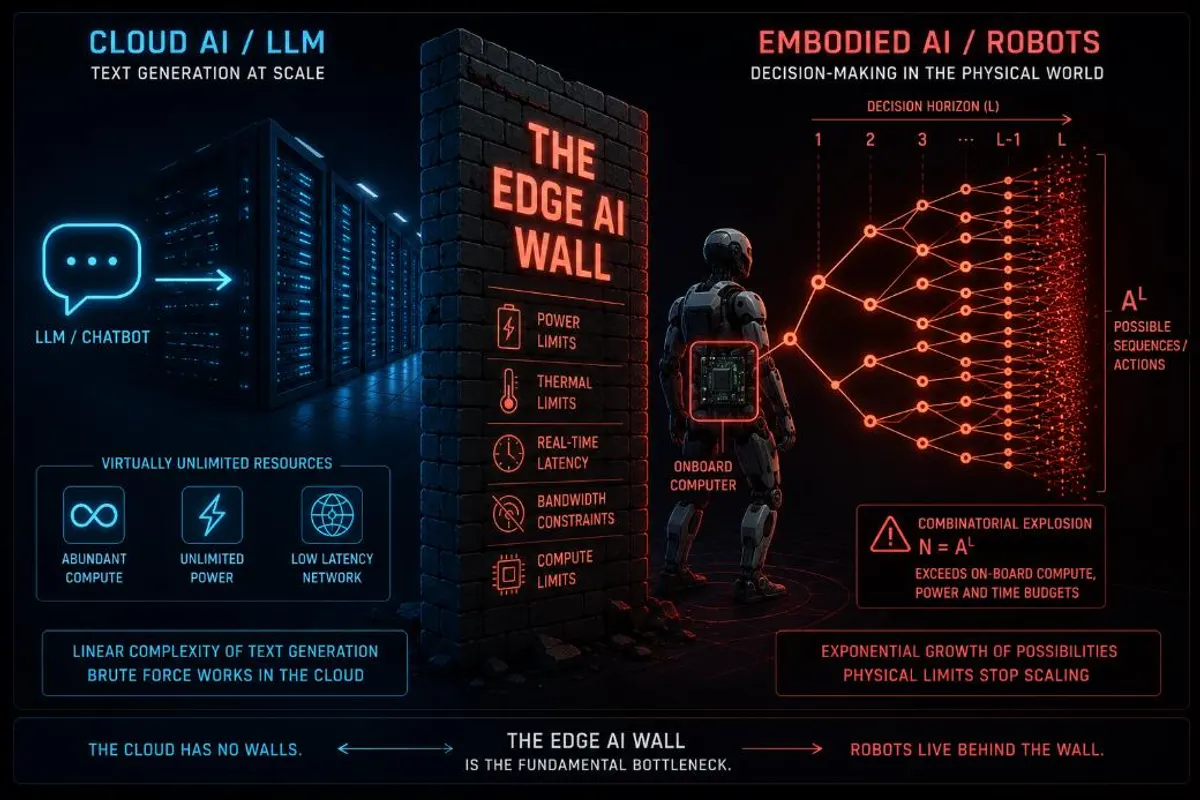
Autonomous robots operating in the real world face a fundamental problem that cloud AI never encounters: they must make split-second decisions with limited onboard computing power while navigating exponentially expanding decision trees. This collision of physical constraints and mathematical complexity has created what researchers now call the "edge AI wall"—a systemic barrier threatening the viability of embodied artificial intelligence.
The issue extends far beyond individual navigation failures. As detailed in research first reported by The Robot Report, the challenge affects the entire stack of physical AI systems, from warehouse robots to autonomous vehicles to humanoid assistants. While the AI industry has succeeded by scaling computational resources in data centers, that same approach breaks down when intelligence must operate inside a battery-powered mobile platform.
Why hardware scaling hits a physical ceiling
The problem is dual-layered. First, mobile robots face strict energy budgets. Adding more GPUs or accelerators to handle complex AI models creates a vicious cycle: more processing power demands larger batteries and cooling systems, which add weight, reduce payload capacity, and shorten operating time. Each additional watt of performance becomes prohibitively expensive from an engineering standpoint.
But even if future microelectronics provided unlimited onboard compute at zero power consumption, a second barrier remains—pure mathematics. Real-world environments generate continuous streams of chaotic changes. Planning robot behavior in such settings triggers combinatorial explosion, where the decision space grows exponentially with planning depth.
The math is brutal: with just 10 alternative actions per decision point, a robot planning 20 steps ahead faces 10^20 possible scenarios to evaluate. In continuous action spaces involving joint angles and velocity vectors, the effective number of alternatives multiplies far beyond 10. Traditional brute-force algorithms cannot traverse these exponentially expanding trees fast enough, regardless of processor speed.
Why cloud computing doesn't solve it
Shifting computation to remote servers—the "cloud robotics" approach—fails for safety-critical control loops. Physical systems operate in strict real time, where even 50 milliseconds of latency from network transmission can cause accidents. A humanoid robot or autonomous vehicle receiving commands based on outdated sensor data becomes an unguided physical object weighing hundreds of kilograms.
Wireless networks add another vulnerability: signal attenuation, interference, and dead zones mean any connection drop instantly removes the robot's decision-making capability. Safe embodied systems must possess autonomous onboard computing.
Why it matters
This edge AI wall represents a fundamental architectural question for the robotics industry: extensional hardware scaling—the strategy that powered cloud AI breakthroughs—may have reached its physical and economic limits for mobile platforms. The barrier affects every company pursuing general-purpose humanoid robots, autonomous delivery systems, and next-generation self-driving vehicles. Solutions must address the mathematical structure of decision-making itself, not just processing speed.
A mathematical alternative: compressing decision spaces
Researchers have proposed an alternative paradigm called the Combinatorial Compression Engine (CCE), which targets the search space itself rather than the model. Based on Duality-Nonequilibrium theory, this approach dynamically prunes redundant or destructive branches from planning trees before wasting compute cycles evaluating them.
In simulation testing documented in the DeltaCore-Robot-Sim repository, a regulator using this approach compressed search spaces by factors of 8 to 11 while maintaining decision quality. In chaos scenarios, it reduced near-collision events by over 90 percent. In ambiguous path-choice situations where traditional planners freeze or oscillate, it eliminated behavioral instability entirely.
The research remains confined to 2D simulation and has not been validated on physical robots. Transferring the mathematical model to real edge hardware represents a significant engineering challenge requiring substantial resources. The researchers are seeking academic and industrial partnerships for the next phase: integration and testing on actual robotic platforms.
These findings were first reported by The Robot Report, which noted the work represents a shift from optimizing hardware to actively managing solution-space structure in real time.
This is an original analysis by the Omega editorial team. Source reporting: AI Watch.
Want systems like this working for your business?
Book a Call