Databricks Open-Sources Omnigent Meta-Harness for AI Agents
New abstraction layer lets developers compose, control, and collaborate across multiple AI agents and models through a unified interface.
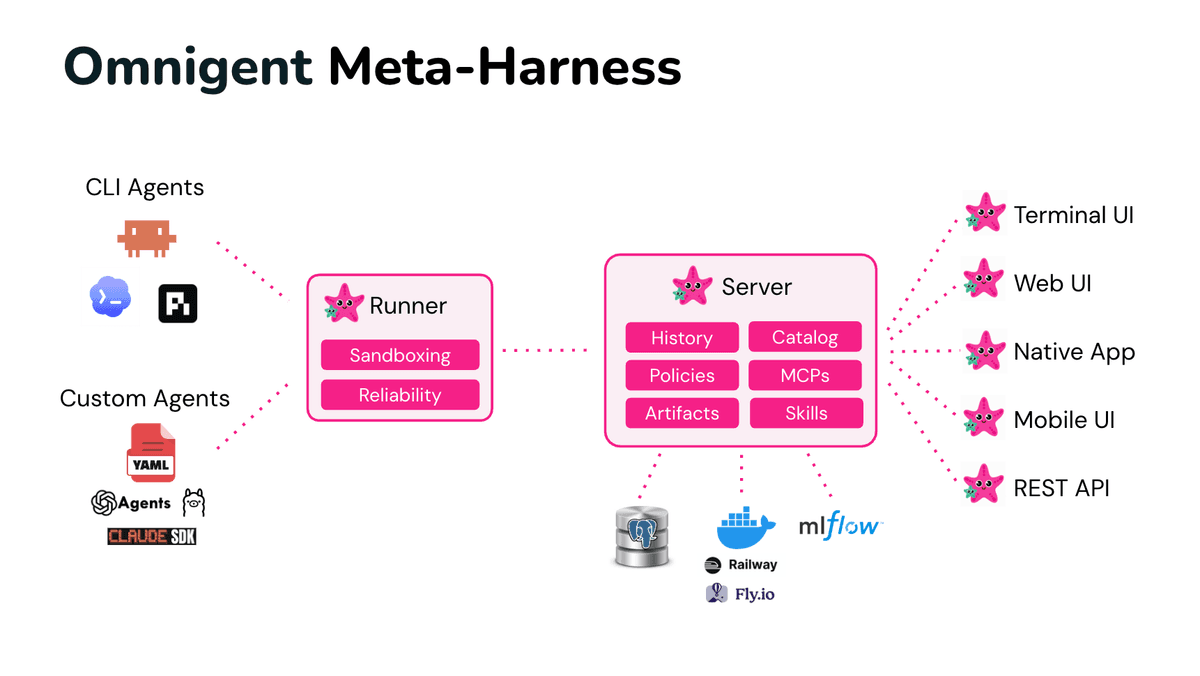
A unified control layer for AI agent orchestration
Databricks has released Omnigent, an open-source meta-harness designed to sit above individual AI agent frameworks and provide a unified interface for composition, governance, and collaboration. The company announced the Apache 2.0-licensed project as a response to the growing complexity of working with multiple AI agents simultaneously.
The platform addresses a practical problem facing organizations deploying AI agents at scale: each agent harness—whether Claude Code, Codex, Pi, or custom implementations—operates in its own silo with distinct interfaces and contexts. Databricks reports that its 5,000-member engineering team routinely works with four to five agents concurrently, manually copying information between tools and collaboration platforms.
Omnigent provides a common API layer that wraps both terminal-based coding agents and agent SDKs, treating them as interoperable components. The system recognizes that despite internal differences, all agent harnesses share the same user-facing pattern: messages and files as inputs, text streams and tool calls as outputs.
Three core capabilities
The meta-harness introduces three primary functions that individual agent frameworks cannot easily provide on their own.
First, composition: developers can combine multiple models, harnesses, and techniques without rewriting code. Switching between different agents requires only single-line configuration changes, and teams can specify custom agents in YAML that port across harnesses.
Second, control through stateful, contextual policies rather than prompt engineering. Omnigent tracks agent actions dynamically and enforces guardrails at the meta-harness layer. For example, policies can require human approval for git pushes after an agent downloads new packages, restrict write access to only agent-created documents, or pause execution after specific cost thresholds.
Third, real-time collaboration: users can share live agent sessions via URL, allowing teammates to view workspaces, comment on files, and send commands together. The same agent session remains accessible across terminal, web, desktop, and mobile interfaces.
Why it matters
Databricks' move reflects an architectural shift in how organizations deploy AI agents in production. The company's experience building thousands of customer agents and shipping products like Genie revealed that frontier performance increasingly comes from orchestrating multiple models rather than relying on a single harness. Harvey improved quality and cost by pairing open-source worker models with frontier advisors; Anthropic's research product uses a lead agent coordinating parallel subagents; Genie itself employs different LLMs for planning, search, and code generation. A meta-harness layer makes these multi-agent patterns practical to implement and govern at enterprise scale.
Additional features and roadmap
The current alpha release includes cloud execution support for launching agents on local machines or hosted sandbox providers like Modal and Daytona. A flexible OS sandbox from Databricks' security team can lock down system access and intercept network requests—for instance, injecting GitHub tokens only in approved egress proxy requests without exposing them to agents.
Databricks plans to add automatic optimization using GEPA, code-based introspection similar to MemEx and RLM, and an Omnigent Server MCP enabling agents to work across sessions. The platform supports deployment on Fly.io, Railway, Modal, and Daytona, with multiple LLM provider integrations.
The details were first reported by Databricks in a company blog post announcing the open-source release.
This is an original analysis by the Omega editorial team. Source reporting: AI Watch.
Want systems like this working for your business?
Book a Call
