Cornell Researchers Beam AI Model Data Directly Into Memory
A new optical receiver uses light to update chip memory without power-hungry analog circuits, potentially cutting energy costs for data centers and robots.
Cornell Researchers Beam AI Model Data Directly Into Memory
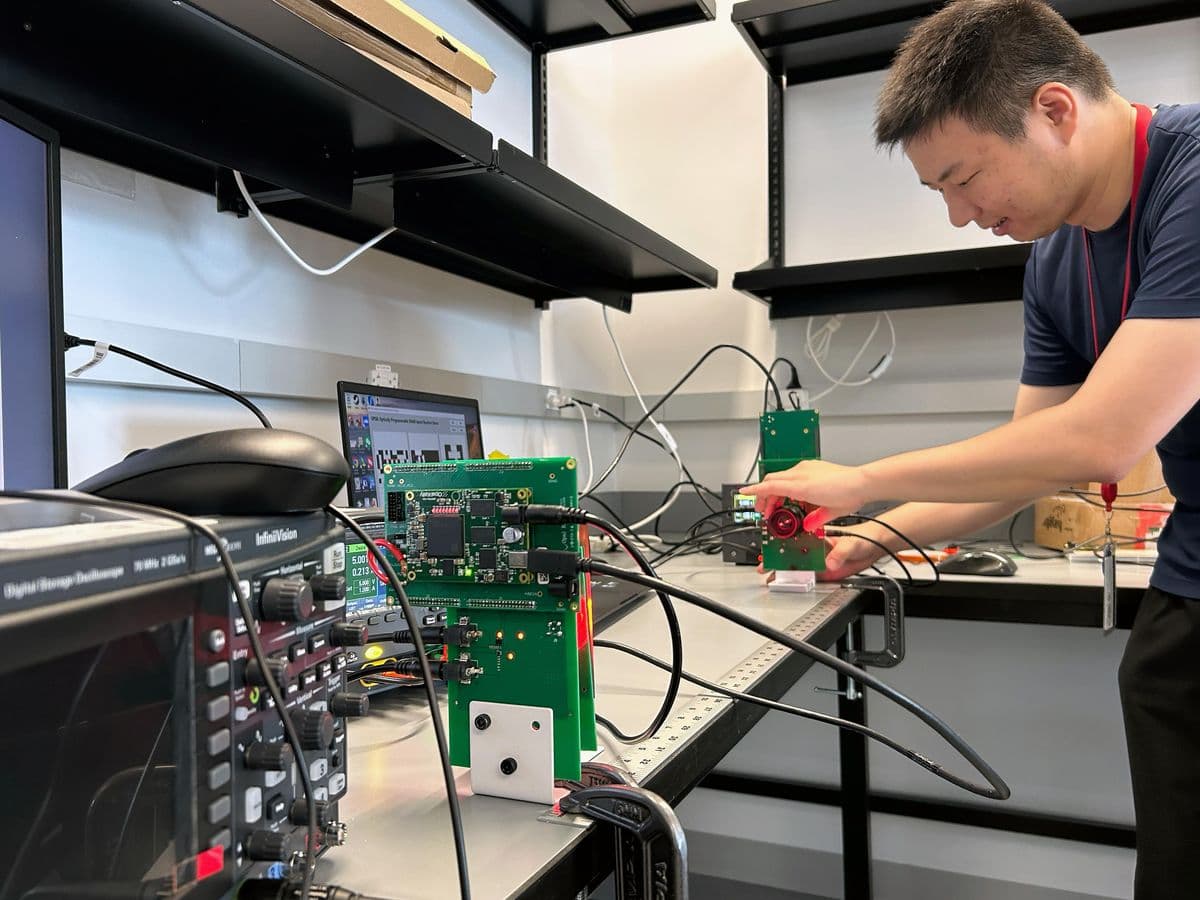
Researchers at Cornell Tech have developed an optical receiver that uses beamed light patterns—similar to QR codes—to directly modify memory on AI chips. The approach bypasses traditional analog circuits, potentially reducing energy consumption in data centers, autonomous vehicles, and AI-powered robots.
The system, presented at the IEEE/JSAP Symposium on VLSI Technology & Circuits last month, addresses a fundamental bottleneck in AI computing: moving model parameters between storage and processors.
Why it matters
As AI models grow larger, the energy cost of shuttling data between memory and processors has become a critical constraint. This optical approach could reduce power consumption in applications ranging from warehouse robots that need frequent model updates to microrobots with severe size limitations. The shift from analog to fully digital optical communication represents a meaningful step toward more efficient AI infrastructure.
How the optical memory system works
The receiver design places dynamic random-access memory (DRAM) with a transmitter, while the processor's static random-access memory (SRAM) contains the receiver. Modified SRAM cells include photodiodes that respond to incoming light.
When light strikes each photodiode, it generates a current that flips binary values in the SRAM—effectively writing data optically. The system uses a calibration circuit to account for alignment issues between transmitter and receiver, referencing a data frame with expected pixel positions.
"People are designing all sorts of different AI chips," says Jae-sun Seo, an associate professor of electrical and computer engineering at Cornell Tech who led the research with postdoctoral researcher Yifan He. These processors typically lack room for complete AI models, requiring electrical connections to external memory that "create cost and efficiency concerns when systems scale up."
Optical links offer higher bandwidth and lower energy loss than metal wires, but conventional optical receivers require power-intensive analog circuits to convert light into electronic bits. The Cornell team's digital approach eliminates that conversion step.
Challenges before commercialization
The current prototype transmits only a static 14×14-bit matrix through a metal mask. The researchers are collaborating with optics groups to build a transmitter capable of altering the light matrix millions of times per second to achieve gigabit-per-second transfer rates.
Dennis Sylvester, an IEEE Fellow who chairs the University of Michigan's electrical and computer engineering department, notes that the photosensitive bit cells are currently larger than conventional SRAM cells. "Those larger cells mean the chip can fit less memory, a trade-off that could cancel out the added efficiency," he says.
Seo acknowledges the size challenge but says the team is working to shrink bit cells through transistor optimization and CMOS scaling.
Target applications in robotics and edge AI
The researchers see near-term applications in robotics, particularly AI-powered warehouses and factories where optical transmission could accelerate model updates across robot fleets. Microrobots, constrained by their physical size, could eventually benefit from more compact versions of the technology.
"Edge AI is a big growth area, and in three, four, five years, you're going to hear as much about that as you are with data centers," Sylvester says.
These details were first reported by IEEE Spectrum.
This is an original analysis by the Omega editorial team. Source reporting: AI Watch.
Want systems like this working for your business?
Book a Call