Coherent Expands Texas InP Fab for AI Optical Interconnects
Sherman facility will scale production of indium phosphide lasers and optical components that enable data center networking at light speed.
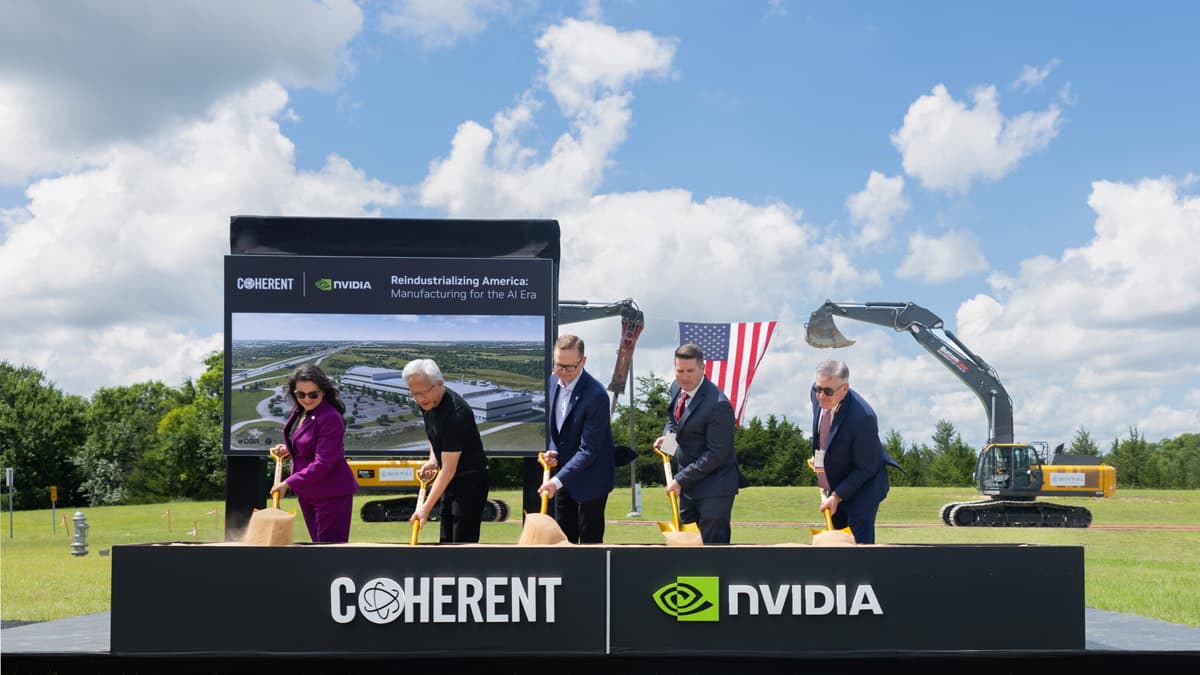
Coherent broke ground on an expanded manufacturing facility in Sherman, Texas, that will scale production of indium phosphide wafers and optical components essential to modern AI infrastructure. The expansion marks a concrete step in rebuilding advanced semiconductor manufacturing capacity in the United States.
The company operates what it describes as the world's first 6-inch indium phosphide fab. NVIDIA founder and CEO Jensen Huang joined Coherent CEO Jim Anderson at the groundbreaking ceremony, alongside local and state officials.
Why it matters
As AI systems scale to hundreds of thousands of processors distributed across data centers, copper wiring can no longer carry signals efficiently over distance. Optical interconnects using indium phosphide lasers have become the critical bottleneck-breaker — yet domestic supply chains for compound semiconductors remain thin. This expansion addresses a strategic gap in U.S. manufacturing capability for components that determine how fast AI infrastructure can grow.
Funding and partnership details
Coherent announced a $50 million CHIPS Act grant to help finance the Sherman expansion, building on roughly $17 million in earlier support from the Texas CHIPS program and the Sherman Economic Development Corporation. The facility will support more than 550 direct jobs at full capacity, according to Anderson.
The expansion deepens a relationship between Coherent and NVIDIA that spans roughly two decades. In March, the companies formalized a multiyear strategic partnership in which NVIDIA committed $2 billion to support Coherent's R&D, future capacity, and U.S.-based manufacturing, alongside a multibillion-dollar purchase commitment for advanced laser and optical networking products.
The physics problem optical interconnects solve
When NVIDIA's upcoming Vera Rubin Ultra NVL576 system links 576 GPUs across eight racks into a single computing domain, copper cannot carry the signal across that distance without burning excessive power on retimers and signal conditioning. Optics pays a one-time conversion penalty from electrical to light, but once paid, distance becomes nearly free from a power perspective.
"As AI systems grow larger and more powerful, connectivity is just as important as compute," Anderson said during the event. "AI runs on compute, but it scales on connectivity — and Sherman is where that connective tissue gets built."
Manufacturing scale and material science
Most global indium phosphide production still runs on 3- and 4-inch wafers. Moving to 6-inch wafers roughly quadruples the usable area compared to 3-inch wafers, driving down cost per component and unlocking the volume required for AI infrastructure buildout.
The Sherman facility manufactures lasers, transceivers, and pluggable optical modules that move data across NVIDIA networking systems. These indium phosphide-based components now enable NVIDIA Spectrum-X Photonics and Quantum-X Photonics switches with co-packaged optics, where Coherent supplies the external laser module.
"Coherent is a world-class company, and the work you do is vital to our future, vital to the future of artificial intelligence and vital to reindustrializing the United States," Huang said during a fireside conversation with Anderson.
The semiconductor laser was born in U.S. labs — Bell Labs demonstrated a room-temperature version in 1970 — before the technology and its manufacturing largely migrated overseas. Sherman represents a reversal of that trend, with the most advanced 6-inch indium phosphide line now operating in Texas.
Details of the groundbreaking were first reported by NVIDIA's official blog.
This is an original analysis by the Omega editorial team. Source reporting: AI Watch.
Want systems like this working for your business?
Book a Call