Chinese Cybercrime Group Uses AI Tools to Automate Server Attacks
UAT-10147 deploys machine learning frameworks across a 170,000-target campaign hitting education, media, and gaming sectors worldwide.
Cybercriminals integrate AI across attack lifecycle
A Chinese-speaking cybercrime operation is weaponizing artificial intelligence tools to automate large-scale server compromises, targeting Windows and Linux systems in education, media, technology, and gaming organizations across five continents.
Cisco Talos researchers identified the threat actor, designated UAT-10147, after discovering an exposed directory containing a target list of approximately 170,000 URLs. The group splits these targets into manageable batches of 10,000 URLs each to systematically exploit known vulnerabilities for search engine optimization fraud and data theft.
The majority of compromised systems are located in Brazil, Bolivia, China, Canada, and Vietnam, though the target list shows intended victims span the United States, India, the United Kingdom, Germany, and the Netherlands.
AI tools automate exploitation and post-compromise operations
UAT-10147 distinguishes itself by integrating AI-powered frameworks at multiple stages of its operations. The group deploys PentestGPT, an open-source autonomous penetration testing tool, on command-and-control servers to scan web servers and execute proof-of-concept exploits automatically.
Researchers also found DeepAudit, an AI-driven vulnerability scanning framework, on the group's management infrastructure. While no evidence shows the attackers exploited vulnerabilities discovered by DeepAudit in victim environments, its presence suggests either planned use for identifying new attack vectors or defensive auditing of their own infrastructure.
The threat actor employs AI to refine exploits, troubleshoot logic errors, automate post-exploitation workflows, validate successful compromises, and generate operational documentation. Multiple Python scripts used in the campaign appear AI-generated, handling tasks from post-exploitation diagnostics to exfiltration traffic blending.
Cross-platform implant evades enterprise security
UAT-10147's toolkit centers on SPECTRE, a previously unreported cross-platform backdoor written in C. The Windows version supports 45 commands and uses bring-your-own-vulnerable-driver techniques to terminate endpoint detection and response processes from kernel space, rendering products from CrowdStrike, SentinelOne, and Microsoft Defender blind to malicious activity.
The Linux variant deploys a kernel-level rootkit that grants persistent control surviving reboots and most user-level security controls. Both versions employ weighted scoring mechanisms that trigger self-termination if sandbox indicators exceed threshold values.
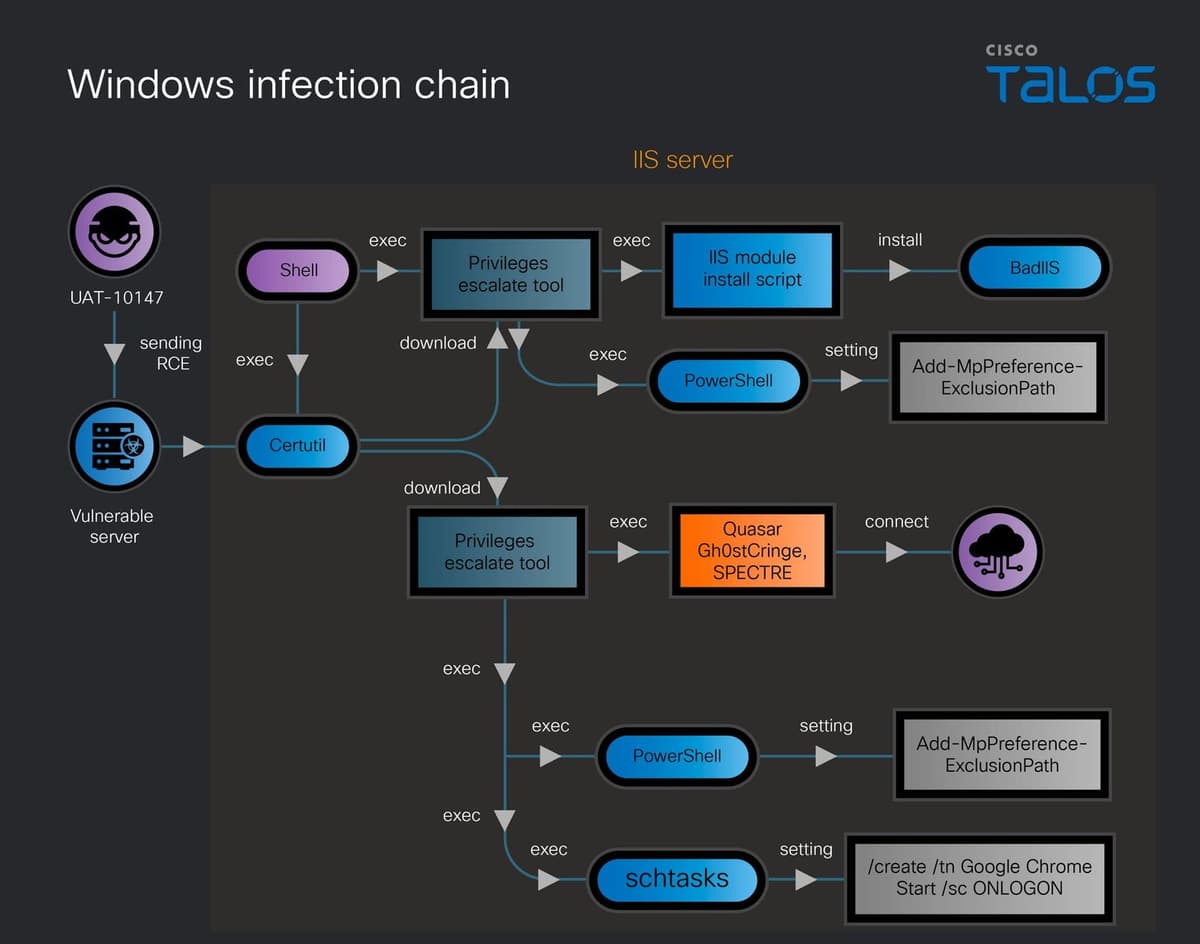
Attack chains begin by exploiting known vulnerabilities in Zimbra, AjaxPro, Telerik UI, and Alibaba Nacos to achieve remote code execution. The group then deploys privilege escalation tools, establishes persistence through deceptive scheduled tasks, and installs backdoors including BadIIS malware, Gh0stCringe, Noodle RAT, and Quasar RAT.
Why it matters
This campaign demonstrates how commodity cybercrime operations are adopting AI tools to achieve enterprise-grade automation previously associated with nation-state actors. The 170,000-URL target list and systematic exploitation approach show threat actors scaling attacks beyond manual capacity. Organizations must assume adversaries can now identify and exploit vulnerabilities faster than traditional patch cycles, requiring accelerated vulnerability management and enhanced detection of automated reconnaissance patterns.
Cisco Talos first reported these findings in a two-part analysis published last week, providing detailed technical indicators and defensive recommendations for security teams.
This is an original analysis by the Omega editorial team. Source reporting: AI Watch.
Want systems like this working for your business?
Book a Call