China's AI Adoption Outpaces US Amid Divergent Safety Views
Survey data reveals 80% of Chinese citizens use AI weekly versus 54% in America, reflecting starkly different attitudes toward existential risk and government oversight.
Contrasting attitudes toward AI risk
A Morgan Stanley survey released this week found that 80% of Chinese respondents use artificial intelligence at least weekly, significantly exceeding the 54% adoption rate in the United States. The gap reflects more than usage patterns—it reveals fundamentally different perspectives on AI safety between the world's two leading AI superpowers.
While prominent US tech executives and researchers have issued warnings about AI's existential threats to humanity, Chinese citizens and officials have remained comparatively quiet on catastrophic risk scenarios. Instead, China's public discourse centers on operational control, malicious use, and social disruption rather than human extinction, according to industry analysts.
Why it matters
The divergence in AI attitudes between China and the US will shape how each country regulates the technology and competes for AI leadership. China's commercial focus and high public trust in government oversight may accelerate deployment of AI applications, while American caution could slow frontier development. Understanding these cultural and political differences is essential for business leaders navigating AI strategy in both markets.
Commercial deployment drives acceptance
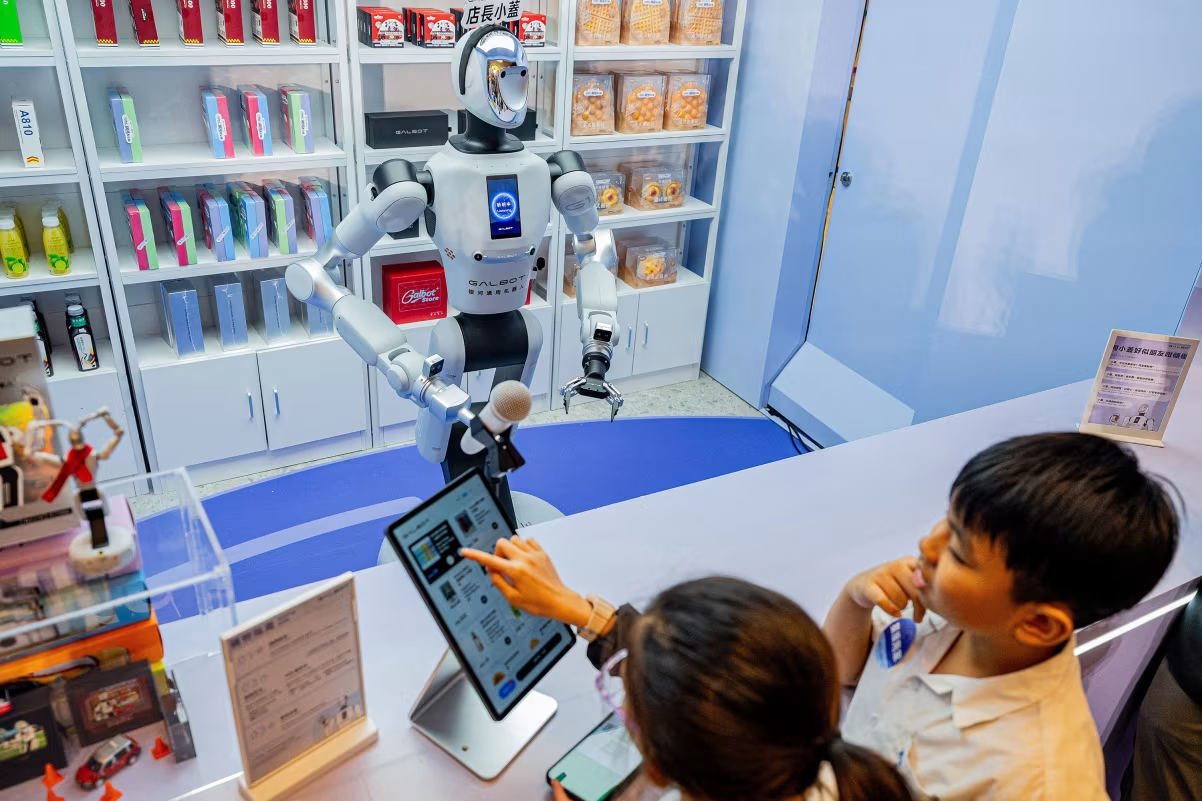
China's widespread AI adoption stems partly from aggressive commercial rollout by tech companies offering free chatbots and AI features integrated into existing applications. Citizens access government services through AI-powered digital employees, students receive instant feedback on assignments by uploading photos, and hotels deploy robots for parcel delivery.
"Most Chinese people meet AI as a cheap product first and as a debate second," said Poe Zhao, founder of Hello China Tech newsletter. "When a technology shows up as a useful, low-cost service, people judge it by what it does for them, not by what it might do to them."
An Ipsos survey earlier this year found 83% of Chinese respondents found AI products exciting, compared to just 33% in the US.
Trust in government oversight
Cultural factors also play a significant role. An Edelman survey showed 86% of Chinese respondents trust their government to do what is right, versus 39% in the US. This trust gap influences how citizens view AI governance.
"In the US, there is a general public perception that without whistleblowing, big corporations could escape accountability or scrutiny due to weak government oversight," said Lian Jye Su, chief analyst at Omdia. "Whereas in China, I think there is this very strong confidence from the public that if any sh*t hits the fan, the government will step in."
China's 2020 regulatory crackdown on major tech companies—which wiped out over $1.5 trillion in market value—reinforced public belief that authorities will intervene when necessary.
Different development priorities
Chinese AI companies focus more heavily on commercial applications and profitability than their American counterparts, potentially reducing emphasis on frontier capabilities that could trigger extreme risks. While Chinese labs have narrowed the gap with leaders like OpenAI and Anthropic, their models still trail the most advanced US systems, partly due to restrictions on advanced AI processors and lower capital investment.
China's intelligence chief Chen Yixin published an article detailing AI's strategic importance while outlining risks including cyberattacks, misinformation, and threats to political security—but notably absent were warnings about human extinction.
These details were first reported by CNN, with reporting from Hong Kong and Beijing.
This is an original analysis by the Omega editorial team. Source reporting: AI Watch.
Want systems like this working for your business?
Book a Call