China's AI adoption accelerates job displacement across industries
Government policies push rapid automation while workers scramble to adapt, raising questions about economic stability.
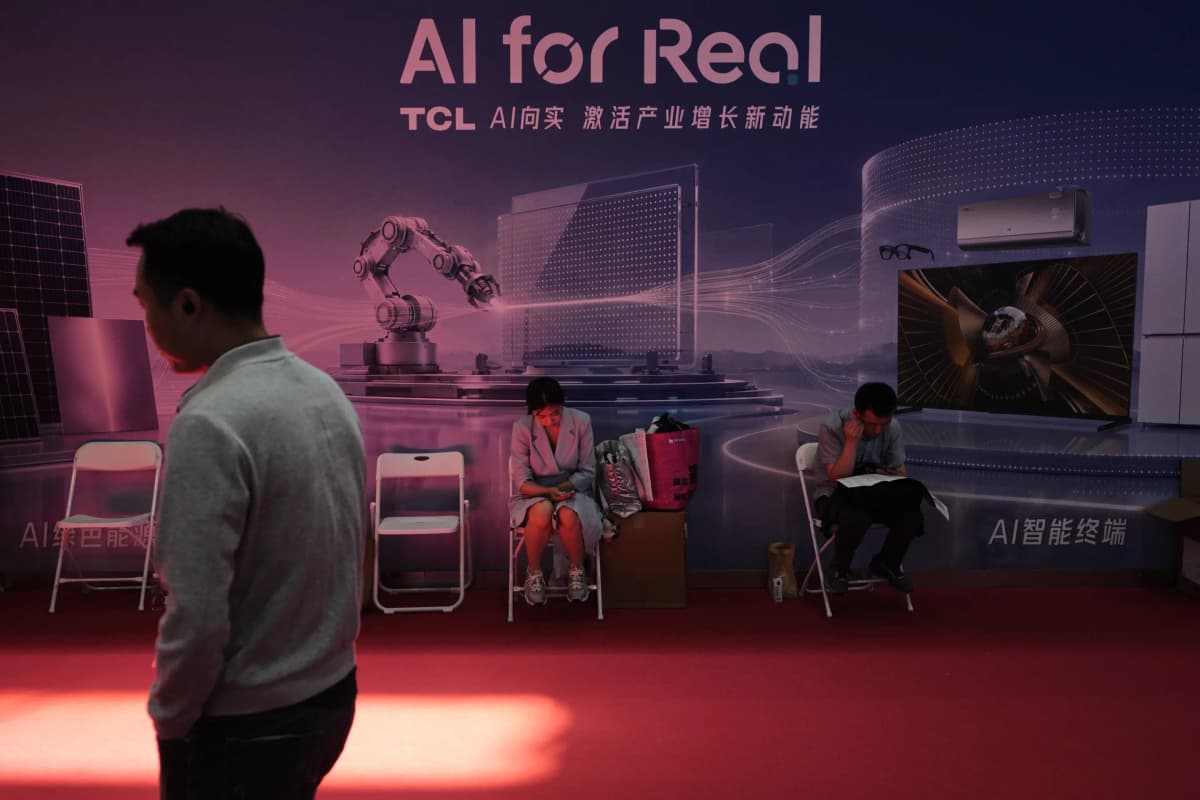
Automation hits China's workforce at scale
Computer programmer Fei Zhaojun lost his Beijing job along with 160 colleagues two weeks after his boss questioned whether AI could replace human coders. His experience reflects a broader transformation sweeping through China's labor market as government policies accelerate artificial intelligence adoption across virtually every sector.
The displacement extends far beyond technology roles. Translators report wages cut by more than half as AI-powered tools proliferate. Short drama production teams have shrunk dramatically, with live-action series dropping 75% year-over-year in early 2025. Even foreign language programs at universities face declining enrollment as students recognize AI translation capabilities.
According to market intelligence firm IDC, the share of Chinese industrial enterprises using AI models and agents surged from 9.6% in 2024 to 47.5% last year. The details were first reported by the Associated Press.
Government policy drives rapid deployment
China's "AI Plus" initiative and its five-year plan through 2030 explicitly push AI integration across industries, part of the country's technology competition with the United States. This top-down approach distinguishes China's AI rollout from other nations.
"What is specific to China is that the government is really into diffusing AI across the economy, so AI may get into different domains more quickly comparing to other countries," said Zilan Qian, a research associate at Oxford China Policy Lab.
The policy environment has created what Beijing-based analyst Shujing He of advisory firm Plenum describes as notably less anti-AI sentiment than elsewhere. Workers facing displacement often pivot toward AI-enabled businesses rather than resisting the technology.
Economic implications remain uncertain
The automation wave arrives as China's economy already faces headwinds. Consumer spending lags partly because workers worry about job security, compounding problems from a prolonged housing market downturn.
China's official urban unemployment rate hovers around 5%, but youth unemployment for those aged 16 to 24 runs roughly triple that figure. Tech giants have cut or restructured tens of thousands of positions, mirroring their U.S. counterparts.
"AI is likely to lift productivity across the board but could have a severe disruptive effect on employment, worsening the employment growth problem and resulting in a detrimental effect on social stability," said Eswar Prasad, a Cornell University professor of economics and trade policy.
Why it matters
China's aggressive AI deployment serves as a real-world test case for how rapid automation affects labor markets and economic stability. With the world's second-largest economy pushing AI adoption faster than most nations, the outcomes—both positive and negative—will inform policy decisions globally. The tension between productivity gains and employment disruption may prove especially acute in an economy already grappling with slowing growth and demographic challenges.
Workers adapt as roles evolve
Some displaced workers are finding ways forward. Fei now creates vlog-style videos about ordinary people's lives while considering his next career move. Former scriptwriter Wang Zhicheng, 32, launched his own studio producing illustrated children's books after his company eliminated roughly half its writing staff.
Translator Du Qinchun has temporarily gained work training AI translation models, though he acknowledges the irony of helping build systems that may ultimately replace him.
Longer-term demographic trends may ease pressure. China's rapidly aging and shrinking population of 1.4 billion means that by 2050, fewer than two working-age adults will support each retiree, compared with more than 2.5 in the United States. Automation could partially offset workforce contraction rather than purely threatening employment, according to Xuenan Cao, a professor at San Francisco Bay University.
The Associated Press first reported these developments, with reporting by Fu Ting and Wu Jia.
This is an original analysis by the Omega editorial team. Source reporting: AI Watch.
Want systems like this working for your business?
Book a Call
