China Launches Global AI Cooperation Organization With 29 Nations
President Xi Jinping unveils WAICO in Shanghai, pledging training programs and warning systems for developing countries while calling for equitable governance.
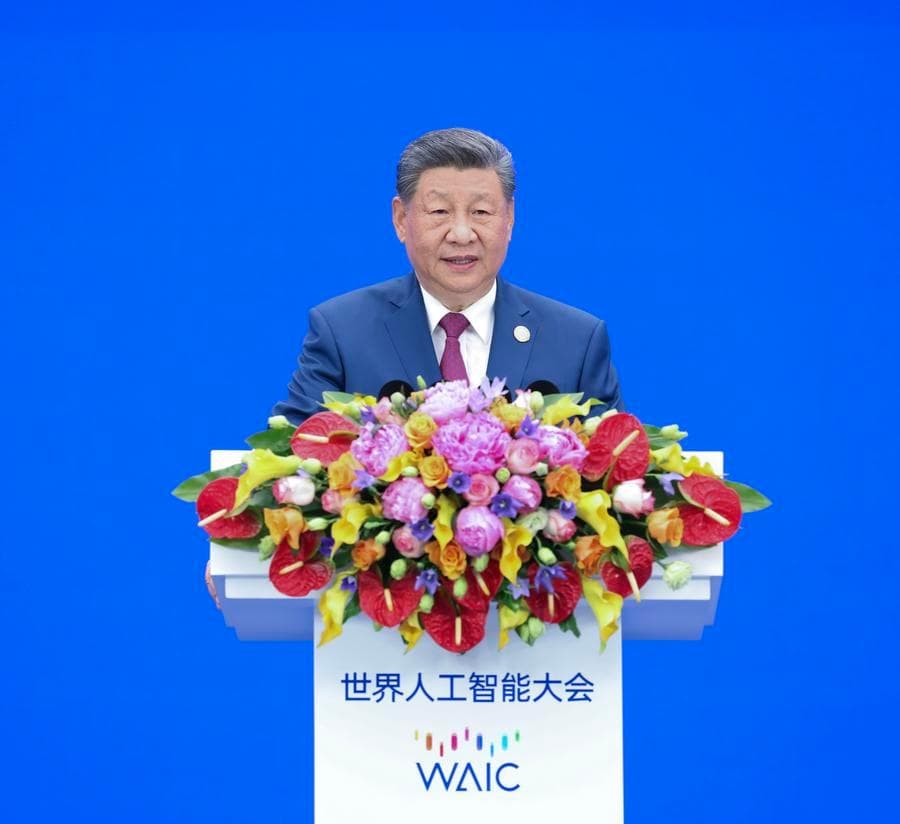
China establishes international AI governance body
China has created the World Artificial Intelligence Cooperation Organization (WAICO), a new multilateral body designed to coordinate AI development and governance across nations, President Xi Jinping announced at the 2026 World AI Conference in Shanghai on July 17.
Twenty-nine countries signed on as founding members of the organization, which Xi described as "a major move by China to answer the call of the Global South and unite the international community together to promote vigorously AI development and governance."
The announcement came during Xi's keynote address at the conference's opening ceremony, where he outlined a vision for collaborative AI governance centered on shared prosperity and security. He framed AI development as requiring international cooperation rather than unilateral action, stating that "AI development should not be a solo performance by a single country, but a symphony of international cooperation."
Why it matters
The creation of WAICO represents China's bid to shape global AI governance frameworks at a moment when regulatory approaches remain fragmented across major economies. With China's core AI industries valued at 1.2 trillion yuan ($176.6 billion) in 2025 and more than 6,200 AI enterprises operating nationwide, the country is positioning itself as a standard-bearer for international collaboration—particularly with developing nations that lack resources to build independent AI capabilities. The initiative could influence how AI governance evolves outside Western-dominated institutions.
Commitments to capacity building
Alongside the organizational launch, Xi announced concrete measures aimed at bridging what he termed the "AI and digital divides." China will provide 5,000 training and seminar opportunities in AI for developing countries over the next five years.
The country also plans to establish international AI application cooperation centers with regional bodies including ASEAN, the League of Arab States, the African Union, the Community of Latin American and Caribbean States, the Shanghai Cooperation Organization, and BRICS. Additionally, China will extend access to its MAZU AI-powered meteorological warning system to 30 countries.
Governance principles and warnings
In his address, Xi raised fundamental questions about AI's trajectory: how humans can coexist with thinking machines, how to ensure security when algorithms inform decisions, how to address ethical challenges through adaptive governance, and how to achieve inclusive AI access amid widening divides.
He emphasized that countries "should jointly oppose overstretching the national security concept in the field of AI and placing one country's security over that of others"—an apparent reference to export controls and technology restrictions implemented by the United States and allies.
Xi called for recognizing the United Nations' role in global AI governance and urged alignment on development strategies, governance rules, and technical standards. He advocated for principles including openness, risk awareness, inclusiveness, and solidarity.
Conference context
The World AI Conference has served as China's primary platform for international AI partnerships since 2018. This year's event, themed "AI Partnership for a Brighter Future," featured more than 140 forums and 1,400 participants from multiple countries.
Kazakh President Kassym-Jomart Tokayev, Cambodian Prime Minister Hun Manet, Thai Prime Minister Anutin Charnvirakul, and UN Secretary-General António Guterres delivered speeches at the opening ceremony, with speakers expressing support for WAICO's potential role in addressing cross-border AI challenges.
China previously proposed the Global AI Governance Initiative in 2023 and has launched related efforts including the AI Capacity-Building Action Plan for Good and for All and the AI Plus International Cooperation Initiative. Chinese open-source large AI models have been downloaded more than 10 billion times globally, according to the announcement.
These details were first reported by China's official government sources covering the Shanghai conference.
This is an original analysis by the Omega editorial team. Source reporting: AI Watch.
Want systems like this working for your business?
Book a Call
