C3.ai Revenue Drops 25% as UiPath Growth Slows to 13%
Contrasting fortunes for two enterprise AI vendors reveal leadership transitions and market saturation pressures.
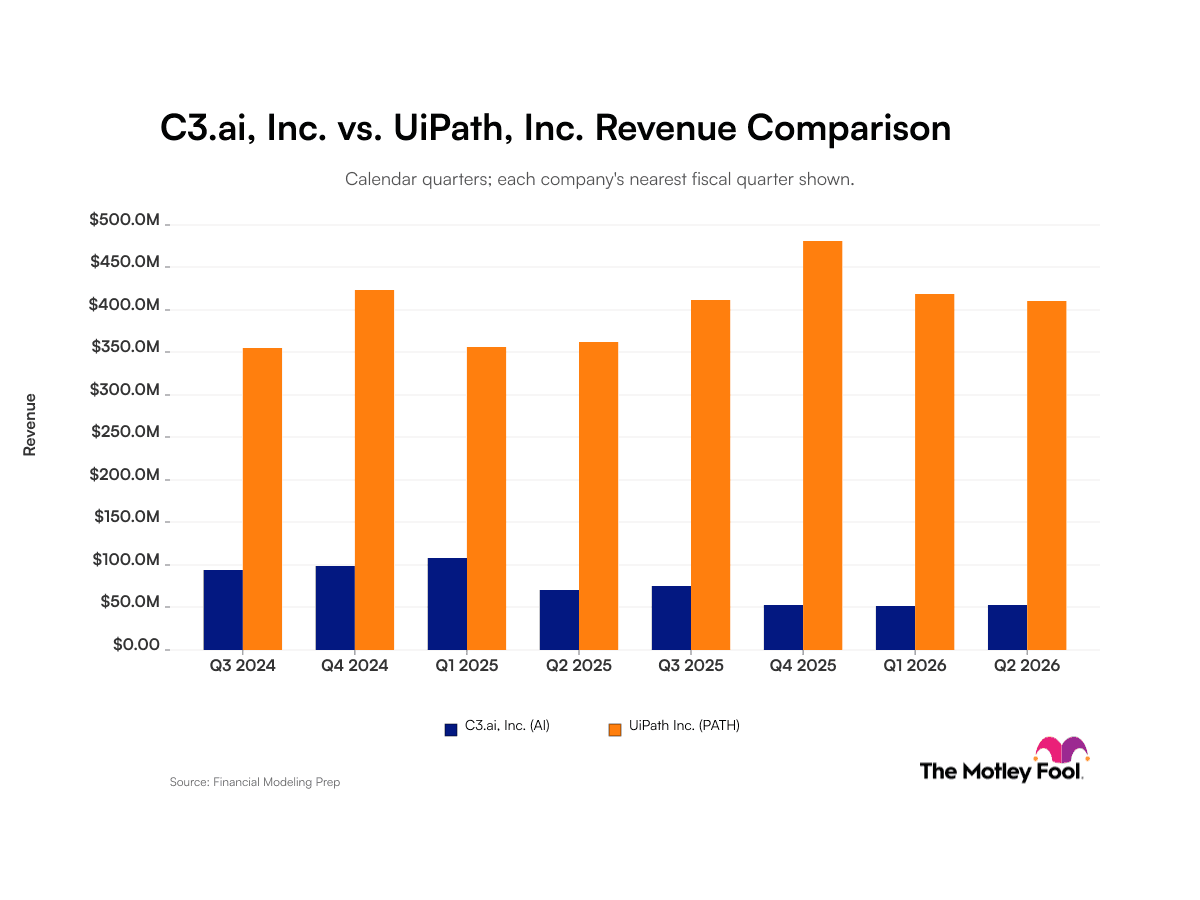
Diverging Trajectories in Enterprise AI
Two prominent enterprise artificial intelligence vendors reported starkly different revenue patterns for the quarter ended July 31, 2026, with C3.ai experiencing consecutive quarters of year-over-year contraction while UiPath maintained growth albeit at a decelerating pace.
C3.ai, which provides enterprise AI applications and development platforms, recorded $52.4 million in revenue for its fiscal second quarter—a decline from $70.3 million in the same period a year earlier. The company posted an operating margin of negative 188% during the quarter as it executed a corporate restructuring that included significant headcount reductions and resolved a securities class action lawsuit.
UiPath, which offers AI-powered process automation software for enterprise workflows, generated $410.3 million in revenue for the same quarter, representing approximately 13% year-over-year growth. The company reported a positive operating margin of about 8%.
Leadership Disruption at C3.ai
The revenue decline at C3.ai coincides with a period of leadership instability. Founder and CEO Thomas Siebel resigned in 2025 due to health issues, during which time the company's quarterly revenue fell from a peak of $108.7 million in the quarter ended April 30, 2025, to $51.6 million by April 30, 2026.
Siebel returned to the CEO position in June 2026. Early indicators suggest potential stabilization: C3.ai reported that customer bookings increased 73% quarter-over-quarter in the fiscal first quarter ended July 31, 2026, according to details first reported by The Motley Fool.
UiPath Faces Growth Deceleration
While UiPath's revenue remains substantially larger than C3.ai's—nearly eight times greater in the most recent quarter—the company is experiencing its own challenges. Management guidance for the third quarter projects revenue between $440 million and $445 million, which would represent approximately 8% year-over-year growth, a notable slowdown from the 13% growth rate achieved in the second quarter.
The quarterly data reveals UiPath's revenue peaked at $481.1 million in the quarter ended January 31, 2026, before declining in subsequent quarters.
Why it matters
These contrasting patterns illuminate two distinct pressures in the enterprise AI market: the operational risk of leadership transitions at smaller vendors, and potential market saturation or competitive intensity affecting even well-established players. For investors evaluating AI infrastructure companies, revenue consistency and operating margins remain critical indicators of sustainable business models, particularly as the sector matures beyond initial adoption waves.
The revenue trends and financial details were originally reported by The Motley Fool based on company filings as of September 11, 2026.
This is an original analysis by the Omega editorial team. Source reporting: AI Watch.
Want systems like this working for your business?
Book a Call