AWS Ships Agent Skills for Automated Reasoning Policy Workflows
Six open-format instruction packages let coding agents build, test, and deploy formal logic guardrails for AI systems end-to-end.
AWS Ships Agent Skills for Automated Reasoning Policy Workflows
AWS has released a suite of six Agent Skills that enable coding agents to manage the complete lifecycle of Automated Reasoning policies in Amazon Bedrock. The open-format instruction packages address a persistent challenge: teams want to manage AI compliance policies in code, but the authoring process has a steep learning curve and workflow constraints that frequently cause errors.
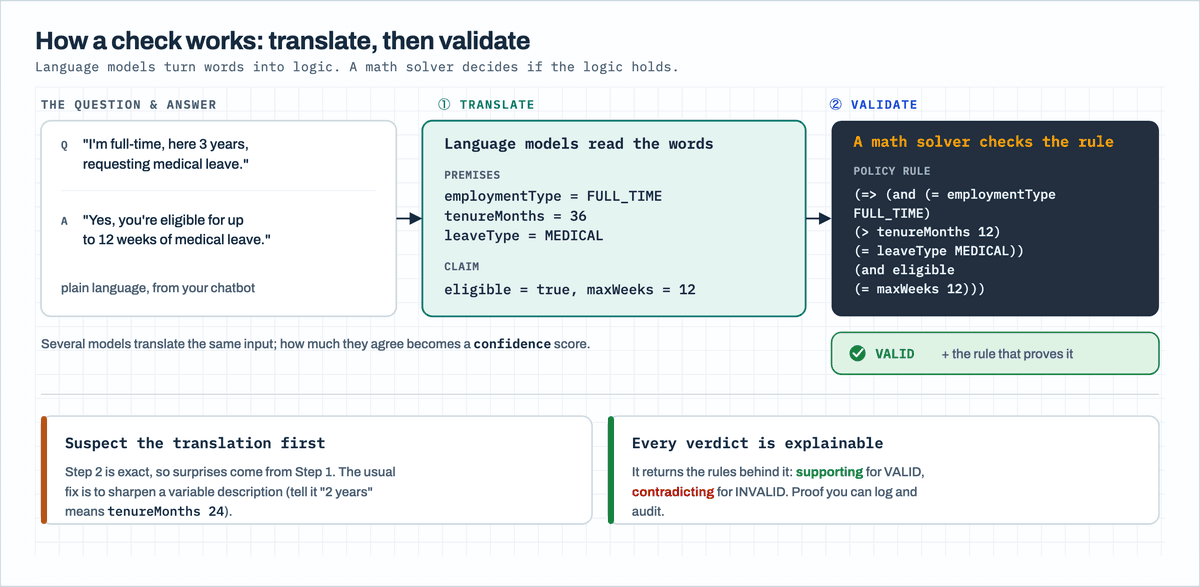
Automated Reasoning checks validate AI outputs against formal logic rather than statistical sampling, delivering mathematical certainty that responses comply with defined rules. That precision comes at a cost—policy authors must write rules in SMT-LIB (a standard input format for automated theorem provers), tune variable descriptions until the service correctly translates natural language, and navigate a build-test-refine loop with its own API constraints.
The new skills package that repetitive, detail-heavy work into structured instructions that coding agents can execute reliably. Each skill covers one stage: building policies from source documents, reviewing quality reports, generating test scenarios, debugging failures, deploying versioned policies behind guardrails, and validating runtime answers.
How the skills work
Agent Skills follow an open format from Anthropic that extends coding agents with specialized knowledge. Each skill includes a core instruction file, reference documentation loaded on demand, and standalone Python scripts that call Amazon Bedrock APIs. The scripts accept --help and --dry-run flags so developers can inspect operations before execution.
The skills install into any compatible agent—including Claude Code, Kiro, Cursor, and Codex—and activate automatically when a developer asks about a relevant task. A shared library handles common operations like creating clients, polling build workflows, and managing the service's concurrent build limit.
Why it matters
Automated Reasoning's two-step architecture—foundation models translate natural language to formal logic, then an SMT solver validates that logic against rules—produces explainable verdicts with mathematical proof. Every decision returns the specific rules that support or contradict it, creating an audit trail for compliance-sensitive domains like finance, healthcare, and insurance.
But that explainability depends on policy quality. The skills encode critical domain knowledge that general training data misses: that a SATISFIABLE verdict (answer consistent with policy) differs from VALID (answer proven by policy), that contradicting rules from failed checks should feed back into model rewrites, and that the service's build-slot limit requires automatic cleanup of completed workflows.
Running the full lifecycle through an agent makes policy development repeatable and reviewable. A short human resources policy for parental leave eligibility—three sentences stating that full-time employees with over 12 months of service qualify—produced six rules, four variables, and one custom type in a single build. The tester skill then validated question-and-answer pairs against the extracted logic, and the deployer skill created an immutable version behind a guardrail.
Implementation details
The suite demonstrated two architectural insights during development. First, explainability sits at the center of the feature: validated answers ship with mathematical proof of why they were allowed, and rejected answers carry the exact rule they violated into rewrite loops. Second, the distinction between consistent and proven answers shapes how agents interpret verdicts—treating SATISFIABLE as failure leads developers to modify correct rules.
The skills handle a practical constraint automatically: policies support limited concurrent builds, and refinement sessions can hit that cap. The shared library releases a slot before each build by removing the oldest completed workflow, preventing stalls during iterative development.
The code repository includes a complete walkthrough using a parental leave policy, from rule extraction through runtime validation. Cleanup requires deleting resources in dependency order—test cases, then build workflows and versions, then the policy, then the guardrail.
These details were first reported by AWS in a Machine Learning Blog post authored by Adewale Akinfaderin and Nafi Diallo.
This is an original analysis by the Omega editorial team. Source reporting: Automation Watch.
Want systems like this working for your business?
Book a Call