AWS Open-Sources 38 Healthcare AI Agent Skills to Fix Reasoning Gaps
New toolkit addresses silent failures in clinical decision-making by encoding domain procedures foundation models can't learn from training data alone.
Foundation models know facts but lack clinical reasoning procedures
AI agents built on foundation models routinely misapply healthcare decision frameworks even when they've encountered the guidelines during training. Ask an agent to classify a genetic variant using ACMG/AMP criteria and it will cite the correct framework but skip population frequency thresholds or hallucinate computational scores. The model possesses factual knowledge but lacks the structured reasoning procedures domain practitioners internalize through years of training.
AWS has released a collection of 38 open-source agent skills spanning 11 healthcare and life sciences domains to address this methodology gap. The skills are structured markdown documents that encode decision procedures AI agents can consume at inference time. According to evaluation results shared by AWS, agents equipped with these skills win 70–86 percent of head-to-head comparisons against baseline agents without skills, with the strongest effect on critical thinking tasks (78–85 percent win rate).
Why it matters
Silent failures in AI-assisted clinical workflows carry regulatory and patient safety consequences. When an agent produces output that looks correct but applies wrong criteria in variant interpretation, claims adjudication, or imaging analysis, the errors are difficult to detect. By encoding domain decision procedures as portable, auditable artifacts rather than relying on model weights alone, healthcare organizations gain a mechanism to inject verified reasoning frameworks into AI systems without retraining models or managing complex retrieval pipelines.
Two skill types: reasoning and pipeline
The HCLS Agent Skills collection organizes capabilities into reasoning skills and pipeline skills. Reasoning skills encode methodology and decision frameworks—for example, the genomic variant interpretation skill contains the full ACMG/AMP classification framework including evidence categories, population frequency thresholds, and computational predictor cutoffs. Pipeline skills encode tool-specific commands and validated parameters that produce executable artifacts, such as GATK4 HaplotypeCaller commands with correct annotation groups.
Each skill follows the Agent Skills open standard with triggers, dependencies, and metadata declared in YAML frontmatter. The content includes decision frameworks, parameter tables, code patterns, and validation criteria. All 38 skills are released under the MIT-0 license and work across more than 20 services including Amazon Bedrock, AWS Strands Agents SDK, and third-party coding agents.
Multi-agent architecture solves context engineering challenges
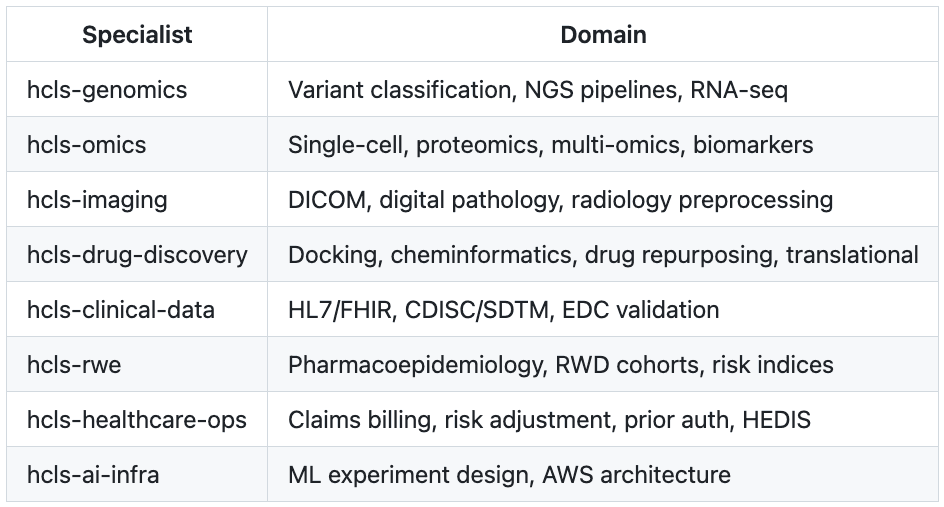
Loading all 38 skills into a single agent context consumes approximately 80,000 tokens, creating a context engineering problem where irrelevant skill content competes for attention. AWS demonstrates a multi-agent architecture in Kiro CLI where a lightweight coordinator routes queries to eight domain specialists, each loading only relevant skills (roughly 15,000 tokens per specialist). The coordinator handles intent classification while specialists handle domain reasoning.
For production deployment, Amazon Bedrock AgentCore provides managed hosting with auto-scaling, security boundaries, and observability. Skills can be embedded in agent code or configured at the environment level.
Evaluation results from drug discovery, claims, and imaging workflows
AWS shared three detailed use cases demonstrating measurable improvements. In drug repurposing for idiopathic pulmonary fibrosis, a skill-equipped agent applied structured evidence hierarchies and translational research criteria rather than producing a generic literature review. In Medicare Advantage risk adjustment, the agent correctly implemented CMS-HCC Model V28 hierarchy resolution—preventing the double-counting errors that trigger audit findings. In neuroimaging preprocessing, the agent specified the correct processing order with critical dependencies explained, such as applying bias field correction before skull stripping to prevent brain mask errors.
The skills are distinct from retrieval-augmented generation, which retrieves limited passages from indexed documents. Skills encode the complete decision procedure and error conditions. They're also not fine-tuning—they're structured prompts that activate contextually based on trigger patterns in user queries. Annual medical policy changes can be reflected by editing a text file rather than retraining a model.
The HCLS Agent Skills collection and installation instructions were detailed in a post on the AWS Machine Learning Blog.
This is an original analysis by the Omega editorial team. Source reporting: AI Watch.
Want systems like this working for your business?
Book a Call