AWS launches AI agents that earn autonomy through supervised learning
New security and coding tools start in learn mode, gaining permission to act independently as customers grant trust category by category.
AWS introduces graduated autonomy for enterprise AI agents
Amazon Web Services unveiled a suite of AI agents designed to handle security vulnerabilities, code maintenance, and business workflows while keeping humans firmly in control of how much independence the systems gain over time.
The centerpiece is AWS Continuum, a security agent that begins in supervised "learn mode" and earns the right to act autonomously only as customers explicitly grant permission for specific categories of tasks. The approach reflects a deliberate attempt to make AI more powerful without sacrificing oversight — a balance that has become critical as AI capabilities accelerate faster than human teams can respond.
Continuum addresses code vulnerabilities by working through issues methodically: triaging findings, testing whether flaws are exploitable, proposing fixes, and estimating potential side effects. In categories where customers have granted autonomy, the agent can apply fixes directly into existing deployment pipelines. AWS plans to expand Continuum's scope beyond code vulnerabilities to other security domains.
Why it matters
The shift to graduated autonomy acknowledges a paradox facing enterprises: AI tools that accelerate development also create more work for humans to review, test, and maintain. By letting agents handle background tasks with minimal intervention — but only after proving themselves in supervised mode — AWS is offering a middle path between fully manual security operations and unchecked automation. This matters especially as offensive AI capabilities advance, with models now able to chain minor software flaws into critical exploits faster than human teams can patch them.
Quick assistant gains custom agents and unified triage
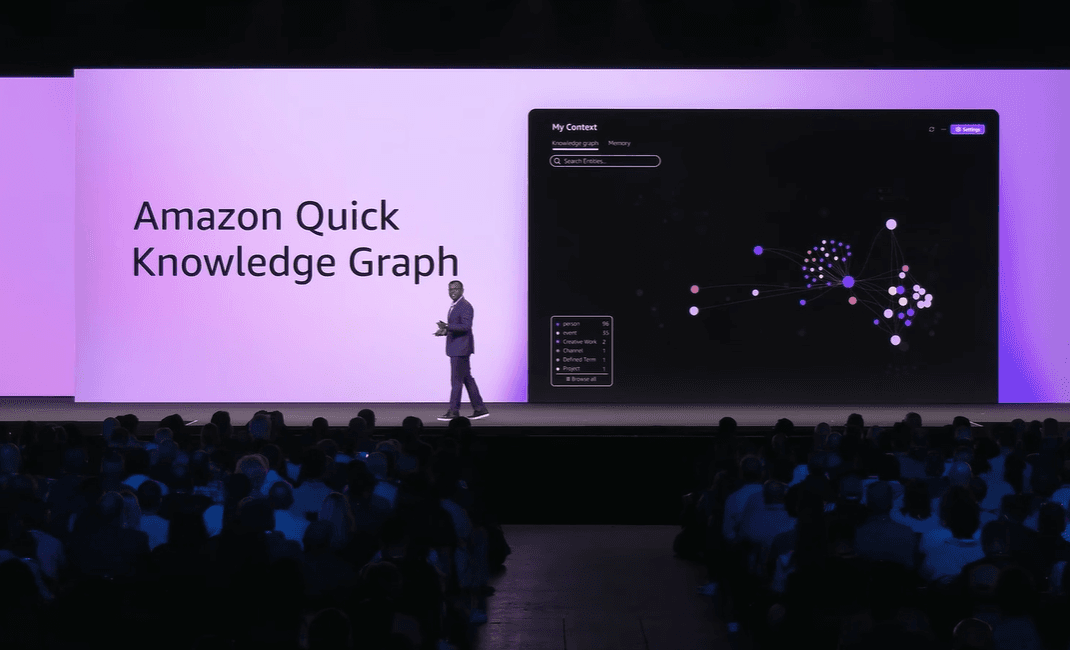
AWS also enhanced its Quick AI assistant, allowing users to build custom background agents in plain language for tasks like following up on stalled deals or monitoring regulatory changes. Quick now includes a redesigned activity feed that consolidates email, messages, and calendar items into a single prioritized view, plus new integrations with Adobe, Figma, Snowflake, and WhatsApp.
The assistant can now query multiple connected services to answer a single question, expanding its utility for cross-platform workflows.
Developer tools expand mobile access and code maintenance
For developers, AWS is pushing its coding agents to take on more routine work — checking and testing new code before shipment and cleaning up legacy code — while leaving final merge and deployment decisions to humans. A new iPhone app for Kiro, the company's AI coding assistant, lets developers initiate and monitor these tasks from mobile devices.
Deepak Singh, AWS vice president leading the Kiro team, said the goal is to offload the background work that AI has paradoxically created. "The faster AI writes code and surfaces problems, the more there is for humans to review, test, and maintain," Singh noted.
AWS also expanded AgentCore, its platform for building custom agents, and introduced AWS Context, a service that organizes enterprise data so agents can reason over it effectively.
Neha Rungta, AWS director of applied science who led the Continuum project, emphasized the urgency: AI can now combine multiple medium- and low-severity vulnerabilities into critical exploits — something that previously required significant attacker expertise. "The floor has been lowered," Rungta said. "The goal is to raise that floor up again."
The announcements were made at the AWS Summit in New York, as first reported by GeekWire.
This is an original analysis by the Omega editorial team. Source reporting: AI Watch.
Want systems like this working for your business?
Book a Call