AWS Bedrock Detects AI-Generated Phishing Through Behavioral Analysis
Amazon's foundation model service adds contextual threat detection to catch sophisticated phishing that traditional filters miss.
AWS Bedrock Detects AI-Generated Phishing Through Behavioral Analysis
Amazon Web Services has detailed how its Bedrock foundation model service can identify AI-generated phishing attacks that evade conventional email security systems. The approach shifts detection from surface-level filtering to behavioral pattern analysis, addressing a threat landscape where attackers use generative AI to craft grammatically perfect, contextually accurate messages at scale.
Traditional phishing filters flag typos, generic greetings, and mismatched sender domains—characteristics that defined earlier attack waves. Modern social engineers now deploy generative AI alongside open source intelligence gathering to produce thousands of unique messages with correct grammar, appropriate context, and personalized details drawn from professional networks and corporate websites.
Why it matters
Security teams face a detection gap. The indicators that powered email filters for years—poor grammar, formatting errors, generic language—no longer apply when attackers use the same AI tools enterprises deploy internally. Organizations need detection methods that evaluate whether a message matches how a sender normally communicates, not just whether it looks professional. This behavioral approach becomes critical as AI-generated phishing scales beyond what manual review can handle.
How the detection pipeline works
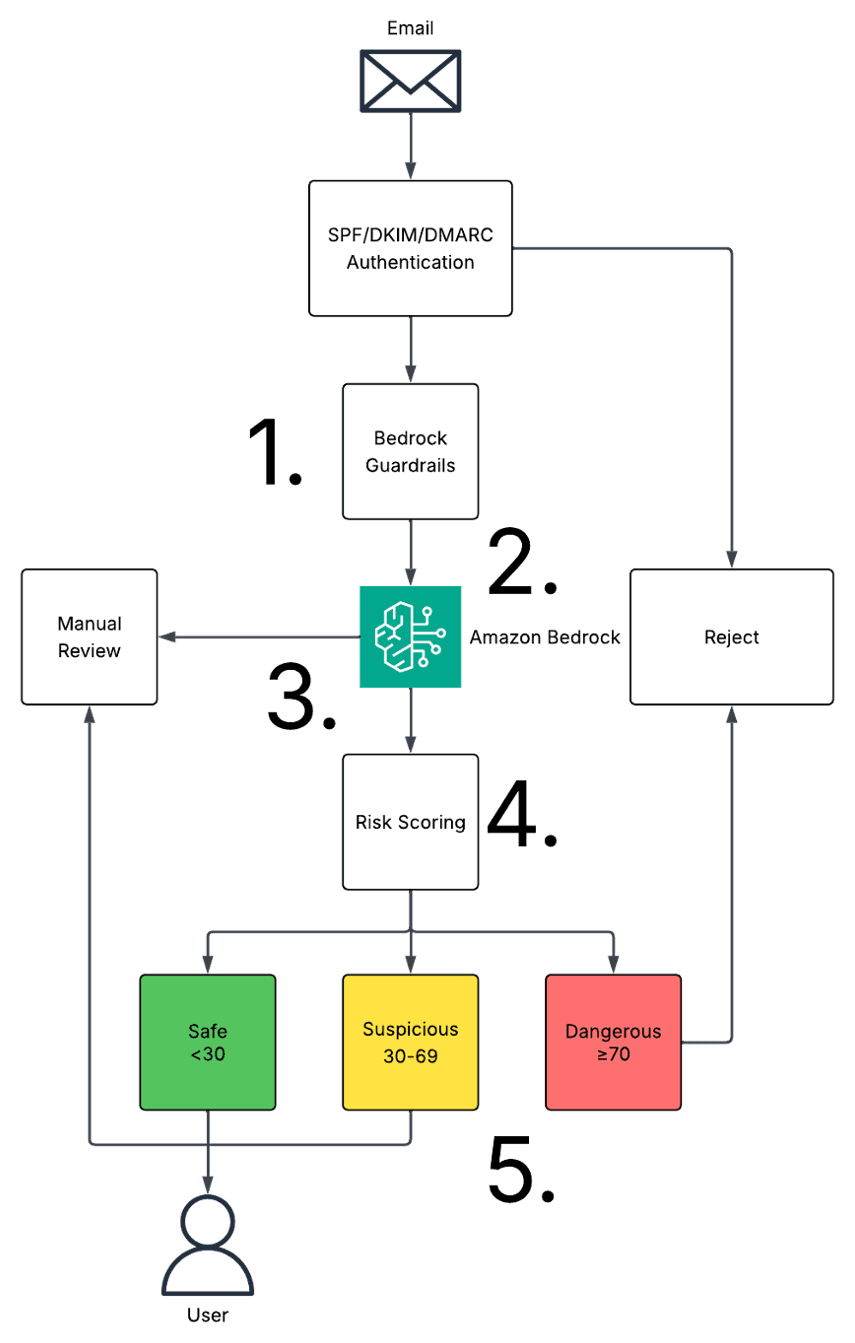
The Bedrock implementation operates as a multi-stage analysis pipeline that processes emails after standard authentication checks verify sender legitimacy. Each message undergoes behavioral analysis against three factors: word choice patterns, communication style deviations, and contextual appropriateness of requests.
The system maintains sender baseline profiles that track how individual senders typically write—vocabulary, formality level, request types, and communication frequency. When an email arrives, foundation models compare it against these baselines to detect anomalies. A colleague who normally sends brief messages suddenly requesting an urgent wire transfer in formal language triggers elevated risk scoring.
Bedrock Guardrails provide configurable controls over how foundation models process email content. These guardrails automatically redact personally identifiable information during analysis and filter both input prompts and model outputs to prevent confidential data leakage. The configuration requires calibration: guardrails must allow analysis of suspicious content that legitimately needs evaluation while blocking inappropriate inputs in other contexts.
Risk scoring and routing decisions
The analysis generates three scores—content anomalies, behavioral deviations, and contextual alignment—combined into a single 0-100 risk score. Messages scoring below 30 deliver normally. Scores between 30-70 trigger quarantine for security review. Scores at 70 or above result in blocking and security alerts.
The system incorporates continuous learning through feedback loops. Security teams classify quarantined messages as confirmed threats or false positives. Confirmed phishing attempts populate a knowledge base that enriches future analysis prompts. False positives update sender baselines to account for legitimate communication variations. This feedback mechanism refines detection accuracy over time without requiring model retraining.
Implementation considerations
The framework integrates with existing email security infrastructure rather than replacing it. Standard SPF, DKIM, and DMARC authentication checks run first. Bedrock analysis operates as an inspection layer that evaluates behavioral risk before messages reach inboxes.
AWS demonstrated the approach with an example of vendor impersonation: a message with perfect grammar referencing a valid purchase order but originating from a lookalike domain. The system flagged it based on domain mismatch, first-ever payment change request from that sender, and phone number discrepancies—patterns invisible to traditional filters but detectable through behavioral baseline comparison.
These implementation details were first reported by AWS in a Machine Learning Blog post on the Bedrock service.
This is an original analysis by the Omega editorial team. Source reporting: AI Watch.
Want systems like this working for your business?
Book a Call