Auto Plants Now Build Five Powertrains on One Line
BMW, Mercedes, and Volvo are redesigning factories to handle electric, hybrid, and combustion vehicles simultaneously—without stopping production.
Auto Plants Now Build Five Powertrains on One Line
Automakers are fundamentally rethinking what flexible manufacturing means. The challenge is no longer just building multiple variants of the same model—it's producing vehicles with entirely different powertrains on the same assembly line while markets shift unpredictably.
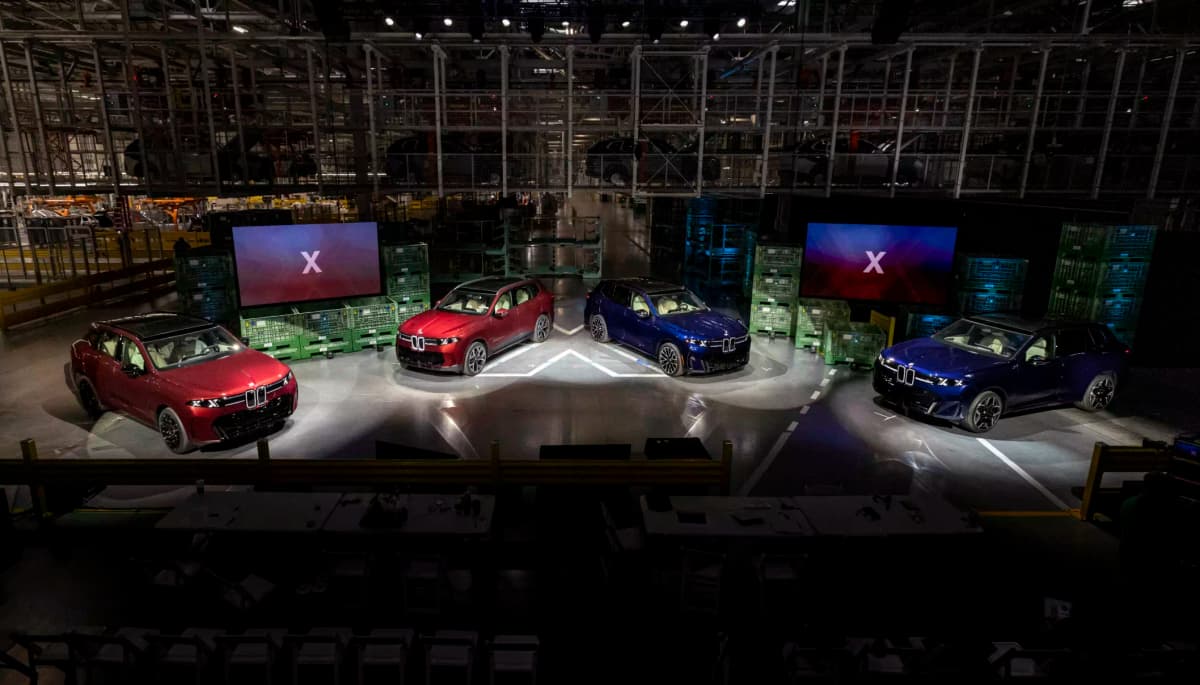
BMW's $1.7 billion investment in its Spartanburg, South Carolina plant illustrates the scale of this transformation. The facility now runs a single assembly line that handles five different powertrain technologies for the new X5: gasoline, diesel, plug-in hybrid, mild hybrid, and battery-electric. The battery-electric iX5 will join production in 2026.
The strategic value isn't the number of powertrains—it's the decoupling of production capacity from any single technology's market performance. When demand shifts between electric and combustion vehicles, BMW can adjust the production mix within the existing structure rather than ramping dedicated lines up or down.
Why it matters
Automakers are making billion-dollar plant investments while facing unprecedented uncertainty about which powertrains will dominate which markets. Electrification is advancing at different speeds globally, hybrids are resurging in some regions, and model programs are changing on short notice. Factories that can accommodate multiple technologies and integrate new models without extended shutdowns represent a form of investment protection—reducing the risk that facilities designed for one scenario become obsolete when markets move differently than expected.
Virtual conversion before physical installation
Mercedes-Benz took a digital-first approach when expanding its Kecskemét, Hungary plant for approximately $1.1 billion. The facility will produce the electric C-Class, electric GLC, and a smaller G-Class, with capacity potentially reaching 400,000 vehicles annually.
The company used a Digital Factory Twin to map new systems and processes virtually before physical installation began. Project manager Patrick Walz noted the approach catches issues as mundane as light fixtures that would collide with newly planned equipment—problems that could cost valuable production time if discovered only during installation.
This matters especially in brownfield projects, where new production must be integrated into plants that continue building vehicles during much of the conversion. BMW is applying similar logic at its Munich parent plant, where the new i3 of the Neue Klasse will launch in 2026.
Platform design determines factory flexibility
The limits of factory flexibility are often set during vehicle development, not plant design. Jaguar Land Rover is incorporating manufacturing requirements into its EMA platform program while vehicle architecture can still be modified.
The earlier that components, materials, tolerances, and joining processes align with existing or universally applicable production methods, the fewer plant-specific special solutions are needed later. A platform strategy isn't just about sharing components between vehicles—it determines how much production equipment can be shared and how complex integrating a new model into an existing plant will be.
Volvo demonstrated this at its Torslanda plant, where it invested approximately $1.1 billion in megacasting, battery assembly, modernized painting, and revised assembly. The facility integrated the new electric EX60 into existing production without stopping the line—a feat requiring adaptable material supply, maintenance, training, and production control systems, not just flexible assembly equipment.
Survey data shows the shift
In a recent AMS/ABB survey, 29 percent of respondents cited more flexible and modular production processes as their response to cost pressure. Another 31 percent are pursuing additional automation and robotics, while 26 percent are focusing on digitalization and data integration.
Flexible production increasingly emerges from this combination: modular systems, digital planning, and data-based control. The boundary between product and production strategy is blurring—a platform designed for efficient industrialization simplifies plant integration, digital conversion planning shortens physical implementation, and flexible lines accommodate different powertrains.
The future-proof factory's strength lies not in perfect optimization for a single vehicle, but in how well it handles change.
These details were first reported by Automotive Manufacturing Solutions.
This is an original analysis by the Omega editorial team. Source reporting: Automation Watch.
Want systems like this working for your business?
Book a Call