Apple Ships Mac Mini and Mac Studio With M6, M5 Chips for AI
New desktop models target developers running local AI agents and researchers training frontier models, with prices rising alongside capabilities.
Apple targets AI developers with upgraded desktop lineup
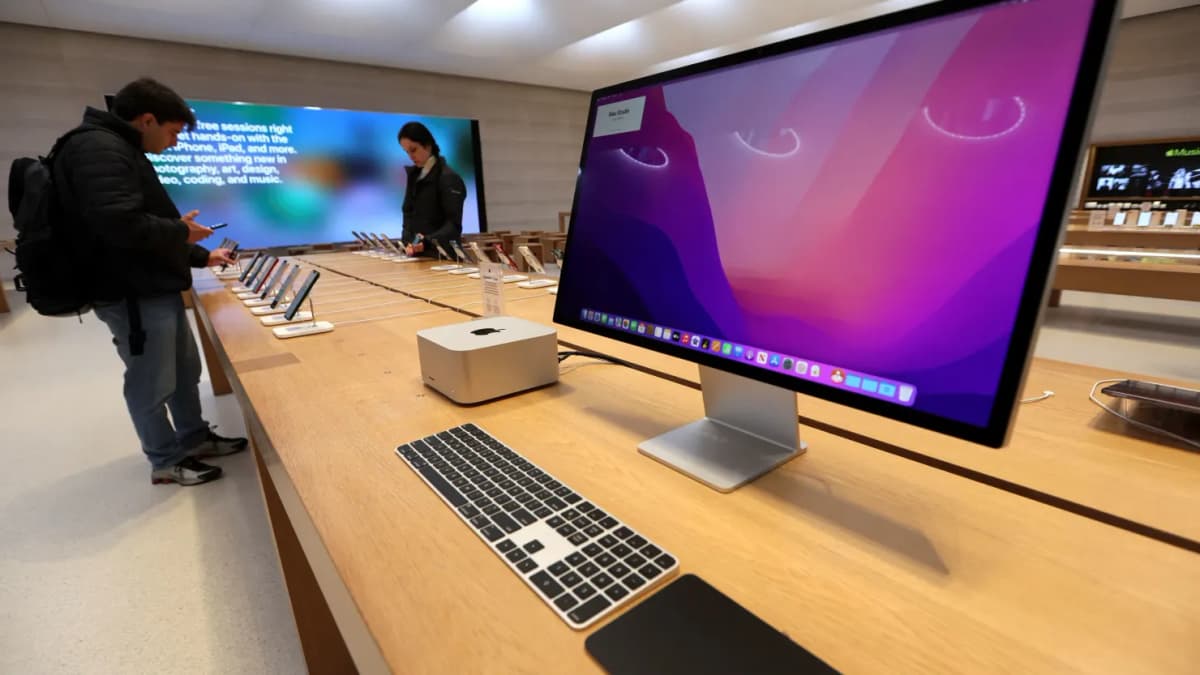
Apple has introduced updated Mac Mini and Mac Studio computers equipped with new silicon designed specifically for artificial intelligence workloads, according to details first reported by CNBC. The announcement positions Apple's desktop hardware as infrastructure for developers building AI agents and researchers training models locally rather than in cloud environments.
The Mac Mini now ships with two chip options: the M6 and M5 Pro. The M6 represents Apple's first 2-nanometer processor, manufactured by Taiwan Semiconductor Manufacturing Co. Apple claims the M5 Pro configuration processes large language model prompts 8.5 times faster than previous Pro-equipped Mac Mini models.
Pricing for the Mac Mini starts at $899, reflecting a $100 increase from the previous generation. Apple raised prices earlier in the summer from $599, citing memory costs as the driver.
Mac Studio gets M5 Max and Ultra configurations
The Mac Studio, Apple's most powerful desktop without an integrated display, now offers configurations with either the M5 Max or M5 Ultra chip. The M5 Max delivers nearly four times the LLM performance of its predecessor, according to Apple's specifications.
The M5 Ultra configuration introduces a notable capability: multiple Mac Studio units can be linked to pool memory and computational resources, enabling them to run trillion-parameter frontier models as a unified system.
Mac Studio pricing begins at $2,499 for M5 Max models—unchanged from the previous generation—while M5 Ultra configurations start at $5,499, up from $5,299 for the prior M3 Ultra model.
Why it matters
Apple's focus on desktop AI capabilities reflects a strategic shift in how developers are building AI applications. Developers using tools like OpenClaw to create custom agents increasingly prefer dedicated local hardware over cloud infrastructure for performance and privacy reasons. By positioning Mac hardware as purpose-built for these workflows—with dedicated neural engines and optimized memory architecture—Apple is competing for mindshare in the AI development ecosystem, not just the consumer market. The ability to link multiple Mac Studios for frontier model training also signals Apple's ambition to serve serious AI research operations, a segment traditionally dominated by Linux workstations with Nvidia GPUs.
Availability and positioning
Both models are available for presale beginning Tuesday and will ship September 22. Apple emphasized in its announcement that its chips include specialized neural engines for running AI models and use a RAM architecture designed to eliminate memory bottlenecks during model inference and fine-tuning.
The timing, several weeks ahead of expected iPhone releases, underscores how desktop computers have become strategically important for Apple as it establishes credibility in AI development circles. The Mac Studio has already gained traction among AI researchers experimenting with local model deployment, while the Mac Mini serves developers who need dedicated hardware for running agents continuously.
These details were first reported by CNBC.
This is an original analysis by the Omega editorial team. Source reporting: AI Watch.
Want systems like this working for your business?
Book a Call