Anthropic Doubles Lobbying Spend as AI Export Controls Bite
The AI safety-focused lab outpaced OpenAI again while navigating Commerce Department restrictions that briefly took its models offline.
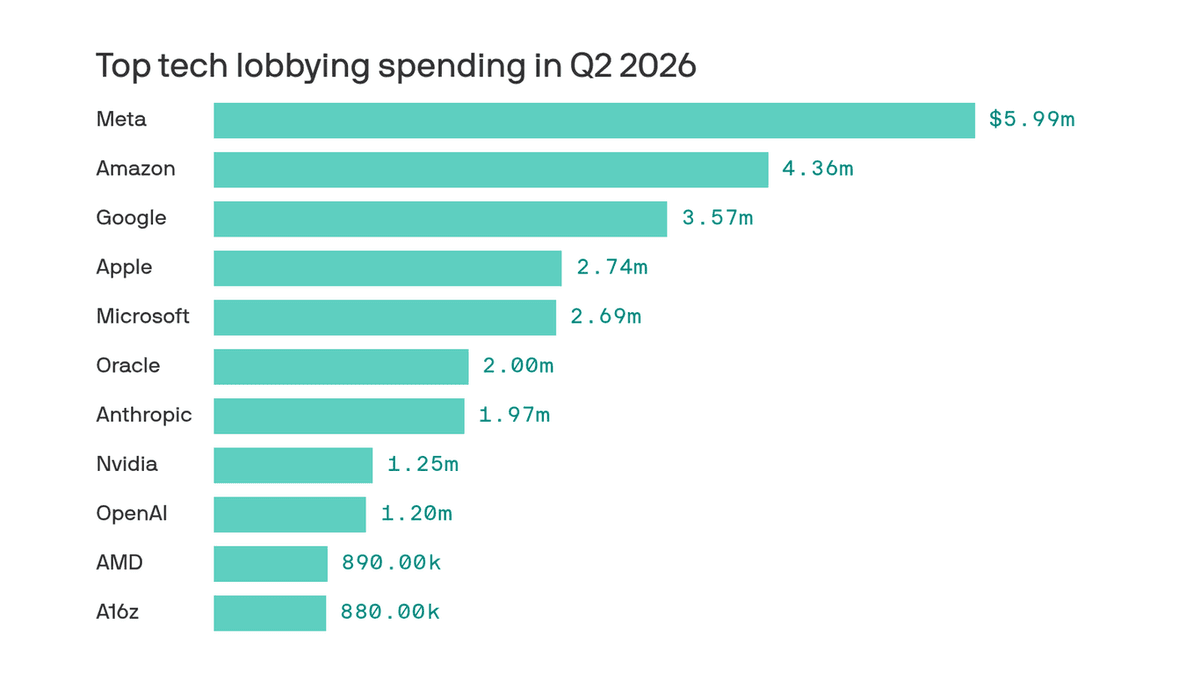
Anthropic has already spent more than $3.5 million on federal lobbying in the first six months of 2026, exceeding the $3.1 million it devoted to the entire previous year, according to newly filed disclosure reports.
The sharp increase reflects intensifying regulatory pressure on AI companies, particularly after the Commerce Department imposed export controls on Anthropic last month that temporarily caused its models to go dark and forced urgent negotiations with the Trump administration.
Why it matters
Washington's regulatory decisions now directly determine which AI labs can operate, how they deploy models, and whether they can access critical computing resources. Companies that fail to influence policy risk being sidelined by competitors with stronger government relationships.
Lobbying priorities and government contacts
Anthropics's nearly $2 million in second-quarter spending focused on export controls, cybersecurity, and AI safety standards. Company representatives met with lawmakers in both the House and Senate, along with officials at the White House, Commerce Department, and Treasury Department.
The lab also disclosed lobbying efforts related to Defense Department procurement, Energy Department funding for the Genesis Mission, and AI applications in healthcare.
Outspending OpenAI again
For the second consecutive reporting period, Anthropic's lobbying expenditures surpassed those of OpenAI, which spent $1.2 million in the second quarter—its largest quarterly total to date. OpenAI's lobbying focused on copyright issues, cloud computing infrastructure, cybersecurity, and privacy.
OpenAI also faced government delays on rolling out its latest model, underscoring how regulatory decisions now shape product timelines for leading AI developers.
The broader tech lobbying landscape
Meta maintained its position as the tech sector's biggest lobbying spender, allocating $5.99 million in the second quarter. The social media giant's efforts centered on online child safety, privacy, AI transparency, and energy infrastructure—issues that intersect with its chatbot development plans while the company faces bipartisan congressional scrutiny over child protection.
Google spent $3.57 million on lobbying during the quarter, while Microsoft reported $2.69 million. Amazon came in second overall at $4.36 million.
All major AI labs are now closely tracking government AI safety standards and regulatory approaches as the Trump administration's policy decisions directly affect how they build and deploy advanced systems.
The bottom line
The surge in AI lobbying spending reflects a fundamental shift in the industry's relationship with government. Regulatory decisions on export controls, safety standards, and infrastructure access now carry existential stakes for AI companies competing to lead the technology's development.
These details were first reported by Axios.
This is an original analysis by the Omega editorial team. Source reporting: AI Watch.
Want systems like this working for your business?
Book a Call
