AMD MI455X Helios: Software Progress and Supply Chain Risks
SemiAnalysis upgrades AMD's AI accelerator outlook but identifies critical cluster capacity and rack production challenges ahead of 2026 deployment.
AMD's AI software stack reaches inflection point
AMD has made substantial progress closing the software gap with Nvidia in AI accelerators, according to a detailed technical assessment from SemiAnalysis. The research firm, which previously gave AMD a "0% chance" of competing on software, now assigns the company "a great chance of success" — contingent on resolving two major risks.
The upgraded outlook reflects tangible customer wins and architectural improvements. Anthropic has publicly committed to deploying 2GW of AMD chips, while Microsoft will deploy the MI455X Helios system primarily for OpenAI workloads on Azure. AMD has also announced a partnership with Cerebras for disaggregated inference workloads requiring ultra-fast interactivity.
SemiAnalysis attributes the turnaround to leadership changes under CEO Lisa Su, who implemented many of the firm's recommendations after direct engagement. The company has embraced open-source compiler and kernel development, positioning itself well for agentic AI workflows. Anthropic's Head of Compute Tom Brown publicly cited using Claude with a "/goal" command to bring up the internal inference stack on AMD hardware over a weekend.
Critical bottlenecks threaten momentum
Despite software progress, AMD faces two significant obstacles that could slow market share gains.
First, the Helios rack-scale system is experiencing production ramp challenges. The system lacks a cableless design compared to Nvidia's Rubin Oberon rack, and AMD's weak SerDes design requires up to 85% of the backplane to be retimed using over 550 Broadcom ethernet retimers per rack. The company is also encountering backplane reliability issues during production scale-up.
Second — and more critically for software development velocity — AMD suffers from persistent GPU cluster capacity shortages for internal teams. Engineers report inadequate stable clusters for both software development and automated continuous integration testing. This constraint is particularly acute for distributed multi-node inference optimization work and is worsening as agentic coding practices multiply GPU requirements. Each AI agent needs GPUs for testing, and engineers now run dozens of agents simultaneously, each spawning sub-agents.
The capacity problem has already caused setbacks. AMD's vLLM team recently lost progress toward a 90% parity target with CUDA when leadership reallocated clusters to other deployments. The company's Kubernetes inferencing CI remains at 0% parity with Nvidia's nightly testing. Plans to establish MI455X automated CI by the "Advancing AI" milestone were missed, with timelines now pushed to October 2026.
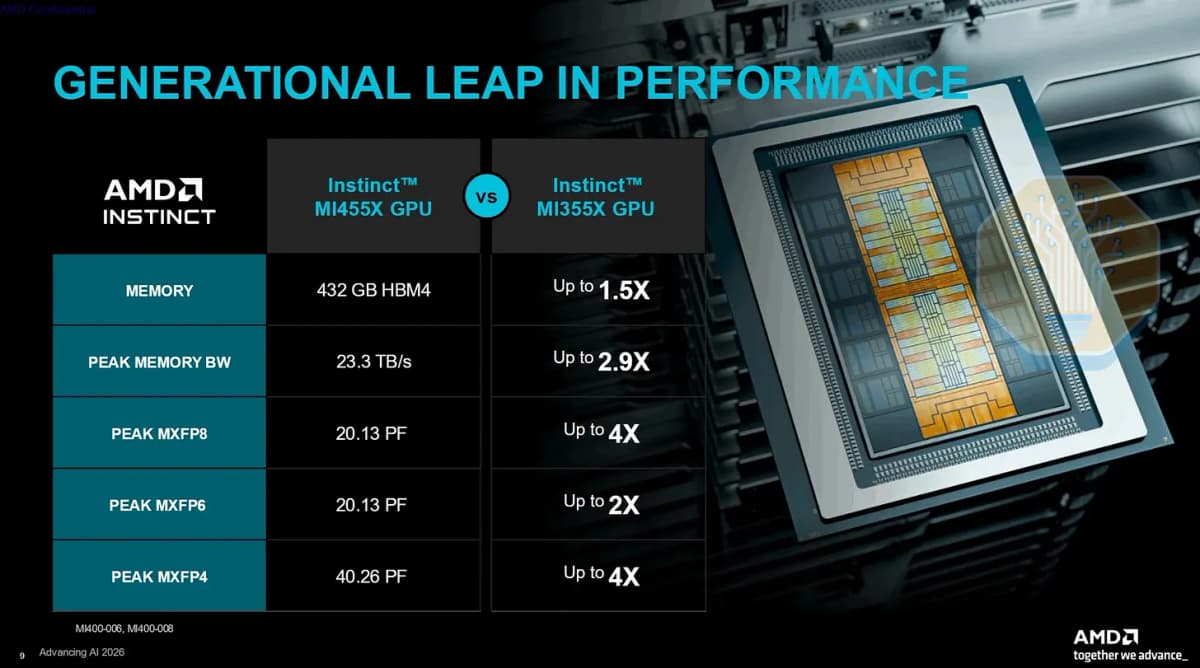
The MI455X itself represents a silicon engineering achievement. Built on TSMC's N2 process, it's the first 2nm datacenter chip to ship, featuring 3,470mm² of logic silicon across eight compute dies hybrid-bonded to base dies. The package delivers 20 petaflops of FP8 performance and 23.3 TB/s memory bandwidth with 12 HBM4 stacks totaling 432GB — both industry-leading figures.
Why it matters
AMD's software improvements and aggressive pricing — including equity rebate structures that make cost-per-token "practically negative" for customers like OpenAI and Meta — create genuine competitive pressure in the AI accelerator market. But the internal GPU cluster shortage directly undermines the company's ability to maintain development velocity and software quality at the pace required to sustain momentum. Without resolving capacity planning for both CI infrastructure and development clusters, AMD risks squandering its architectural advantages and customer commitments. The company's best engineering talent, concentrated in Shanghai, needs stable infrastructure to deliver on the software parity roadmap that underpins the entire competitive strategy.
These details were first reported by SemiAnalysis, which maintains active engagement with AMD's software stack and serves as the company's top bug reporter each quarter.
This is an original analysis by the Omega editorial team. Source reporting: AI Watch.
Want systems like this working for your business?
Book a Call